Colossal’s Reported $23B-$24B Fundraising Talks
– 4 min read
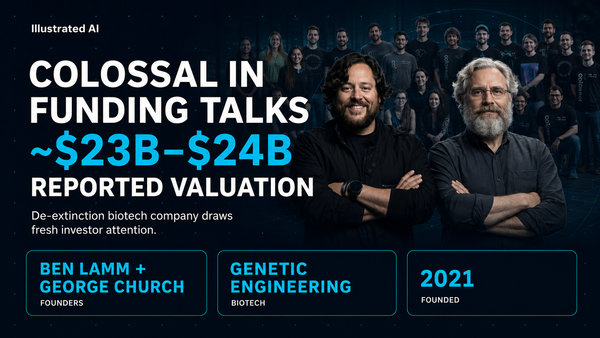
Money chases the possibility that an industry could be reshaped so dramatically that today's numbers look small in hindsight. Colossal Biosciences is reportedly in fundraising talks at a $23–24 billion valuation, a dramatic jump from its $10.2 billion post-money valuation in early 2025. That leap suggests investors see more than a fascinating science project—they see a platform capable of influencing genomics, biotech, reproductive medicine, computational biology, and longevity research simultaneously.
Invest in top private AI companies before IPO, via a Swiss platform:
 SmartProfit Finder AG
Think of a platform company as a machine producing many products rather than one. That possibility supports larger valuations because there are more paths to commercial success. The jump would symbolize a shift from confidence in a daring scientific mission toward belief in a gateway to massive commercial opportunity.
Still, reported fundraising talks are not a finished deal. Terms can change, appetite can shift, and valuations can be renegotiated or abandoned. That uncertainty matters. Even so, the talks signal that investors believe biology is becoming more programmable, scalable, and economically important—potentially one of the defining technology platforms of the next era.
De-extinction captures public imagination, but beneath the dramatic narrative sits something more important: a broad biological engineering platform. Scientists study extinct animals' DNA, compare it with living relatives, and use genome engineering and reproductive technologies to introduce desired traits into living organisms—reading nature's code, rewriting parts of it, and turning those changes into living biology.
This requires genetic analysis, precise genome editing, reproductive science, and computational biology working together. Those same capabilities can address problems in medicine, agriculture, animal health, and human longevity. A platform is valuable because it can be reused—like a powerful operating system rather than a single app.
The conservation mission also attracts elite talent, capital, and partnerships faster than conventional stories. But excitement alone doesn't create durable value. What matters is whether the company can repeatedly solve difficult biological problems faster, cheaper, or more precisely than traditional approaches. When that happens, de-extinction stops being a moonshot and becomes proof that an entire biological engineering platform is maturing. Platforms compound. That's what investors are watching for.
Each field is powerful alone. Together, they rewrite what's possible. Genome engineering moves biology from observation toward deliberate design—editing specific genetic instructions with precision, similar to correcting one sentence without rewriting an entire chapter. Reproductive technologies make those edits actionable, turning lab-level changes into viable living organisms. Computational biology acts as the navigation system, processing enormous genetic datasets to detect patterns, simulate outcomes, and guide smarter decisions at speed.
Integrated, these capabilities create a programmable biological system. Experimentation costs fall, iteration speeds rise, and targeting desired outcomes improves—the same ingredients that drove disruption in software and semiconductors. For investors, this convergence enables scale across conservation, diagnostics, therapeutics, animal health, fertility science, and longevity research, with each application reinforcing the others.
This integrated capability also becomes strategically scarce. Not every company can combine elite genetics, advanced reproductive science, large-scale computation, and ambitious execution under one roof. Scarcity plus optionality is a powerful valuation driver—especially when markets begin believing a capability is crossing from curiosity to utility, making the future addressable market suddenly appear far larger than previously assumed.
Conservation provides the moral spark, but commercial potential captures investor imagination at scale. The core question is simple: if a company masters identifying critical genes, editing them accurately, guiding embryonic development, and optimizing results computationally, where else do those skills apply? The answer spans biotech, genomics, fertility, animal health, agriculture, and longevity research.
In biotech, gene-level precision supports new therapeutic approaches. In genomics, expertise in complex DNA interpretation enables diagnostics and disease prediction. In reproductive science, advanced embryo methods open doors in animal breeding and medical innovation. Longevity research—drawing growing investor attention—may benefit from strengths in genome engineering and computational biology, even if that opportunity remains early.
There's also the spinout model: licensing tools, creating separate businesses around adjacent opportunities, or partnering with larger firms without diluting internal focus. This creates additional value layers beyond the flagship mission and broadens the investor thesis from one dramatic idea into a pipeline of optionality—multiple credible ways to win across sectors.
The risk is real: expanding too broadly can dilute resources and slow progress. The strongest platform businesses pair bold ambition with disciplined prioritization. But when technology has this kind of reach across health, agriculture, and life sciences, capital tends to pay attention in a very big way.
Excitement is powerful, but precision matters. Reported fundraising discussions mean negotiations are happening—not that a transaction has closed, a valuation is final, or terms are agreed. Fundraising is fluid. Companies enter talks at one target and close at another. Market sentiment shifts. Even late-stage negotiations change quickly. A deal is real when signed and announced, not when rumored.
Words like "reported," "in talks," and "roughly" are signals of status, not legal clutter. They prevent misunderstanding in fast-moving private markets where valuation headlines can shape narratives long before facts are finalized—creating momentum that may run dangerously ahead of reality.
Good investing holds two ideas simultaneously: the signal may be meaningful, and the outcome may still change. The reported valuation range is fascinating because it signals belief in a potentially transformative biological platform. But until financing is formally confirmed, the number remains part of a developing negotiation.
Big vision matters. So does factual discipline. In disruptive markets, the smartest view holds both at once.