TypeSafe AI’s Jev: Structured Decision AI Gains Enterprise Traction
– 4 min read
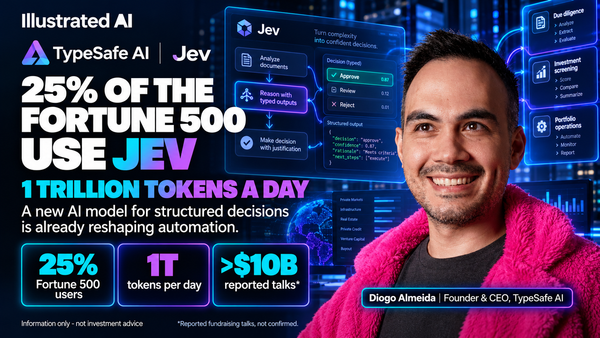
TypeSafe AI released Jev in early access on 15 September 2026. Unlike conversational models designed primarily to generate text, Jev is intended to make structured decisions inside software systems by selecting from predefined choices or returning scores and probabilities. Companies run on decisions. Claims get approved or rejected. Tickets get routed. Payments get flagged. Many large organisations need answers that fit neatly into workflows rather than open-ended paragraphs.
Invest in top private AI companies before IPO, via a Swiss platform:
 SmartProfit Finder AG
Instead of producing free-form text, Jev takes in messy information and returns structured outputs: a label, a probability, a score or a predefined choice. That changes the economics of automation significantly. TypeSafe’s chief executive says Jev is already used by approximately 25% of Fortune 500 companies and processes about one trillion tokens daily. These company-reported figures indicate substantial early interest, but TypeSafe has not disclosed how many deployments are paid, how extensively customers use the model or how much revenue it generates.
This challenges a common assumption: that bigger, broader AI models will dominate every category. Some workloads may instead favour specialised tools. A Swiss Army knife is flexible, but a factory robot arm is faster and more dependable for its assigned task. Businesses often choose the robot arm when consistency matters.
The AI boom has been dominated by language generation. But inside large businesses, the most valuable output is often not a sentence. It is a decision. A decision model can return a predefined label such as billing, accompanied by a probability, rather than generating a paragraph that must subsequently be parsed and validated. This can simplify software integration, although it does not guarantee that the selected label is correct or eliminate the need for monitoring and human review.
Think of a busy airport: a conversational AI gives spoken directions, while a structured decision system uses exact codes like an air traffic controller. Enterprise software resembles air traffic control far more than casual conversation. Specialised systems may process narrowly defined workloads more efficiently than general-purpose models. In high-volume applications such as routing, classification and risk scoring, even modest reductions in cost or latency could become commercially significant.
Operational teams also need predictability. A model constrained to predefined output types may be easier to integrate, test and monitor than one returning unrestricted text. Format compliance, however, should not be confused with decision accuracy, calibration or operational safety. If AI can reliably classify documents, score transactions and route requests, it could reduce substantial amounts of repetitive labour. That is where tangible value creation begins.
Excitement gets headlines, but economics decides what survives. A system designed specifically for structured decisions may process that workload more efficiently than a general-purpose model, meaning lower cost per task and faster turnaround. A company may run relatively few marketing campaigns but process a far greater volume of operational decisions involving fraud checks, routing, classification, compliance screening and risk scoring.
Cost alone is insufficient. The model must also be reliable, secure and sufficiently responsive for its intended workload. Specialised models may gain adoption where they perform narrowly defined, high-volume tasks more efficiently than general-purpose alternatives, particularly when they provide measurable advantages in cost, latency or reliability.
Integration with core workflows could create switching friction because replacing a model may require renewed testing, calibration and software changes. TypeSafe has not yet disclosed retention, contract duration or migration data demonstrating that Jev has developed meaningful switching costs.
TypeSafe has reportedly discussed raising more than $1 billion, while some prospective investors have proposed valuations exceeding $10 billion. No financing at that level has been announced as completed, and discussions may change or produce no transaction. The reports follow a completed $40 million seed round that reportedly valued TypeSafe at approximately $200 million. In private markets, preliminary discussions, investor proposals and completed financings are materially different. The reported talks indicate interest in the potential size of the category, but they do not establish Jev’s reliability, commercial adoption or financial performance.
TypeSafe’s decision to pursue a narrower model architecture distinguishes it from companies competing primarily through increasingly broad language models. Reported early interest supports the commercial relevance of that approach, but deployment depth, paid adoption and long-term customer retention remain undisclosed.
Still, excitement carries risk. Early metrics can prove fragile. Large incumbents can respond aggressively. A specialist category can either blossom or be absorbed by broader platforms. The real question serious investors ask is simple: what if this becomes default infrastructure?
The most important technology stories are about the birth of a category. Jev’s launch has been followed by growing attention to decision-oriented models and comparable tools from other technology providers. It is too early to determine whether this represents a distinct and durable model category or functionality that broader AI platforms can readily incorporate. Businesses may increasingly adopt hybrid AI stacks: one system for conversation and reasoning, and another for routing, scoring and execution. A customer support platform could use a large language model to understand a message and draft responses, while a structured decision model determines queue priority, fraud probability and escalation path.
For investors, a category in formation can create substantial opportunities, but it also carries significant uncertainty because the eventual leaders, market size and competitive boundaries are not yet clear. Key signals will include independent customer evidence, retention rates, reliability at scale, competitive response and whether these models can expand into adjacent automation without losing the precision that made them valuable.
The bottom line: TypeSafe AI’s Jev offers a specialised alternative for software workloads requiring predefined choices, scores and probabilities rather than unrestricted text. Company-reported adoption and the speed of investor interest are notable, but Jev launched only recently and TypeSafe has not disclosed revenue, paid-customer numbers, retention or production error rates. Investors should watch independent benchmarks, decision accuracy, calibration, customer expansion and whether reported financing discussions result in a completed transaction.