Modal’s AI Inference Boom: Valuation Soars on Infrastructure Demand
– 5 min read
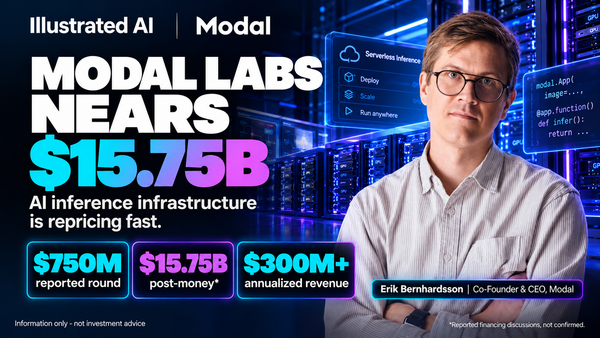
Modal is reportedly nearing a $750 million financing led by Accel at a $15.75 billion post-money valuation. The proposed transaction highlights investor interest in the infrastructure used to develop and operate AI applications. Modal supports inference as well as training, agent sandboxes, notebooks, batch processing and serverless functions, so it should not be characterised solely as an inference provider.
Invest in top private AI companies before IPO, via a Swiss platform:
 SmartProfit Finder AG
Every time a user asks an AI assistant for help, every time software quietly makes a prediction, inference is doing the heavy lifting. Training may create the brain, but inference is the nervous system carrying signals through the economy every second of the day. Production inference must be responsive, reliable and capable of handling changes in demand.
Infrastructure providers can serve multiple model developers and application companies, reducing their dependence on any single model supplier. They are not entirely model-agnostic, however: demand can shift with model architectures, accelerator requirements, customer preferences and changes in the economics of self-hosting. Agentic applications can generate multiple model calls while reasoning through tasks, using tools and checking outputs, potentially increasing inference demand. The resulting growth will also depend on efficiency improvements, caching, model compression and the use of smaller specialised models.
Inference is no longer just a technical detail. It is the economic engine room.
Modal is reportedly nearing a $750 million financing led by Accel at a $15.75 billion post-money valuation. If completed on those terms, the transaction would value the company at approximately 3.4 times the $4.65 billion post-money valuation established by its $355 million Series C in May 2026. This would represent a substantial repricing within approximately four months.
The reported valuation may reflect Modal’s revenue growth, demand for AI infrastructure and investor expectations about the future inference market. Modal and the prospective investors have not publicly disclosed the financial projections or valuation methodology underlying the proposed terms. Investors are searching for businesses that benefit from broad AI adoption regardless of which model wins the headlines. The proposed valuation appears to reflect expectations that Modal could capture a larger share of future AI workloads, although the assumptions supporting that expectation have not been disclosed.
Building infrastructure for demanding AI workloads requires technical expertise, reliable access to computing capacity and software capable of managing deployment, variable traffic and uptime requirements. Modal could command stronger pricing if its platform delivers performance or usability that customers cannot obtain economically from hyperscalers or competing infrastructure providers. Evidence on retention, margins and customer expansion is needed to establish that advantage.
The proposed financing indicates that investors are assigning substantial value not only to model developers but also to companies operating the infrastructure on which AI applications depend.
Modal’s value proposition is to reduce the time developers spend managing servers, provisioning and cloud infrastructure. A specialised platform can provide access to CPUs and GPUs, support workload deployment and inference, and offer notebook-based experimentation without requiring every development team to manage the underlying infrastructure directly. Advanced AI computing should feel less like assembling a machine from spare parts and more like flipping a switch.
This abstraction can create economic value by allowing development teams to spend less time managing infrastructure and more time improving their products. Serverless design can allocate resources as workloads arrive, potentially reducing idle provisioning and helping applications respond to unpredictable traffic. The economic benefit depends on workload patterns, pricing, start-up latency and hardware utilisation. Agent sandboxes are designed to isolate tasks such as code execution and multistep operations. Their practical value will depend on security controls, reliability, start-up latency and integration with production workflows.
An infrastructure company does not need to develop the most advanced model to create substantial value. Its commercial position may depend on becoming an efficient, responsive and dependable platform for teams building with those models. Developer adoption could increase platform usage, but durable economics will depend on paid conversion, customer expansion, infrastructure costs and whether Modal can retain workloads as competing services improve. Reducing infrastructure complexity can create commercial value, but profitability will depend on how efficiently Modal delivers the underlying compute.
Modal said in May 2026 that annualised revenue had surpassed $300 million after increasing fivefold since the previous September. Annualised revenue is a run-rate measure rather than recognised annual revenue, and Modal has not disclosed audited revenue, customer concentration, retention, gross margins or profitability. Customers associated with coding, music and media demonstrate use across several applications, but Modal has not disclosed revenue by sector or product.
But revenue quantity is only the beginning. The deeper issue is quality. Are customers returning and expanding usage? Are workloads sticky once integrated? A usage-based model could allow Modal’s revenue to expand as customer workloads grow, although the resulting profitability will depend on pricing, computing costs and hardware utilisation.
AI infrastructure is not a pure software story with negligible marginal expense. Gross margins matter. Investors will watch whether scale improves economics through better hardware utilisation, smarter scheduling and stronger pricing power. Durable economics means proving that bigger can also be better. Markets forgive many things in early growth phases, but eventually they look for signs that growth and economic strength can coexist.
Every exciting market reaches the same test: can promise survive competition? Specialised inference platforms, start-ups, hyperscalers and adjacent infrastructure providers are competing to host production AI workloads. Focused providers may offer products designed more specifically for AI-native workflows, while hyperscalers bring greater scale, established enterprise relationships, broader service portfolios and the ability to bundle services or reduce prices selectively.
Access to computing capacity sits at the centre of the story. Accelerators remain among the most precious resources in the AI economy. Scarcity raises the value of anyone who can allocate compute well, but it also constrains growth if demand outruns availability. A company serving AI inference at scale is managing a living industrial system—technically sophisticated and financially disciplined simultaneously.
The biggest question behind the hype is not whether AI infrastructure matters. It clearly does. The real question is whether economics can mature as quickly as valuations. Can a fast-growing platform translate strong demand into sustainable margins, customer retention and defensible market share?
The bottom line: Modal’s prospective $750 million financing at a reported $15.75 billion post-money valuation would represent a substantial increase from the $4.65 billion valuation established by its May 2026 Series C. Modal’s company-reported annualised revenue above $300 million indicates strong growth, but the figure dates from May and is not equivalent to audited or recognised annual revenue. The company has not disclosed retention, customer concentration, gross margins, profitability or the economics of the proposed financing. Investors should watch whether the round closes on the reported terms and whether Modal can convert infrastructure demand into durable margins and customer retention while competing with hyperscalers and specialised AI-cloud providers.