RobCo’s $1B Repricing Signals the Rise of Physical AI in Factories
– 5 min read
Physical AI is reaching an inflection point. Instead of living inside controlled demonstrations, it is beginning to work where stakes are high and conditions are messy: on factory floors, in industrial workflows, and inside real production environments where mistakes cost money.
Invest in top private AI companies before IPO, via a Swiss platform:
 SmartProfit Finder AG
Unlike traditional software that automates digital tasks, Physical AI allows machines to sense the world, make decisions in changing conditions, and act in physical spaces. A warehouse aisle is not a spreadsheet. Lighting changes, objects vary, humans move nearby. Machines need perception, adaptation, and learning to cope with that reality.
Manufacturing, logistics and industrial operations represent large global markets that have historically been difficult to modernise. That difficulty is exactly what makes the opportunity so large. Investors who watched AI transform digital work are now focusing on the physical layer of the economy.
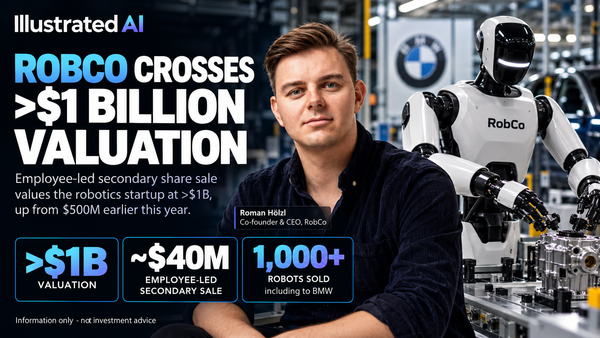
RobCo's reported valuation jump above $1 billion signals that private-market participants see more than a research project. RobCo has reportedly sold more than 1,000 robots and identifies BMW among its industrial customers. These figures provide evidence of commercial activity, but RobCo has not disclosed how many robots are currently deployed, contract values, utilisation, customer concentration or revenue. The company positions its systems as addressing labour constraints, production efficiency and repetitive industrial work. When intelligence enters the factory, automation stops being static and starts becoming strategic.
RobCo has sold approximately $40 million of shares in a transaction valuing the company at more than $1 billion, compared with roughly $500 million when it raised $100 million in January 2026. Most of the shares in the latest transaction were reportedly sold by employees. The available reporting does not disclose whether the transaction was entirely secondary or whether RobCo received any proceeds.
The price accepted for employee-held shares provides a private-market valuation signal, but a negotiated transaction involving limited liquidity is not directly comparable with a primary financing or public-market valuation. Employee liquidity may support recruitment and retention by allowing eligible shareholders to realise part of their equity value. RobCo has not disclosed how many employees participated or whether the transaction has affected retention.
The repricing may reflect reported commercial activity and broader investor interest in physical AI, although the financial assumptions supporting the transaction price have not been disclosed. Crossing the $1 billion threshold may increase RobCo’s visibility among prospective investors, commercial partners and employees. The valuation does not independently establish revenue growth, profitability or technical performance.
RobCo’s sale of more than 1,000 robots and its relationships with industrial customers provide evidence that its existing systems have progressed beyond demonstrations. However, units sold should not be treated as equivalent to active deployments, recurring revenue or successful operation at scale.
RobCo describes its platform as vertically integrated across hardware, software and service. This structure could simplify implementation for customers, but RobCo has not disclosed evidence showing that it produces better margins, faster deployment or stronger retention than competing models. Providing installation, workflow integration, software updates and maintenance through one supplier could reduce coordination costs for customers. Whether this creates a competitive advantage will depend on deployment results, service quality and total operating costs.
Operating robots can generate information about failures, task performance and changing factory conditions. Whether this becomes a defensible advantage depends on the data RobCo is permitted to collect, its ability to apply those data across deployments and whether the resulting improvements are measurable. RobCo has not disclosed sufficient information to establish such a data moat.
Alfie represents the ambition to create robots that handle variable factory work with less manual programming. Traditional industrial robots excel at repetition but struggle the moment variation enters a process — a shifted part, a new workflow, an unexpected obstacle can force manual reprogramming, adding time and cost.
Alfie is a mobile, bimanual system designed for changing objects, containers and factory layouts. Its two arms are intended to support tasks requiring stabilisation, alignment and assembly. RobCo describes the system as progressing towards Level 3 and Level 4 autonomy, but this is company terminology rather than evidence that Alfie has achieved an independently certified autonomy level.
RobCo’s April announcement described Alfie as in final development, with first customer deployments planned for later in 2026. Its current product page refers both to upcoming deployments and work with selected manufacturers under real conditions. RobCo has not disclosed the number, duration or results of these trials.
For investors, this points to category expansion. If adaptive systems move beyond highly repetitive tasks, the addressable market grows meaningfully — more factory processes become candidates for automation, more recurring software opportunities emerge, and the long-term revenue pool widens. Adaptive robotics could extend automation into tasks requiring more context-dependent decisions, provided performance and safety can be demonstrated in production.
The most exciting technologies do not always become the best investments. What separates them is the business model. The Robotics-as-a-Service (RaaS) approach shifts robotics from large upfront equipment purchases toward an ongoing service relationship — hardware, software, deployment, monitoring, and support bundled together. The RaaS model could generate recurring revenue and deepen customer relationships, but RobCo has not disclosed recurring revenue, renewal rates, contract duration, gross margins or capital requirements.
A common hardware and software stack may allow RobCo to reuse engineering work across installations. However, RaaS remains exposed to hardware costs, installation, maintenance, financing and field support, so software-like margins should not be assumed. If operational data feeds back into learning systems — reducing service costs, expanding use cases, and strengthening retention — a genuine competitive moat begins forming.
Execution risk remains real. Hardware failures destroy customer trust. Service costs can consume margins. Customer concentration creates vulnerability. The next milestones investors will watch are operational: how fast robots deploy across different tasks, how often human intervention is required, how well uptime holds, and whether recurring revenue grows while support costs fall with scale.
The bottom line: RobCo’s approximately $40 million share transaction values the industrial-robotics company at more than $1 billion, roughly double the valuation associated with its January 2026 financing. Most of the shares were reportedly sold by employees, although the complete primary-versus-secondary composition has not been disclosed. RobCo has sold more than 1,000 robots and identifies BMW among its customers, but it has not disclosed revenue, active deployment numbers, retention, customer concentration or margins. Alfie expands RobCo’s ambitions into adaptive bimanual robotics, but its deployment status and trial results remain incompletely disclosed, and its Level 4 positioning reflects company terminology. Investors should watch deployment performance, uptime, human-intervention rates, RaaS unit economics and whether Alfie progresses from selected trials to repeatable commercial use.