Scale AI’s Shift From Data Labeling to Enterprise AI Agents
– 5 min read
Scale AI is positioning itself around exactly this problem: helping organizations move from capable AI models to systems that can operate reliably inside real workflows. The most exciting shift in AI is not what models can do in isolation. It is that AI is now being pushed into the hard, messy world of real work. Hospitals, banks, and governments need systems that work day after day, with mistakes minimized and accountability built in. A glamorous demo may look magical, but placing that system inside a live workflow raises immediate questions: How often does it make subtle mistakes? How much human supervision is required? What does total operating cost look like once humans are added back?
Invest in top private AI companies before IPO, via a Swiss platform:
 SmartProfit Finder AG
Reliability is becoming the new battleground. An AI system that performs well in theory but needs constant checking may not save time or money. What matters in production is not simply whether the machine is good, but whether the machine and human together create a better, cheaper, safer system. The winners in the next phase may not be companies that merely build powerful models, but those that make models usable inside complicated organizations. Confidence is a powerful product, and the ability to provide measurable evidence of performance is becoming one of the most valuable positions in the AI supply chain.
AI is growing up. Once it can be measured, trusted, and integrated into mission-critical operations, it stops being an entertaining novelty and starts becoming infrastructure. The move into production is not a side story. It is the story.
A major breakthrough in AI does not always mean a dazzling new model. Sometimes it is a smarter way to judge whether existing technology is actually useful. That is what makes a deployment framework like READY significant. Instead of asking only whether an AI agent can complete a task, it asks whether the agent can be trusted enough to deploy inside a real operational system.
READY focuses on reliability, human oversight, and combined operating cost. Think of it like hiring an employee: someone slightly less dazzling but far more dependable is often more valuable than brilliance that requires constant correction. Tiny differences in autonomous accuracy can mask large differences in required human review. Two systems appearing almost identical on a leaderboard may demand materially different levels of human intervention to reach the same reliability threshold. Human review is not free. It consumes labor, slows workflows, and reduces the economic benefit of automation.
A company that owns a respected deployment framework can influence how customers make decisions. If enterprises adopt READY as part of procurement, it becomes a market standard, shaping how products are compared and trust is established. In plain language, READY transforms AI evaluation from a beauty contest into an operating manual. Real business transformation depends on deployment, not applause.
Every important technology company reaches a moment when it must decide whether to remain a specialist or become a platform. This company began by supplying high-quality data that machine learning systems need to learn. Now it is making a deliberate move up the value chain into evaluation, model improvement, and making AI work in production. Instead of serving only developers during training, it is aiming to serve enterprises during the increasingly important deployment phase.
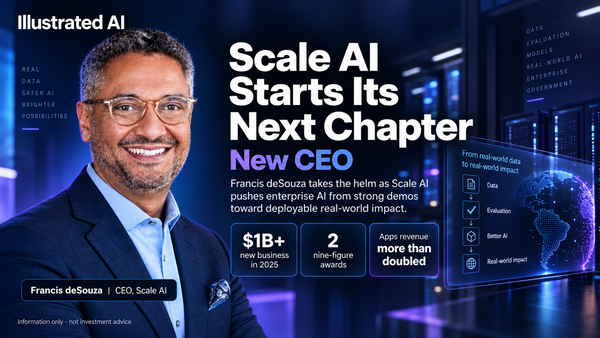
Commercial momentum reinforces this narrative. Claims of more than $1 billion in new business, with applications revenue more than doubling in the second half of the year, suggest the company is proving this shift commercially. As foundation models become more capable, the bottleneck moves from building models to operationalizing them. A company providing data quality, model evaluation, workflow integration, and production performance becomes a partner in execution, not just a vendor in preparation.
In simple terms, the company is trying to move from selling picks and shovels to helping design and operate the mine. That is a much more influential position.
Leadership changes in fast-growing technology companies are signals. The appointment of Francis deSouza as chief executive strongly suggests the next phase is about commercialization, enterprise scale, and operational credibility. His background spanning Google Cloud and Illumina points to a leader comfortable with complex customers, regulated industries, and products that must prove their value in demanding environments.
The mandate is framed in practical terms: get solutions into more businesses and governments, continue supplying high-quality data to AI labs, and demonstrate value through provable outcomes. A company that understands frontier model behavior and enterprise deployment constraints can occupy a rare strategic position, translating cutting-edge capability into practical implementation. That translation layer may become one of the most valuable assets in the AI economy.
The CEO appointment is a declaration. The company is signaling that the next chapter will be about trust, scale, and converting technical advantage into broad commercial adoption.
A valuation above $29 billion signals that serious capital has been placed behind the belief that this company can play a major role in the AI stack. The core thesis is simple: as AI spreads through healthcare, finance, and public services, the bottleneck will not only be model capability but also reliability, deployment, and governance. Companies sitting between frontier AI and enterprise execution could capture an outsized share of spending.
The Meta investment validates this position, suggesting major technology players recognize the importance of the data-and-deployment layer. Three indicators will determine whether strategic promise converts into durable growth: whether the applications business continues expanding rapidly; whether evaluation frameworks like READY become embedded in procurement decisions; and whether the business achieves platform-like economics across AI labs, enterprises, and governments.
For a simple analogy, imagine the AI boom as a new electricity grid. Early excitement focuses on generators, but businesses also need transformers, control systems, and reliable distribution. The companies providing those layers become important. The opportunity is no longer limited to building smarter AI. Increasingly, it is also about making AI reliable enough to work when it matters. For Scale AI, the key test will be whether that capability translates into sustained enterprise adoption and durable commercial growth.