Etched’s AI Inference Valuation Surge
– 5 min read
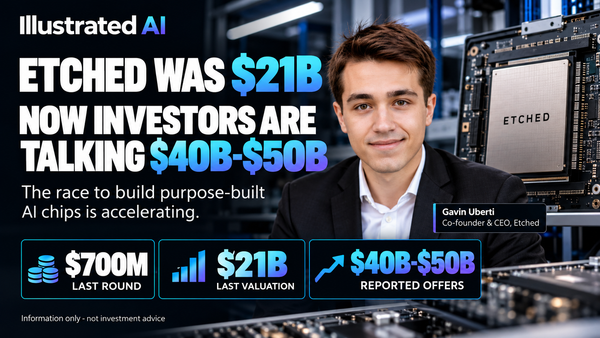
Etched is reportedly reviewing investment offers at valuations between $40 billion and $50 billion. The discussions remain preliminary, and no new financing has been announced as completed. The reported offers highlight investor interest in specialised hardware for inference, the process of running trained AI models to produce outputs.
Invest in top private AI companies before IPO, via a Swiss platform:
 SmartProfit Finder AG
Etched announced a $700 million financing led by Jane Street at a $21 billion valuation on 18 August 2026. The company also said it had shipped its first rack to Jane Street following hardware testing. The new reported valuation range would represent approximately 1.9–2.4 times that earlier valuation, if a transaction were completed on those terms.
This is why specialized inference hardware is attracting serious attention. A chip built specifically for transformer inference workloads may consume less power, respond faster, and handle more requests per dollar than a general-purpose alternative. At scale, tiny efficiency gains become enormous economic advantages. For investors, this is not a narrow chip story. It is a platform story, the difference between backing a product and backing the backbone of AI delivery.
Inference also captures imagination because it feels like monetization. Growing AI usage can increase demand for computing infrastructure, but individual queries do not necessarily generate incremental revenue. Commercial value depends on pricing, utilisation and the cost of serving each workload. Infrastructure providers stop looking like speculative enablers and start resembling toll collectors on a digital highway. The most valuable layer in AI may not be the one that dazzles first. It may be the one that quietly powers everything after the headlines move on.
General-purpose technology leads early in any revolution, but once demand patterns clarify, specialists emerge with sharper tools and better economics. That is the opening for purpose-built inference hardware. A specialised inference chip may improve throughput, latency or energy efficiency for supported workloads. Establishing an advantage requires comparable testing across model quality, batch sizes, context lengths, power consumption and total system cost.
Etched’s transformer-focused strategy also creates architecture risk. Changes in model design or customer workload requirements could reduce the advantage of specialised hardware relative to more flexible accelerators.
Crucially, this is not just a chip story. It is a system story. Winning AI infrastructure products bundle chips, networking, software integration, and deployment support into a cohesive package. Coordinating chips, networking and software could improve system performance and simplify deployment. Integration may also create switching friction, but durable market share and pricing power require evidence of customer retention, repeat orders and competitive performance.
There is a second effect worth noting: lower inference costs expand the market itself. Services too expensive to run continuously become commercially viable. Startups launch more cheaply. Enterprises deploy more broadly. Lower inference costs could make additional applications commercially viable and increase usage. Whether that produces profitable growth for a hardware supplier depends on customer adoption, competitive pricing and manufacturing costs.
In AI markets, stories travel faster than facts. What separates genuine opportunity from noise is the oldest question in business: who is actually buying? Customer contracts pull a story out of theory and into commercial reality. They signal that real buyers assessed the economics and committed capital, shifting the debate from whether anyone cares to whether the company can deliver at scale.
The identity of early customers matters as much as contract size. Jane Street’s participation as both investor and recipient of an early system provides a concrete customer reference. Its testing and receipt of a rack do not, however, establish long-term reliability, broad customer adoption or independently verified performance advantages.
Still, disciplined investors read these signals carefully. Contracts are not recognized revenue. They may include phased delivery, future milestones, or conditions that take time to convert into reported results. The sharper questions are: how much is binding, over what timeframe, and what are the margins behind the sale? Traction is powerful evidence, but its quality matters as much as its size. Reorders, expanded deployments, and reference customers deepen the case far more than headline announcements alone.
AI chip infrastructure does not scale with code alone. It demands silicon, factories, supply chains, power grids, and relentless execution. Designing a clever architecture is only the beginning. That design must be manufactured at yield, packaged into systems, and shipped to customers who expect everything to work immediately. Every stage requires specialized expertise, and every delay compounds.
Capital is both the enabler and the pressure valve. Larger financing rounds can fund engineering, secure manufacturing capacity, and accelerate delivery, turning technical promise into industrial reality. But higher valuations raise expectations. The market stops rewarding ideas and starts demanding proof: production yields, shipment volumes, on-time delivery, and customer systems running reliably in the field.
The saving grace is that difficulty creates moats. If a company can navigate manufacturing complexity, build ecosystem partnerships, and satisfy demanding customers at scale, it may earn a position that latecomers struggle to replicate. The very brutality of the build-out becomes a barrier to entry. Manufacturing expertise and supply relationships could become barriers to entry. Capital intensity also increases financing needs and exposes the company to delays, inventory risk and hardware obsolescence.
A reported valuation is a forecast disguised as a number. What matters is the evidence that follows. Investors will first watch whether financing discussions close on actual terms, since completed rounds reveal true confidence across a buyer base. They will then examine structure: primary capital flowing into growth signals different intent than a large secondary sale by existing holders.
Operational proof is the ultimate test. Shipment volumes show whether products move from announcement to deployment at scale. Contract conversion shows whether signed commitments become active systems and eventually recognized revenue. Real-world performance, not benchmark claims, determines whether early adopters become long-term advocates. And infrastructure readiness, including data-center capacity and supply-chain coordination, signals whether the company is preparing for commercial scale rather than boutique deployment.
The bottom line: Etched’s reported investment offers at $40–$50 billion valuations indicate substantial investor interest, but negotiations remain preliminary. Its completed $700 million financing at a $21 billion valuation and first rack delivery to Jane Street provide concrete financing and early shipment milestones. The reviewed disclosures do not establish recognised revenue, gross margins, profitability or shipment volumes at commercial scale. Investors should watch financing terms, independent performance comparisons, repeat orders, manufacturing yields and whether customer commitments convert into profitable deliveries.