Inference Efficiency Becomes AI’s New Battleground at MiniMax
– 3 min read
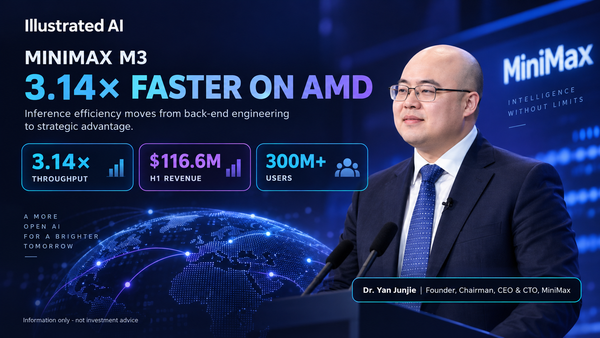
The real AI fight is no longer about who builds the smartest model—it's about who can run that intelligence at scale, cheaply and quickly. Inference, the moment a trained model does useful work, is the business engine. MiniMax M3's jump from 109.1 to 342.4 output tokens per second per GPU on AMD hardware illustrates why this matters: the same hardware suddenly produces far more output, transforming economics. Faster responses also change user experience—dropping time-to-first-token from 1.46 to 0.67 seconds makes AI feel more alive, driving engagement and adoption. As workloads grow heavier—coding assistants, agentic systems, long-context analysis—inference efficiency shifts from advantage to necessity. The winners won't just build brilliant models; they'll industrialize intelligence reliably and cost-effectively.
Invest in top private AI companies before IPO, via a Swiss platform:
 SmartProfit Finder AG
Major performance gains rarely come from one breakthrough—they come from layered engineering precision. MiniMax M3's improvements combined better kernel selection, Mixture-of-Experts fusion, speculative decoding, sparse-attention optimization, cache reuse, and prefill/decode disaggregation. Each fix exposed the next bottleneck, turning AI infrastructure into a living, continuously optimized system. For investors, this reveals a critical insight: the competitive moat in AI increasingly includes systems expertise, not just model weights. The company that squeezes more real-world output from the same compute has built an advantage that may be invisible on benchmark leaderboards but proves decisive commercially.
MiniMax's H1 2026 revenue reached $116.6M—up 283% year over year—with enterprise and Open Platform revenue surging 703% to $73.9M, representing 63% of total revenue. Token consumption rose 20-fold from January to July. This growth is exciting but demanding: every token has a cost, and usage can scale faster than revenue if unit economics don't improve. Gross margin rising from 12.1% to 17.9%, driven by infrastructure efficiency, signals that engineering gains are beginning to show in financials. The key distinction is between demand growth and profitable demand growth—a gap that can be enormous in AI.
MiniMax M3 targets high-value, high-cost workloads: frontier coding, agentic reasoning, native multimodality, and context windows up to 1 million tokens. Agentic systems multiply token consumption dramatically—a single task may involve dozens of reasoning loops. Long-context processing creates serious memory and compute pressure. Video and audio generation add further intensity. The prize is a shared infrastructure stack supporting text, code, agents, and media efficiently. Every latency reduction expands what customers are willing to deploy commercially. Advanced capability is only transformative when delivered at manageable cost.
R&D spending reached $296.9M in H1 2026, up 139%, while adjusted net loss widened to $293M. MiniMax reported a cash balance of approximately $1.32 billion as of June 30, 2026, providing funding capacity while the company works toward stronger unit economics. The real question is whether marginal economics improve as scale grows. Signals worth watching: continued enterprise revenue outpacing consumer revenue, gross margin expansion alongside surging token volumes, and production adoption replacing benchmark applause. Hardware portability across AMD and NVIDIA adds strategic flexibility. MiniMax's public listing offers rare transparency into what scaling a frontier AI company actually costs—a valuable benchmark as private-market valuations remain opaque. The emerging AI moat combines model quality, systems optimization, hardware flexibility, and improving unit economics. The future belongs to companies that industrialize intelligence without losing financial discipline.