Multiply Labs’ $75M Bet on AI-Powered Biomanufacturing
– 3 min read
Manufacturing is a significant constraint on the scale and affordability of some advanced therapies. Multiply Labs is developing robotic systems intended to automate complex production workflows using manufacturers’ existing instruments. AI is increasingly used in drug discovery, but translating a candidate into a treatment also requires clinical development and reliable manufacturing. Some advanced-therapy workflows involve delicate biological materials, stringent contamination controls and substantial manual handling. Automating those steps could improve production consistency and capacity, although the benefits will vary by therapy and process.
Invest in top private AI companies before IPO, via a Swiss platform:
 SmartProfit Finder AG
Multiply Labs is betting that robotics can close that gap. Rather than asking manufacturers to rebuild from scratch, its approach wraps an intelligent operating layer around instruments already in use. The result is what might be called physical AI for medicine—software and robotics working together to perform complex production tasks with precision and repeatability. Contamination control and repeatability are central to the platform’s value, alongside throughput, manufacturing cost and reliable operation.
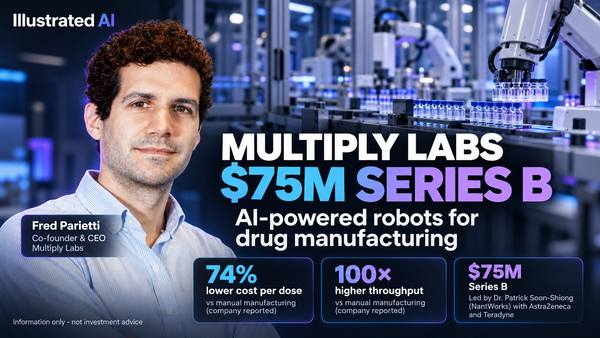
Multiply Labs announced a $75 million Series B on 6 October 2026, bringing its total capital raised to more than $100 million since its founding in 2016. The round was led by Dr. Patrick Soon-Shiong with NantWorks, with new participation from AstraZeneca, Teradyne, Lingotto, and Strange Ventures, alongside returning investors including Lux Capital, Casdin Capital, Fifty Years, Ora Global, and Founders Fund.
Participation from AstraZeneca and Teradyne brings pharmaceutical and automation expertise into the investor group. Their investment indicates interest in Multiply Labs’ approach, but it does not independently establish production performance, customer economics or commercial scalability.
Multiply Labs reports a 74% reduction in manufacturing cost per dose and up to 100 times greater throughput per square foot of cleanroom compared with manual manufacturing. The published research describes a preliminary estimated cost analysis and demonstrates comparable cell yields, viability and identity for a robotic T-cell expansion workflow. These findings should not be treated as evidence that every therapy or commercial deployment will achieve the advertised savings.
Manufacturing capacity and cost can limit access even when a therapy has demonstrated clinical benefit. Robotics could help address those constraints where automation preserves product quality and improves production economics.
Multiply Labs describes its cluster as having four robotic arms, up to 24 instrument modules, more than 50 automated unit operations and a footprint under 600 square feet. Greater output per square foot could improve cleanroom utilisation, but total savings will depend on equipment, installation, validation, maintenance and operating costs.
The real power lies in orchestration. Software coordinates timing, instrument sequencing, data capture, and real-time monitoring across entire production workflows. Multiply Labs describes its software as supporting electronic records and signatures compliant with 21 CFR Part 11. That capability does not by itself establish compliance for a customer’s manufacturing operation: system validation, access controls, audit trails and operating procedures remain important requirements. Customers operate the robots at their own facilities, and reported revenue sources include equipment, cartridges and service and support. These relationships could support repeat revenue, but the reviewed disclosures do not establish recurring-revenue share, renewal rates or margins.
Every disruptive technology eventually meets reality. In biomanufacturing, reality arrives with audit trails, validation documents, sterility standards, and quality systems that allow very little improvisation. Important milestones include repeat customer deployments, equipment qualification, process validation, demonstrated contamination control and compliance with applicable manufacturing requirements. Independent evidence of production performance and customer economics will help establish whether the platform can scale commercially.
Commercial expansion will depend on long sales cycles, demanding validation requirements and reliable operation at customer facilities. Technical expertise and deployment experience could create barriers to entry, but a durable competitive advantage will require evidence of repeat orders, retention, consistent batch quality and attractive economics.
The bottom line: Multiply Labs’ $75 million Series B provides capital to expand its robotic biomanufacturing platform. Its published research and reported deployments provide development milestones, but broad commercial-scale performance and financial economics remain incompletely disclosed. Investors should watch repeat orders, validation timelines, batch quality, uptime, deployment costs and whether estimated manufacturing savings translate into sustained customer benefits and attractive margins.