Tenstorrent’s $1.5B Raise Signals an Open AI Infrastructure Challenge to Nvidia
– 4 min read
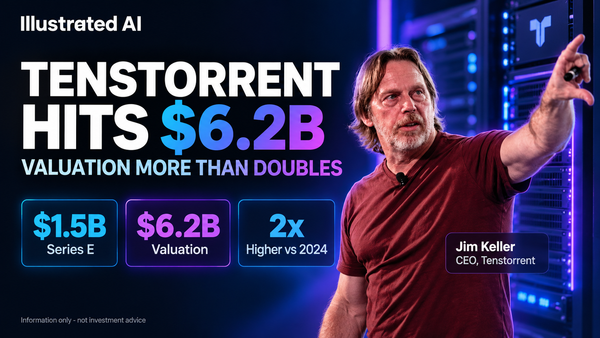
Tenstorrent announced on 19 October 2026 that it had closed a $1.5 billion Series E at a $6.2 billion post-money valuation. Trace Capital and Innovation X led the round. The company says the capital will support volume deployment of Galaxy servers and development of AI and CPU intellectual property licensed to customers designing their own chips. The financing demonstrates investor backing, rather than independently established profitability or competitive superiority.
Invest in top private AI companies before IPO, via a Swiss platform:
 SmartProfit Finder AG

AI is no longer a laboratory curiosity. It is an always-on utility driving coding assistants, instant answers, video generation, and enterprise automation. If AI is the electricity of the digital age, infrastructure companies are building the power stations. Tenstorrent is pitching itself as a serious alternative in a market long dominated by Nvidia, offering processors, server systems, and licensable intellectual property across multiple layers of the AI stack.
Still, funding is not proof. Valuation is not revenue. The next test is whether existing products and licensing relationships translate into repeat orders, sustained customer use and attractive margins. But the market backdrop is powerful: AI is spreading from giant labs to ordinary businesses, from experimental pilots to daily operations. Whoever delivers powerful, efficient, scalable AI systems at the right price may help shape the entire digital economy.
Inference creates recurring computing demand as deployed models serve users and applications. Its economics depend on workload, utilisation, latency requirements and energy costs. Training remains important, and Tenstorrent markets Galaxy systems for both training and inference; the opportunity should not be framed as a complete shift from one to the other.
Tenstorrent targets this directly. The inference market rewards efficiency over spectacle: predictable costs, fast response times, and manageable energy consumption. Lower inference costs could improve customer economics, although the benefit depends on workload performance, utilisation, migration costs and the provider’s pricing. Inference also invites more competition, with varied workloads creating room for alternative architectures to prove themselves.
Tenstorrent offers an open-source software stack, uses standards including RISC-V and commercially licenses CPU and AI processor IP. These are different forms of openness: open software and instruction-set standards do not mean every hardware design is freely available. Customers may gain greater scope for adaptation, but portability and migration costs depend on model support, tooling and implementation.
As AI deployment moves from experimental labs to broad commercial usage, purchasing decisions grow more cost-sensitive. Flexibility starts to matter more. Open architecture can widen the market by attracting partners and enterprises who want alternatives. The challenge is execution: customers will not embrace freedom if it comes with friction.
Tenstorrent spans processors, server systems, software, and licensable IP. Customers do not buy semiconductor theory; they buy outcomes. By offering complete systems alongside its processors, the company addresses the broader customer problem rather than shipping isolated components.
Tenstorrent sells computing hardware and licenses processor IP. Its open-source software supports those offerings, but the reviewed disclosures do not establish a separate software-tooling revenue stream. Licensing could reduce direct manufacturing exposure relative to selling chips, while still requiring engineering, verification and customer support. The risk is complexity. Every additional layer introduces more moving parts to manage. The best full-stack strategies feel integrated, with each layer strengthening the others. If executed well, this approach can transform a hardware startup into a platform company capable of changing the economics of an entire industry.
Big funding rounds signal confidence, not commercial maturity. The real test begins after the celebration. Investors should watch five signals: production scale, software adoption, independent customer validation, licensing traction, and capital discipline.
Competition sharpens the challenge. Nvidia, AMD, and large technology firms building custom silicon are not standing still. Any challenger must give customers a compelling reason to switch, whether lower cost, openness, or flexibility, and that reason must be real in customer hands.
Infrastructure companies that become trusted parts of the AI stack can enjoy recurring demand and deep customer integration. The prudent approach separates the layers: funding proves interest, vision explains opportunity, products must prove utility, and economics must prove staying power.
The bottom line: Tenstorrent’s $1.5 billion Series E provides capital to expand its AI systems and processor-IP business. Its hardware, open-source software and licensing strategy offer alternatives for customers, but do not independently establish lower total costs or a durable competitive advantage. Investors should watch shipment volumes, independent workload benchmarks, software compatibility, licensing revenue, customer concentration, gross margins and cash consumption.