Saronic’s Shift From Autonomous Boat Prototype to Scaled Naval Production
– 4 min read
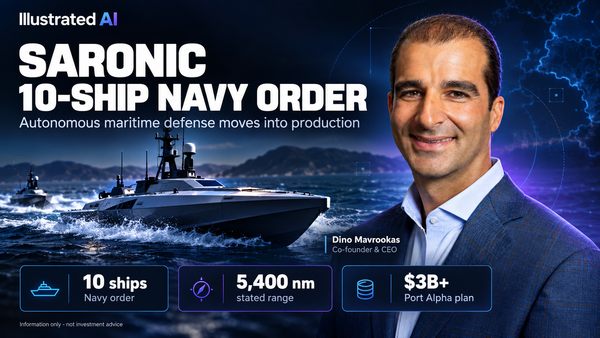
Saronic announced in late September 2026 that it had received a firm-fixed-price production award under the US Navy’s Medium Unmanned Surface Vessel Marketplace for Marauder, its 180-foot autonomous vessel. The award provides evidence of customer commitment, but does not establish completed deliveries, operational acceptance or profitable production at scale.
Invest in top private AI companies before IPO, via a Swiss platform:
 SmartProfit Finder AG

Saronic lists Marauder’s maximum payload as 150 metric tonnes and its range as approximately 5,400 nautical miles with a 25-tonne base load, falling to approximately 4,100 nautical miles at maximum load. These are company-published specifications, rather than evidence that every payload and operating condition achieves equivalent endurance.
The move from prototype to production is the real turning point. A production award creates obligations to manufacture and deliver. Consistency must subsequently be demonstrated through accepted vessels, quality results, delivery performance and operating reliability. The winners are rarely those with the flashiest idea; they are the ones that make it repeatable, dependable, and useful at scale. Once intelligent machines begin operating in one of the toughest environments on earth, the implications spread well beyond the waterline into manufacturing, defense, and logistics.
In disruptive technology, a production order is one of the clearest signals of genuine demand. It suggests the customer no longer wants a demonstration—they want delivery. Demonstrations are about possibility; production is about accountability. A prototype can impress in controlled settings, but a production program must survive deadlines, quality checks, and the unforgiving reality of real-world use.
A multi-vessel order indicates movement from isolated innovation into repeatable deployment, introducing measurable milestones: units completed, production speed, cost discipline, and operational results. It also sends a powerful market signal that the technology has crossed a threshold of credibility—customers do not place serious production commitments lightly, especially in mission-critical environments.
Most importantly, production forces an emerging company to mature: building quality processes, coordinating suppliers, supporting fielded systems, and becoming a durable enterprise. That is the hinge between possibility and execution—when the story becomes truly interesting.
Saronic reports that Marauder completed more than 140 test scenarios during eight days of continuous operations without failure. This is a company-reported result from a defined evaluation, rather than a fleet-wide reliability measure or evidence of performance across all sea states and mission conditions.
The most common mistake in understanding technological disruption is assuming the intelligence layer is the whole story. In autonomous maritime systems, software alone does not win. An autonomous vessel must perceive its environment, make decisions, move through water with stability, manage power and propulsion, and communicate reliably—all without failure becoming the norm.
The strongest businesses in this field look less like pure software ventures and more like AI-enabled industrial platforms, mastering hull design, propulsion, mission integration, manufacturing repeatability, and maintenance planning simultaneously. Hardware integration rarely attracts headlines, yet endurance, payload flexibility, and maintainability often become the decisive operational factors.
Integrated design could help Saronic use operating experience to improve software, hardware and manufacturing processes. Whether that produces a durable advantage depends on data quality, permitted data use, validation and measurable gains in reliability or cost.
Every technological revolution eventually runs into the physical world. Autonomy can scale digitally far faster than ships can be built. Shipbuilding capacity could constrain expansion alongside autonomy reliability, component supply, maintenance, customer funding and operational acceptance. Building production infrastructure early—before demand overwhelms capacity—acknowledges a hard truth: in frontier technology, the company that controls production can shape the market.
Saronic identifies its Franklin, Louisiana shipyard with Marauder construction. Port Alpha in Brownsville, Texas is a separate expansion project: the company says construction has begun and targets initial operations in 2028. Planned capacity should not be counted as currently available output.
Pairing autonomy software with purpose-built shipbuilding capacity unites the fast world of digital innovation with the slow world of heavy industry. Most companies are strong in one domain, not both. A company bridging both worlds could become unusually formidable, particularly given the national-capability significance of shipbuilding beyond its commercial value.
Higher production volumes could support learning and purchasing efficiencies, but costs may also rise through rework, supplier constraints, maintenance and underused capacity. Scale benefits require measured evidence.Production infrastructure may ultimately become the most decisive strategic asset in the entire field.
Once a company moves into production, the market watches for proof of execution. Several themes come into focus: production cadence, factory buildout progress, follow-on demand, unit economics, and real-world autonomy performance. Together, these answer the defining questions—Can it build? Can it scale? Can it deliver economically?
The strongest competitors will likely be those combining reliability, speed, flexibility, and industrial discipline across the full stack: autonomy, hardware, manufacturing, and support. The commercial opportunity depends on demonstrating competitive total costs, adaptability and reliable delivery. These advantages require comparison with alternatives under equivalent operating conditions.
The bottom line: Saronic’s Marauder production award provides a concrete customer commitment following company-reported sea trials. It does not independently establish fleet-wide reliability, sustained delivery cadence or attractive margins. Investors should watch vessel acceptance, delivery schedules, human-intervention rates, maintenance requirements, shipyard execution and cash returns after manufacturing and support costs.