Shield AI’s Hivemind Slashes Autonomous Flight Development Time
– 3 min read
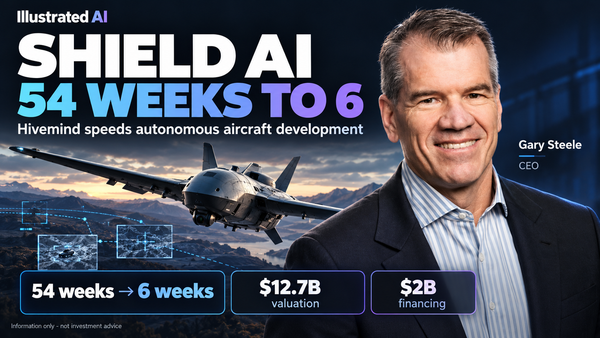
Honeywell Aerospace and Shield AI announced on 13 October 2026 that Honeywell engineers achieved their first autonomous flight six weeks after beginning Hivemind Enterprise training. Engineering leads had estimated that comparable development would normally take 54 weeks. This company-reported comparison is not an independently controlled benchmark or evidence of equivalent savings across other programmes.
Invest in top private AI companies before IPO, via a Swiss platform:
 SmartProfit Finder AG
At the center of this shift is Hivemind Enterprise, a software system giving engineers a ready-made autonomy foundation covering route planning, mission management, communications, and deployment. Instead of starting with an empty workbench, teams begin with a working toolkit.
When a platform removes that burden, engineers can focus on what makes their application unique rather than rebuilding the same digital foundations repeatedly. That is the difference between paving roads and driving on them.
The first autonomous flight took place in mid-June, followed by an official demonstration in July. A separate two-aircraft demonstration on 8 October followed approximately three months of additional development. Honeywell’s detection model identified a target, and Hivemind shared its location with a second aircraft, which navigated there before both returned to base.
This is where autonomy shifts from gadget to infrastructure. A group of machines working together creates a system architecture. Coordination allows machines to divide labor, extend range, improve resilience, and respond dynamically. A fleet becomes more valuable than the sum of its parts.
Once machines can work together, they can take on sophisticated operational patterns across aircraft, ground vehicles, maritime systems, and mixed fleets. The common thread is the software layer enabling diverse machines to cooperate.
Shield AI confirmed in June 2026 that it had closed a $2 billion financing package comprising $1.5 billion in Series G funding and $500 million in preferred-equity financing, at a $12.7 billion post-money valuation. It announced completion of the Aechelon Technology acquisition on 22 June. These are earlier corporate milestones, separate from October’s flight announcement.
Simulation allows intelligent machines to be trained across rare and risky conditions that are difficult or unsafe to recreate in the real world. Combined with the core platform, this suggests a full-stack autonomy proposition: software to build and run autonomy, plus simulation to train and validate it.
The financing demonstrates substantial investor backing for Shield AI’s strategy. It does not independently establish widespread adoption, technical reliability or sustainable profitability.
Shorter initial development could allow more testing and iteration within a given period. Whether this reduces total spending or procurement delays will depend on integration complexity, validation requirements and customer processes.
Reusable software could spread foundational development costs across customers, although each deployment may require substantial adaptation, validation and support.
The reported timeline suggests that reusable autonomy software could shorten initial development. It does not establish lower total programme costs, reduced procurement requirements or readiness for certified operation. Integration, testing, safety assurance and ongoing support remain material costs.
The biggest question is whether external engineering teams can consistently reproduce the same development compression. True platforms do not depend on one elite internal group. If outside teams can build autonomy applications with similar efficiency, confidence in the platform rises sharply.
Expansion into larger uncrewed aircraft and commercial aviation tests whether the software foundation scales under more demanding requirements. Deep integration with avionics, navigation, and sensing systems could weave autonomy into a machine's core operation rather than keeping it a separate layer.
Shield AI says Hivemind has piloted more than 40 platforms. That breadth does not establish equivalent autonomy, operational maturity or regulatory approval across them, nor does it independently demonstrate customer switching costs.
The bottom line: Honeywell’s demonstrations provide a concrete example of an external engineering team building on Hivemind Enterprise. The reported development speed is encouraging, but broader economic and operational benefits remain to be demonstrated. Investors should watch repeat customer deployments, intervention rates, safety evidence, integration costs, software revenue and margins. Financing and simulation capabilities support development; they do not independently establish dependable autonomy at scale.