Neolix’s $400M Bet on Scaling Driverless Delivery
– 5 min read
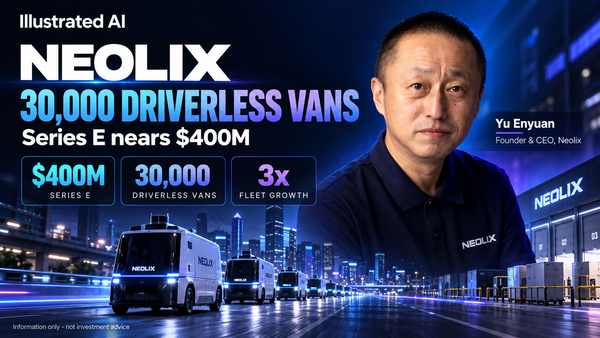
Neolix announced nearly $400 million in Series E financing on 20 October 2026 to support international expansion and autonomous-delivery development. Reporting identifies Boyu Capital and a national-level investment fund as co-leads. The financing demonstrates investor commitment, rather than independently established safety or profitability.
Invest in top private AI companies before IPO, via a Swiss platform:
 SmartProfit Finder AG

The leap from prototype to deployment is where most futuristic technologies stumble. Operating thousands of vehicles across hundreds of cities, under changing weather and endless real-world surprises, is vastly harder than impressing investors with one polished robot. The story here is about a system attempting to work every day, repeatedly, economically, and across diverse environments.
Physical AI must sense its surroundings, make decisions quickly, and act safely. A delivery vehicle has to recognize roads, pedestrians, obstacles, and unexpected disruptions, then convert those observations into precise movement. Unlike software that can afford a momentary glitch, machines on roads face immediate consequences. That is why scale in physical AI is so difficult and so meaningful.
Neolix reports more than 30,000 vehicles, a footprint spanning over 300 cities and approximately 20 countries, and more than 260 million cumulative autonomous kilometres. Its September 2025 milestone concerned 10,000 vehicles delivered. These figures should not be treated as a consistently measured active fleet, and geographic coverage does not establish equivalent paid operations or approvals everywhere.
Cumulative mileage indicates operating exposure, but assessing safety requires incident severity, intervention rates, operating conditions and comparisons with suitable alternatives. Mileage alone does not establish dependable autonomy.
Delivery is a game of narrow margins, repetitive routes, fuel costs, maintenance, and labor. If repetitive tasks can be handled by autonomous electric vehicles, a large cost center in urban logistics begins to bend. Machines do not tire on the twentieth trip or demand overtime for nighttime runs. Every repetitive route becomes a candidate for automation, and that is where a new cost curve begins.
When a company building autonomous delivery vehicles raises nearly $400 million, the headline is about the massive cost of turning advanced technology into a functioning network. Every step toward scale demands real spending: vehicles, batteries, sensors, service hubs, maintenance teams, and city-by-city regulatory compliance. Physical AI is not cheap, which is exactly why financing matters so much.
Fresh capital supports acceleration. It increases fleet size, deepens research, improves software models, and funds expansion into new environments. The mix of institutional investors signals belief that this is not a novelty business but an emerging layer of logistics infrastructure, judged on scale, recurring use, network density, and long-term resilience.
Disciplined observers separate what financing proves from what it does not. A large round proves investor commitment, not profitability. Capital can amplify strengths but also mask weaknesses. The smart question is what the money is meant to unlock. If it funds productive assets generating recurring demand and improving margins, it can be transformative. If it supports structurally unprofitable growth, the excitement fades fast.
Building fleets and service infrastructure could create barriers to entry if those assets support reliable service and attractive returns. Capital intensity also increases depreciation, maintenance costs and financing requirements. A durable advantage depends on productive utilisation and execution, rather than spending alone.
Fleet operations can generate data useful for identifying failures and improving models. Whether those data produce better performance depends on their quality, diversity, permitted use, labelling and validation. Improvements require testing before deployment; vehicles do not necessarily learn continuously from every journey.
Neolix describes vision-based perception and HD-mapless driving capabilities. Its published deployment process still includes service-area and route configuration, on-site validation and operational monitoring. Reduced dependence on pre-built HD maps does not establish unrestricted operation or eliminate local deployment work.
A larger, more varied fleet could improve coverage of unusual driving situations. A defensible data advantage would require measurable gains in safety, intervention rates or deployment costs relative to competitors.
For investors, the excitement lies in data turning a hardware-heavy business into a software-improving one. Hardware can be copied. But a mature AI system trained on broad real-world operational experience may be much harder to replicate quickly. The visible product is a delivery van. The potential hidden asset is an operational intelligence layer whose improvements require validation.
Neolix offers vehicles and operational support and is pursuing RoboVan-as-a-Service offerings. These could support repeat revenue, but the reviewed disclosures do not establish the share generated by vehicle sales, subscriptions or delivery services, nor the associated margins.
Use cases stretching into industrial parts, temperature-sensitive deliveries, and nighttime operations add depth to the platform. Serving complementary demand pools could improve utilisation, provided scheduling, vehicle configuration and repositioning costs allow productive use across those workloads. Utilization is one of the most important numbers in this story. Vehicles that sit still do not earn. Vehicles moving productively across more hours and route types support healthier economics.
International rollout adds opportunity and complexity. Each geography presents different legal frameworks, infrastructure, and customer expectations. A repeatable playbook for entering new markets, covering local approvals, route qualification, service support, and customer onboarding, is evidence that the business model can travel. The deeper investment case depends on whether autonomous delivery becomes embedded in logistics budgets, with customers moving from experimentation to routine spending.
The real transformation begins when the machine disappears into the workflow and the network becomes the product.
Wonder must eventually answer to arithmetic. A large fleet is impressive, but the technology has to win on unit economics. The cost and performance of each completed delivery must beat or convincingly challenge the alternatives. Customers care whether goods arrive on time, safely, and at competitive cost. Human-driven logistics already works. The question is whether autonomy is economically superior.
Unit economics means taking one delivery and asking what it truly costs: vehicle depreciation, electricity, maintenance, supervision, downtime, repairs, and any human intervention needed. Fleet utilization, uptime, remote-intervention rates, maintenance cost, and permit coverage together tell the truth more clearly than fleet announcements ever could.
Geographic generalization is another key test. If each new city requires heavy customization and frequent interventions, scaling becomes slower and costlier than hoped. A genuinely generalizable model lowers the marginal cost of expansion. The absence of disclosed revenue, margins, or profitability leaves the commercial verdict pending. Private-market enthusiasm carries a company only so far.
Paying-customer growth will say more than pilot announcements. Utilization by geography will say more than expansion headlines. Service revenue and contribution margin will say more than cumulative financing figures. The market is moving from possibility to proof.
The future may belong to fleets without drivers. But the market will belong to the fleet that delivers cheaper, safer, and more reliably than everyone else.
The bottom line: Neolix’s financing and company-reported deployment figures indicate substantial activity in autonomous logistics. They do not independently establish fleet-wide safety, comparable commercial maturity across markets or profitability. Investors should watch active paid vehicles, utilisation, incident and intervention rates, deployment costs, revenue mix and margins after maintenance and remote support.