Velaura AI’s Power-Efficient AI Compute Bet
– 3 min read
AI looks glamorous from a distance, but beneath the surface sits something far more important: power. The real contest is no longer about who builds the biggest model — it's about who does the most useful work with the least electricity.
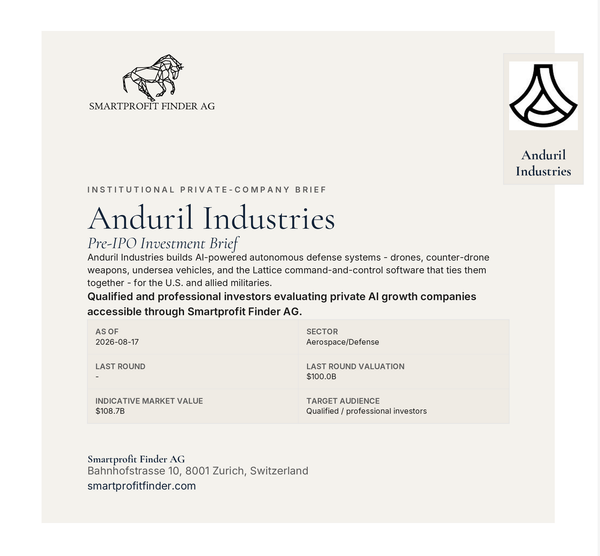
Invest in top private AI companies before IPO, via a Swiss platform:
 SmartProfit Finder AG
Every unit of AI performance demands electricity. Electricity creates heat. Heat requires cooling, space, and capital. Suddenly, AI is an industrial system with very real physical bottlenecks. This is why performance per watt has become the most critical measure in the AI economy — a lever that can unlock scale, lower costs, and determine where AI can exist at all.
AI demand is growing far faster than supporting infrastructure. In that environment, energy efficiency stops being a nice feature and becomes a strategic advantage. A breakthrough in efficiency doesn't just create savings — it creates access, making previously impractical deployments feasible across industrial systems and robotic platforms alike.
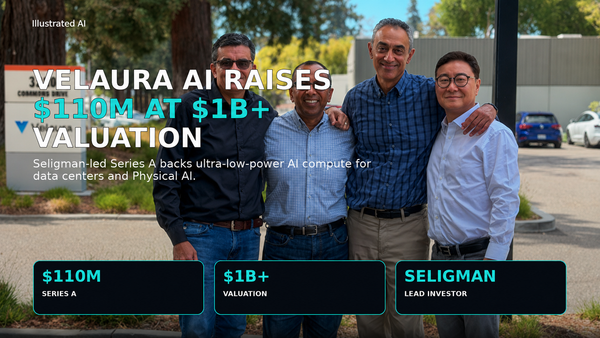
A company raising $110 million in a Series A at a valuation above $1 billion is receiving a clear vote of confidence: power-efficient AI compute is a category with enormous strategic potential. Capital is moving deeper into the stack, away from consumer-facing excitement and toward the machinery supporting the entire ecosystem.
This funding also marks a critical transition — from technical promise to commercial ambition. In semiconductors, product cycles are long, validation is demanding, and customers embed technology into mission-critical systems. Capital is necessary, but execution decides everything. The market eventually wants proof.
At the center of the story is a deceptively simple idea: make AI acceleration more efficient. Titan Core, a proprietary silicon IP platform built around ultra-low-power computing, targets a reported 2–4x improvement in performance per watt without sacrificing speed — directly attacking one of AI's biggest cost centers.
Lower power draw means lower energy bills, less heat, simpler cooling, and more compute within a fixed footprint. Crucially, Titan Core is an IP platform rather than a single chip, creating pathways for licensing and integration across multiple products and use cases. The underlying technology has already been deployed in more than 30 million ASICs — meaning the foundation carries real manufacturing heritage, not just theoretical promise.
Power-efficient compute is relevant across two powerful frontiers. In data centers, better efficiency reduces electricity costs, eases cooling demands, and allows more compute within the same power budget — a force multiplier at scale.
In Physical AI — robots, drones, and autonomous machines — the stakes become even more tangible. These devices can't always rely on distant cloud servers. Local AI compute reduces latency and improves reliability, but hardware must be compact, efficient, and cool enough for tight physical constraints. Here, efficiency isn't merely beneficial; it's often the difference between a viable product and an impractical one.
One technology addressing both centralized AI scale-up and the spread of intelligence into the physical world creates compelling dual market exposure.
The leadership team draws from Apple, NVIDIA, Google, Qualcomm, and Marvell, with repeat founders who have built and scaled chip businesses before. In semiconductors, where design mistakes are expensive and development cycles are long, leadership quality is part of the product.
Yet established incumbents are not standing still, and any newcomer must be meaningfully better in ways customers can trust. Technical claims matter only when confirmed in production environments. Design wins, pilot deployments, and third-party validation will be the true markers of credibility.
The opportunity is large. The technology targets the right bottleneck. But semiconductors reward patience and evidence — ambition opens the door, delivery decides who stays in the room.