Bedrock Robotics’ $4.1B Bet on Autonomous Construction
– 5 min read
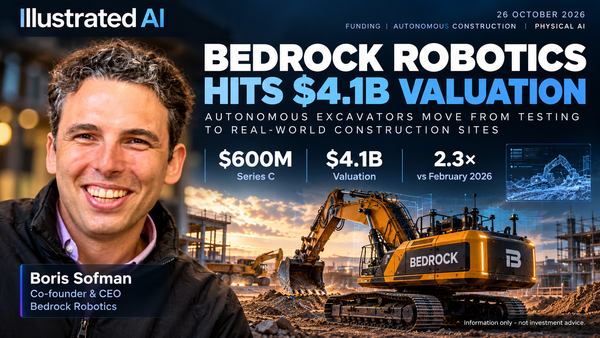
Bedrock Robotics announced a $600 million Series C on 26 October 2026 at a $4.1 billion post-money valuation. CapitalG and Emergence Capital co-led the round, bringing total funding to nearly $1 billion. The company says its autonomous excavators have performed paid work on live commercial sites since mid-August 2026. These milestones establish financing and company-reported commercial activity, rather than independently demonstrated fleet-wide safety or profitability.
Invest in top private AI companies before IPO, via a Swiss platform:
 SmartProfit Finder AG

Physical AI is software intelligence that controls machines in the real world. Unlike a chatbot, it must sense surroundings, interpret change, make decisions, and move safely through uncertainty. In an excavator, that means understanding terrain, bucket position, nearby workers, and the exact task at hand. That is a very different challenge from generating text or sorting images.
The excitement comes from scale. Excavators dig foundations, trenches, and earthworks supporting roads, factories, water systems, and data centers. If intelligence can be added without replacing every unit in the field, automation can spread far faster than expected. Contractors may upgrade equipment they already own rather than waiting for a full hardware refresh. That changes economics.
Human workers remain essential. Safety and oversight remain essential. The real advance is narrower but practical: certain machine tasks can now be performed with increasing autonomy on active sites while people supervise and coordinate. That is how most industrial revolutions begin — not with total replacement, but with targeted improvement where economics are strongest.
The $4.1 billion valuation is approximately 2.3 times the reported $1.75 billion valuation associated with February’s financing. That increase reflects negotiated investor expectations; it does not independently establish corresponding growth in revenue, margins or technical performance.
But valuation is not validation. Private valuation reflects negotiation among investors; it is not proof of durable margins or defendable market share. The money creates capacity for engineering, field operations, safety systems, and expansion. Physical AI is capital hungry because every deployment involves logistics, integration, testing, and operational support. Large financing helps a company survive long enough to solve hard practical problems.
The prize justifies the bet. A company that becomes the standard autonomy layer for heavy machinery might capture recurring revenue across thousands of sites and fleets. Still, industrial transformation rewards reliability more than hype. Capital can accelerate momentum. Only commercial performance can sustain it.
Few industries look more ready for reinvention. Projects run late. Labor is hard to find. Equipment is expensive and often underused. In a world urgently needing more infrastructure, power capacity, and data centers, construction has become a bottleneck. Labor shortages are real. Schedule pressure is real. Demand is rising faster than the system can comfortably deliver.
Excavation sits near the start of most projects. Before concrete is poured or steel rises, ground must be prepared. Delays here cascade through everything that follows. Autonomous systems that improve predictability of early sitework may stabilize entire project timelines — touching the critical path in ways that influence far more value than any narrow niche tool.
Monitoring, operating boundaries and reduced exposure to some tasks could support safer working practices. Demonstrating a safety advantage requires evidence on incidents, near misses, interventions and operating conditions relative to suitable alternatives.
The industry does not adopt novelty for novelty's sake. It adopts tools that save time, reduce headaches, and fit real operating routines. If autonomy can remove friction from processes that sit at the foundation of economic development, the impact could spread far beyond any single balance sheet. Construction may finally begin operating with the precision and machine intelligence that transformed manufacturing and logistics before it.
Bedrock develops autonomy systems that retrofit existing equipment, initially excavators. This could avoid replacing an entire machine, but adoption economics still depend on compatibility, installation downtime, pricing, maintenance and supervision costs. Expansion towards coordinated mixed fleets remains a development direction.
Retrofit also allows the provider to operate more like a platform than an equipment manufacturer. If the technology layer works across different machine types, the company taps into a vast installed base rather than waiting for new machine sales — a powerful go-to-market engine in a sector hungry for productivity gains but cautious about disruption.
The risks are real. Existing fleets are diverse in age, model, and compatibility. If each retrofit becomes a highly customized engineering project, scalability suffers. Operational uptime is critical — contractors earn money when machines are available and productive, not from impressive software diagrams. Liability frameworks must also be clear: who is responsible when autonomy malfunctions or conditions exceed system limits?
The simple version: the smartest machine still needs a realistic path onto the job site. Retrofit may be that path — turning autonomy from a moonshot into a tool contractors can actually buy, deploy, and trust.
Three milestones define the road ahead. First, fleet expansion: expanding the operating fleet while disclosing active machine counts, autonomous operating hours and support requirements tests whether installation, support, and software performance hold up under growing complexity. Second, independent proof of performance: substantiated evidence of improved productivity, safety, and machine availability carries far more weight than internal claims. Third, repeat business across varied sites: repeat contracts indicate customers found enough value to keep spending, while measured results across varied sites would strengthen evidence that the system generalises beyond its initial operating conditions.
Generalization is central to the investment case. Construction is not uniform — soil types, weather, layouts, and project demands all differ. A system that performs only in familiar conditions remains a niche solution. A system that adapts reliably becomes much more valuable.
Investors should also separate customer revenue from capital raised. Large balance sheets can mask weak unit economics longer than expected. The key question is whether each deployment creates attractive returns for both the customer and the company. Physical AI businesses must manage both software risk and operational risk simultaneously — a bug in autonomous heavy equipment can halt a job site. Safety processes and operational discipline are drivers of value, not costs to minimize.
The bottom line: Bedrock’s financing and company-reported paid deployments provide concrete development and commercial milestones. They do not establish sustained productivity gains, superior safety or profitable deployment economics. Investors should watch active machines, autonomous hours, intervention rates, accepted-work quality, installation costs, repeat contracts and margins after field support.