Warp Sciences: AI and Robotics for Drug Discovery Labs
– 4 min read
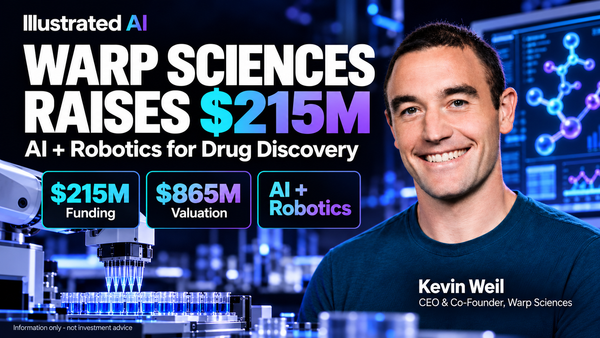
Warp Sciences emerged from stealth on 22 October 2026 with $215 million in funding led by Lightspeed. Participants included Premji Invest, Mayfield, IVP, Lux and Menlo Ventures. The company is building a US-based chemistry contract research organisation combining chemists, AI and robotics. Its initial service focuses on lead-optimisation analogue synthesis: making molecular variants for customers to evaluate.
Invest in top private AI companies before IPO, via a Swiss platform:
 SmartProfit Finder AG

Warp’s ambition is to connect experimental execution with AI development. Chemists would guide workflows as automation expands, with experimental results informing subsequent model training. A useful learning loop would require reliable data, appropriate permissions and validation that model updates improve performance; individual experiments do not automatically make the system better.
Lead optimisation involves evaluating molecular variants to improve a candidate’s properties. Faster synthesis could shorten parts of that cycle, but total savings and result quality depend on testing, interpretation, failed experiments and integration with customer workflows.
Chemistry automation could shorten synthesis turnaround, improve reproducibility and reduce costs for suitable workflows. Those benefits require measurement against comparable methods, including unsuccessful reactions, purification, quality control, scientist time and equipment costs. Faster compound production alone does not establish better drug candidates or clinical outcomes.
Combining AI with laboratory operations could create barriers to entry if Warp demonstrates reliable execution, competitive costs and repeat customer demand. Technical complexity alone does not establish a durable advantage.
Serving multiple discovery programmes could reduce dependence on any single therapeutic outcome. Actual diversification will depend on customer concentration, contract structure and the breadth of paid demand.
Warp says it will support customer-led discovery programmes rather than develop drugs of its own. Customers determine which molecules to pursue and retain control of their programmes. This model changes its exposure to individual drug outcomes, while leaving customer demand, execution and capacity-utilisation risks.
Warp’s proposed service model centres on synthesising compounds and delivering results for customer-led programmes. Commercial scale will depend on paid demand, reliable delivery and repeat projects.
The key performance metrics shift accordingly: compounds synthesized per unit of time, cost per compound, result consistency, customer return rates, and capacity utilization. Paid projects could generate service revenue. Whether their data improve the platform will depend on contractual rights, confidentiality protections, data quality and validated learning gains.
This isn't a magically asset-light business. Labs require capital, equipment needs maintenance, and skilled scientists remain essential. The promise matures only when automation improves productivity enough that margins strengthen as volume grows.
Warp’s founding team includes Kevin Weil, DJ Patil, Sol Reisberg and Mano Paluri, bringing experience across AI, healthcare and medicinal chemistry. That experience supports the development thesis, but does not establish reliable laboratory performance or attractive economics
Large funding rounds signal capital intensity—laboratories, robotics, instruments, and specialized staff all cost money before economics are proven. A substantial valuation reflects investors paying for future strategic importance, not current maturity. That can be justified if operational excellence and customer traction follow. It becomes a burden if expectations race ahead of evidence.
Funding supports development, but runway depends on cash consumption, facility investment, staffing and customer receipts. Capital and team experience provide resources for execution rather than validation of the business model.
The most valuable companies are defined by proof, not possibility. Several clear milestones will determine whether this category delivers on its promise.
First: functioning laboratories with real operational capacity—working facilities synthesizing compounds and delivering reliable results under actual customer demand. Second: customer validation through repeat projects, the clearest signal that a product is becoming infrastructure. Third: meaningful throughput gains that justify the model economically.
Reproducibility matters as much as speed. Standardized workflows can reduce variability, but only if systems are robust. A claimed learning advantage requires evidence that permitted experimental data produce validated improvements in subsequent decisions, laboratory performance or costs.
Competition is real. The field intersects with robotic lab providers, cloud lab models, and AI-driven discovery companies. Broad claims about transforming science won't be enough. Winners will need concrete differentiation: faster synthesis, better integration, richer learning loops, or superior customer outcomes.
The bottom line: Warp Sciences’ financing supports an AI-enabled chemistry-services business. Its proposed integration of scientists, robotics and experimental data could improve research workflows, but the reviewed disclosures do not establish independently measured productivity gains, profitable operations or better clinical outcomes. Investors should watch accepted-compound throughput, purity and reproducibility, turnaround times, repeat paid projects, utilisation and margins after laboratory costs.