Physical Intelligence’s Reported $20B Robot-AI Funding Push
– 5 min read
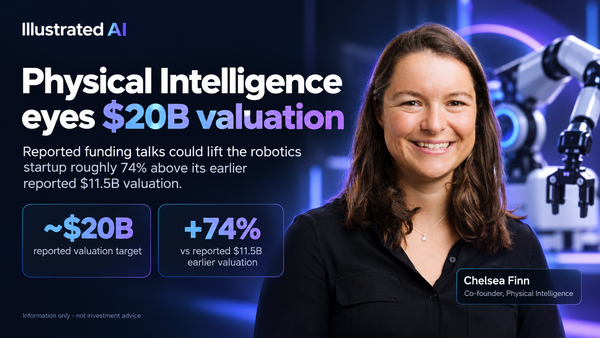
Bloomberg reported on 27 October 2026 that Physical Intelligence was discussing a financing of at least $1 billion at approximately a $20 billion valuation, with Avenir and Lux Capital in talks to lead. The proposed valuation compares with a reported $11.5 billion earlier in 2026—approximately a 1.74-fold increase. The financing has not been announced as completed, and Bloomberg’s reporting says the company has no current revenue.
Invest in top private AI companies before IPO, via a Swiss platform:
 SmartProfit Finder AG

The reported figure matters because of its speed and scale. That valuation would stand far above earlier levels, suggesting investor expectations are racing ahead. This is how disruptive technologies enter financial history: technical progress, then curiosity, then sudden competition among investors fearing they'll miss the next transformational business.
Still, private-market discussions are not signed agreements. Yet even early-stage valuation talks carry information—they reveal what sophisticated capital is willing to contemplate. Investors appear to be asking whether robot intelligence could become as foundational as cloud software or large language models.
The most compelling part of the story is the ambition: Physical Intelligence isn't building one robot for one task. It's building a general intelligence layer that works across different robot platforms—software that helps many kinds of robots see their environment, understand instructions, and take useful physical action.
This is where vision-language-action models become critical. They connect visual information, human instructions, and motor behavior, allowing robots to look at the world, understand what a person wants, and respond with action. The goal is adaptability—robots that generalize from training and respond intelligently when conditions change, rather than following rigid pre-programmed sequences.
If this works at scale, it changes robotics economics entirely. Instead of building software separately for each machine and task—expensive, slow, and hard to scale—a shared intelligence layer means many robots run on a common foundation. Think of it as an operating brain rather than a single body. Deployments can reveal failure modes and generate useful data. Whether these improve the shared models depends on data quality, permitted use, retraining and validation. That is the dream of platform businesses: not just selling a tool, but becoming the standard foundation on which others build.
Physical Intelligence launched its Pi API beta on 13 October 2026. Developers can upload robot data, fine-tune models on company-managed infrastructure and access hosted inference. The announcement describes early partner applications, but does not disclose pricing or paid customer numbers. Beta access does not establish commercial sales.
For robotics, the commercial standard is unforgiving. A chatbot giving a weak answer disappoints a user. A robot misunderstanding a task can drop items, damage goods, or create safety concerns. Real customers pay for outcomes, not elegant theory: Can the robot complete the job? Can it recover from errors? Can it function day after day at acceptable cost?
The beta phase reveals whether the intelligence layer can cross this threshold. Reliability is everything. In the lab, engineers choose favorable conditions. In the field, objects arrive in unexpected positions, lighting shifts, equipment behaves differently, and humans improvise. The technology must handle enough of that messiness to be economically useful—that's what investors mean by moving from demonstration to deployment.
A successful shift from research to external deployment unlocks an entirely new level of value. But deployment is often slower than expected, integration harder, and unit economics weaker. Frontier technologies typically require years of iteration before becoming robust commercial tools. The market will now ask the only question that ultimately matters: can this intelligence create repeatable real-world value for paying customers?
Investors don't earn returns from excitement alone. The central question is whether embodied AI can push robotics closer to software economics—high margins, fast growth, recurring revenue.
The optimistic case: one software stack supporting many robots means each model improvement benefits a broad ecosystem. Better performance could attract customers and generate useful feedback. A compounding learning advantage requires evidence that permitted data improve subsequent models and customer outcomes.
The cautious case begins with costs. Demonstration data must be collected, models fine-tuned, inference run at speed and scale, and integrations supported. The critical distinction investors are trying to make: does this become a true platform, or a sophisticated custom-service business disguised as one? A platform compounds value rapidly. A custom-service business scales slowly because each customer requires substantial new effort.
Large funding provides runway and strategic advantage, but also raises pressure. Once valuations climb, expectations follow. Every delay is judged against a much bigger promise. The economic question is ultimately simple: can robot intelligence become a repeatable, scalable product with strong returns, or will it remain expensive and difficult to deploy? The answer determines whether this category produces niche engineering firms or a new generation of platform giants.
Every technological revolution develops a battleground. In robotics AI, the contest is increasingly about who controls the models, tools, and interfaces that make many robots useful—not just who builds the best single machine.
Physical Intelligence's hardware-agnostic approach is its distinctive bet: create software that works across different systems and benefit from growth across the entire robotics market rather than gambling on one hardware winner. It's a pattern that produced some of technology's biggest winners—companies that provide foundational platforms others rely on, capturing scale without manufacturing complexity.
But hardware-agnostic ambition demands a brutal technical standard. Performing consistently across robots with different sensors, movement capabilities, processing limits, and use cases is an engineering mountain. Rivals are attacking from every angle—some building robot foundation models, others integrating hardware and software under one roof, large technology companies developing internal systems. No company has yet proven it can dominate general-purpose robot intelligence across many commercial settings.
Broad adoption could support developer familiarity, integration advantages and learning efficiencies. Whether these create a durable competitive advantage depends on measurable improvements in performance, deployment costs and customer retention. More developers alone do not establish network effects.
The larger significance extends beyond any single company. AI is beginning to move from language and content into motion, manipulation, and physical execution. Warehouses, factories, labs, stores, and service environments could all be transformed. Whoever solves the hard problem of making robots broadly intelligent, reliable, and commercially deployable could become one of the most important infrastructure players of the next decade.
The bottom line: Physical Intelligence’s reported financing discussions indicate substantial investor interest, while its API beta provides a route for external teams to adapt its robot models. Neither establishes paid demand, dependable performance across hardware or sustainable margins. Investors should watch completed financing, paid adoption, task success, intervention rates, integration costs and margins after compute and support.