Ultra’s Warehouse Robots Move From Hype to Real Orders
– 4 min read
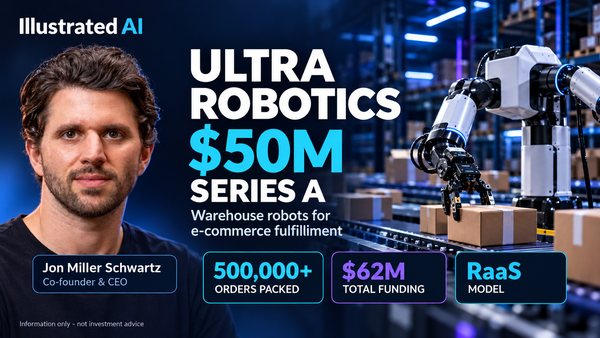
Ultra has raised a $50 million Series A, bringing its total announced funding to $62 million. The warehouse robotics company says its robots have packed more than 500,000 orders. These milestones indicate financing support and operating activity, but they do not independently establish fleet-wide reliability or profitable commercial scale.
Invest in top private AI companies before IPO, via a Swiss platform:
 SmartProfit Finder AG
Ultra’s Operator (OP1) is designed for warehouse tasks including packing, sorting and kitting. The company describes deployments across several US states, providing evidence that its systems are operating beyond controlled demonstrations.
The warehouse is the perfect proving ground. It's busy, complex, repetitive, and expensive. Human labor is hard to scale during peak seasons. Mistakes create downstream costs. In that environment, even small improvements in speed or efficiency have large consequences. A robot successfully packing orders becomes part of the operating engine of commerce.
Physical AI connects intelligence to action in the real world, giving machines the ability to sense and respond to environments where no two tasks are alike. For investors, the transition from concept to repetition is everything. The cumulative packed-order count indicates operating activity, but does not disclose the deployment period, human-intervention rate, error rate or throughput per robot.
How the robot is sold matters as much as what it does. Instead of requiring operators to purchase entire fleets outright, this company charges an integration fee plus recurring monthly payments covering hardware and software support. The decision becomes less like building a factory and more like subscribing to a service.
Monthly payments could support recurring revenue, but its durability will depend on contract terms, renewals and customer retention. Ultra must also fund hardware, installation, maintenance and ongoing support. If customers pay monthly while the provider carries significant service costs, economics can become difficult. Utilization becomes critically important. Higher utilisation and reliable operation could improve unit economics, but profitability also depends on pricing, hardware financing, installation costs, maintenance and human support.
Ongoing support and software updates could help Ultra improve performance and maintain customer relationships. Whether those improvements strengthen retention remains to be demonstrated. For warehouse operators, automation that doesn't force a complete redesign is compelling. The opportunity is real, but the scoreboard is whether recurring contracts produce healthy recurring economics.
Ultra works with Physical Intelligence, whose vision-language-action models power its robots. In a February 2026 account published by Physical Intelligence, Ultra reported a full customer-site shift at 96.4% autonomy using π0.6. That result describes the reported shift rather than fleet-wide performance.
Ultra also describes human operators intervening when models encounter difficulties, with intervention data supporting subsequent training. This provides evidence of an operating feedback loop, but does not establish that every order improves the model or that the partnership produces a durable competitive advantage.
If general-purpose robot intelligence works, it could expand the range of tasks a single machine performs, improving asset utilization and reducing the need for separate systems for every narrow problem. Still, smarter models add computational cost and new failure points. Software errors can interrupt workflows or damage goods, making monitoring, safeguards and recovery procedures important. Reliability remains essential, and practical deployment matters more than grand claims.
The warehouse is not just a market. It's a proving ground for a larger thesis: that machine intelligence can leave the screen and generate value in the physical world at scale. Success here could move into manufacturing, logistics, and retail, representing an entirely new computing layer for industry.
Demonstrations reveal possibilities. Businesses require unit economics. In warehouse robotics, that means asking whether a robot completes enough useful work, at low enough operating cost, to justify deployment. A robot can be technically brilliant and financially disappointing simultaneously.
Key metrics matter enormously: robots deployed, active paid sites, weekly orders per robot, autonomous completion rates, uptime, gross margins after service costs, and time to installation. The conversion of pilots into broader contracts is equally critical. Repeat orders and expansion into additional paid sites would strengthen the evidence of customer value, particularly alongside measured productivity gains and renewal data.
The competitive landscape makes economic scrutiny essential. The central question isn't which robot looks most futuristic but which creates the best balance of flexibility, reliability, and cost. Unit economics is where disruption becomes market power. Winners won't just have the smartest machines. They'll have machines that make financial sense every day, in every box packed, in every customer who decides the robots are worth keeping.
Disruptive technologies create two equal risks: missing the change or getting swept away by excitement. A $50 million Series A bringing total disclosed funding to $62 million signals serious investor belief beyond the concept stage. In robotics, where hardware and field operations are expensive, capital is often the minimum requirement for survival.
Still, numbers demand careful interpretation. Total disclosed funding differs from a single fresh injection. More than 500,000 packed orders is a cumulative company-reported metric, not audited revenue or a profit statement. It points to activity, not financial validation. Funding milestones enable scale; they don't guarantee it.
The most informative next disclosures would be specific: active robots, live paid sites, orders per robot weekly, autonomous completion rates, uptime, installation timelines, and service costs relative to recurring revenue. These details separate real industrial progress from broad technological storytelling.
Markets are usually transformed by systems fitting real workflows and solving painful bottlenecks first. Warehouse packing is operational friction, and reducing friction is how large businesses are born. Deployment experience could strengthen Ultra’s position if it produces measurable improvements in performance, support costs and customer retention.
The bottom line: Ultra’s $50 million Series A and company-reported cumulative packed-order count provide financing and operating milestones. Its Physical Intelligence partnership includes live customer deployments with human intervention when needed. These disclosures do not establish fleet-wide reliability or profitable unit economics. Investors should watch active paid sites, autonomous completion rates, uptime, repeat orders and margins after hardware and support costs.