Oratomic’s $5.4B Quantum Leap in Private Markets
– 4 min read
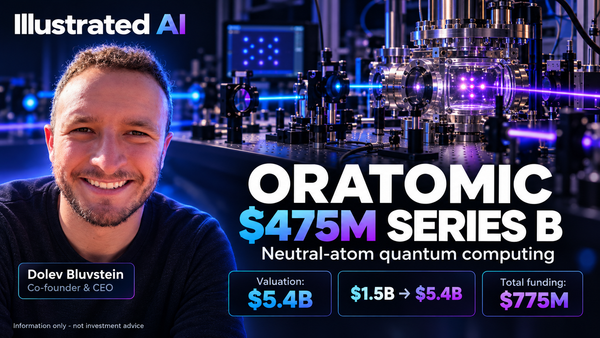
Oratomic has reportedly raised $475 million in a Series B at a $5.4 billion valuation, compared with $1.5 billion following its Series A roughly three months earlier, according to The Wall Street Journal. On 8 October 2026, the company confirmed total funding of $775 million. The valuation increase reflects investor expectations rather than demonstrated commercial performance.
Invest in top private AI companies before IPO, via a Swiss platform:
 SmartProfit Finder AG
The company identifies ARCH Venture Partners, Spark Capital, Khosla Ventures, Index Ventures, General Catalyst and Bezos Expeditions as leading the financing. It says the capital will support scientific and engineering recruitment, laboratory infrastructure and system development.
Classical computers encode information in bits with values of zero or one. Quantum computers use qubits that can exist in superpositions, with algorithms exploiting interference and entanglement to perform certain computations differently. This does not make quantum computers faster for every task.
Oratomic is developing a fault-tolerant system that encodes logical qubits across physical qubits and uses error correction to suppress failures during computation. Fault tolerance requires sufficiently reliable hardware and control systems; it does not mean errors disappear entirely.
Oratomic cites research suggesting that certain large-scale computations could be performed with approximately 10,000–20,000 reconfigurable atomic qubits under specified assumptions. These are theoretical resource estimates, rather than evidence that the company has built an integrated machine at that scale. Required resources and runtimes vary by algorithm, error rates and architecture; the figures should not be treated as a universal threshold for commercially useful quantum computing.
Lower resource requirements could make some fault-tolerant computations more feasible, provided the assumed hardware performance can be achieved. Quantum simulation could eventually support chemistry and materials research, but practical benefits will depend on demonstrated accuracy, runtime and total cost compared with classical methods.
Oratomic uses neutral atoms held and moved by laser light as its building blocks. Neutral atoms can potentially be organized in flexible patterns, manipulated in parallel, and dynamically rearranged, reducing the resources required for fault-tolerant calculations. This architecture competes with superconducting qubits, trapped ions, and photonic designs. Each has strengths and weaknesses. The winner will not be chosen by elegance alone, but by manufacturability, reliability, and cost.
Oratomic's case is compelling because it presents a full-stack vision in which optics, control systems, software, and error correction all work together. A quantum company is not valuable simply because its physics is beautiful. It becomes valuable if that physics can be operationalized at scale. Reconfigurable neutral-atom arrays could reduce some error-correction and connectivity overheads. Whether this produces a practical advantage will depend on gate fidelity, atom loss, control precision, decoding speed and reliable operation of the integrated system.
Oratomic does not fit the familiar template of rising revenue and expanding margins. The investment case is centered on a massive engineering effort that could produce a foundational computing platform. Money arrives before commercial comforts exist, funding laboratories, expensive components, and long development timelines. If fault tolerance becomes practical, quantum computing could become infrastructure on which many later products are built, explaining why investors tolerate sparse near-term business metrics.
A successful hardware platform can become deeply defensible, combining intellectual property, manufacturing know-how, and talent concentration. These are hard advantages to copy. But valuation jumps reflect financing ambition, not automatic validation. They do not confirm product-market fit or that the hardest engineering tasks are complete.
Valuations surge in an instant. Engineering truth takes longer. The next phase will be judged by four milestones. First, error-corrected logical performance must be demonstrated with reproducible results. Second, system integration must prove that optics, vacuum systems, electronics, and software all function together over extended periods. Third, roadmap discipline must show consistent progress against measurable goals. Fourth, financing must convert visibly into stronger teams, better facilities, and clearer technical proof points.
The competitive field remains crowded. Rival architectures are pursuing the same destination with different methods. Progress must be tangible because leadership in perception can evaporate if leadership in execution falters. Big rounds are signals, not verdicts. The larger the valuation, the more important scrutiny becomes.
Oratomic has captured investor imagination and secured substantial resources. But the market's fascination will eventually harden into one question: does the engineering work? The future is not won in press releases. It is won in the lab, in the system, and in the discipline of repeated performance.
The bottom line: Oratomic’s reported $475 million Series B at a $5.4 billion valuation and confirmed $775 million in total funding provide substantial resources for its neutral-atom quantum-computing programme. Its resource estimates support a technical development thesis, but they do not establish an integrated utility-scale machine or commercial advantage. The reviewed disclosures do not establish revenue, margins, cash consumption or funding runway. Investors should watch reproducible logical-error suppression, system reliability, algorithm performance, roadmap execution and whether technical progress translates into economically useful computation.