Lambda’s AI Cloud Backlog Surge and Pre-IPO Funding Push
– 5 min read
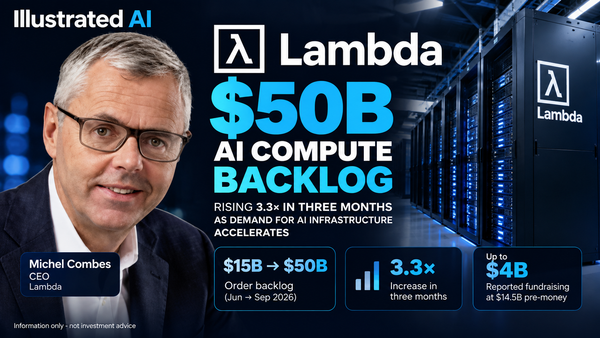
Lambda is reportedly raising up to $4 billion in a round led by Blackstone and Coatue Management at a $14.5 billion pre-money valuation. Reuters, citing The Wall Street Journal, reported that Lambda is targeting a 2027 IPO, subject to execution and market conditions. The reports do not establish that the financing has closed. An investor letter reviewed by the Journal put backlog at $50 billion in September, compared with $15 billion in June 2026.
Invest in top private AI companies before IPO, via a Swiss platform:
 SmartProfit Finder AG
Backlog represents reported orders or contracted business that has not yet been fulfilled. It can provide visibility into future activity, but its value depends on delivery schedules, cancellation rights, payment conditions and customer creditworthiness. Growth in backlog does not by itself demonstrate that a provider is falling behind on delivery. The reported backlog growth increases the importance of securing capacity, financing deployment and earning adequate returns on the resulting infrastructure. Training large models requires powerful chips, specialized networking, cooling, power, and data-centre capacity. This is closer to building railroads or power grids than selling software. Capital must be spent before revenue arrives.
The winners will not only be the most innovative technologists but the best operators and financiers. AI infrastructure is becoming an economy of logistics and execution as much as an economy of ideas. Think of it like a gold rush where the durable businesses sell the picks and shovels. Still, a backlog is not cash. It is a promise that must be converted into delivered systems, paying customers, and real cash flow.
AI's future may look digital, but its foundation is intensely physical. That is where the real race begins.
The Wall Street Journal reported a $35 billion cloud commitment from Anthropic. That amount equals 70% of Lambda’s reported September backlog, although the disclosures do not establish the precise portion of the agreement included in backlog. The relationship therefore warrants close attention to delivery obligations, payment terms and customer concentration.
Large commitments do not always mean immediate earnings. Investors must ask: over what period will capacity be delivered, what milestones trigger payment, and what happens if the customer's priorities shift? These are not minor details. They are the gears inside the machine.
Concentration is not automatically bad. Anchor customers can build credibility, create scale quickly, and support financing discussions. But a mature business needs diversified demand, healthier bargaining power, and less vulnerability to any single contract. The strongest companies use giant anchor relationships as stepping stones, not crutches.
Anchor contracts can support expansion, but their value depends on delivery performance, payment reliability and concentration risk.
The AI boom runs on capital. Chips, servers, cooling systems, and data-centre buildouts all cost enormous sums before generating a single dollar of revenue. Additional contracted demand can increase funding requirements when it requires new capacity. Demand served through existing infrastructure may instead improve utilisation without proportionate capital expenditure. Rapid expansion can require substantial external financing, although customer prepayments, existing cash flow and contract structure affect the funding requirement.
On 1 October 2026, Lambda announced a $1.008 billion delayed-draw term loan at a 6.78% fixed interest rate, supporting three deployments for two investment-grade customers. Draws are linked to cluster commissioning milestones, and the facility is secured by financed infrastructure and contracted cash flows. This structure can align funding with deployment progress, but draw conditions, construction costs, debt service and customer-payment risk remain important. Financing success must ultimately translate into adequate returns on deployed capital. A business is ultimately judged by what it earns on the capital it deploys, not by how much it raises.
Access to low-cost, reliable funding can become a genuine competitive advantage, allowing a company to secure hardware sooner and meet customer demand ahead of rivals. AI infrastructure is increasingly a capital-markets story as much as a technology story.
AI may be written in code, but the winners still need cash, concrete, and discipline.
Growth can make any company look impressive temporarily. The harder question is whether leadership and market position can turn that growth into a lasting advantage. Specialist providers, giant hyperscalers, and customers building internal clusters all compete for the same workloads, so success depends on availability, performance, pricing, and reliability, not just hardware access.
Lambda appointed Michel Combes as CEO effective May 2026, while co-founder Stephen Balaban became CTO. This separates operational leadership from technology strategy, but the effectiveness of that structure will depend on delivery performance, capital allocation and customer outcomes.
A durable advantage comes from multiple reinforcing factors: access to scarce hardware, operational efficiency, strong customer relationships, and financing capability. Enthusiasm fades quickly if deployments are delayed or utilization is weak. Great positioning means having the systems, leadership, and discipline to perform under pressure.
Big markets create opportunities. Great leadership turns opportunity into advantage.
Backlog, financing plans, and growth headlines are only steps on the path. The destination is a business model that converts commitments into revenue, revenue into profit, and profit into cash. Infrastructure generally must be commissioned before it can support contracted cloud services. Revenue recognition depends on the agreement’s performance obligations and how services are delivered over time; hardware procurement or installation alone does not establish recognised revenue.
Asset returns depend on contracted pricing, capacity commitments, utilisation and operating costs. New hardware generations can reduce the competitiveness and resale value of existing GPUs, while accounting depreciation depends on estimated useful lives. Borrowing also adds interest and repayment obligations.. Strong demand must be strong enough to overcome these financial realities. Customer collections matter too. Revenue on paper is not cash received.
A useful framework follows four checkpoints: capital formation, physical deployment, revenue conversion, and public-market readiness through audited disclosures. AI infrastructure can produce an illusion of certainty because demand appears immense and strategic importance seems obvious. But the road from strategic importance to shareholder value passes through financing discipline, operational execution, and cash generation.
The bottom line: Lambda’s reported backlog growth indicates substantial contracted demand, while its proposed equity round and completed deployment-linked debt financing highlight the capital required to serve it. These milestones do not establish profitable backlog conversion. The reviewed disclosures do not provide sufficient financial detail to assess recognised revenue, margins or free cash flow. Investors should watch financing completion, customer concentration, commissioning schedules, contract terms, collections, hardware utilisation and returns on invested capital. A potential IPO remains subject to execution and market conditions.