TypeSafe AI’s Breakout Funding for Decision-Focused Enterprise AI
– 3 min read
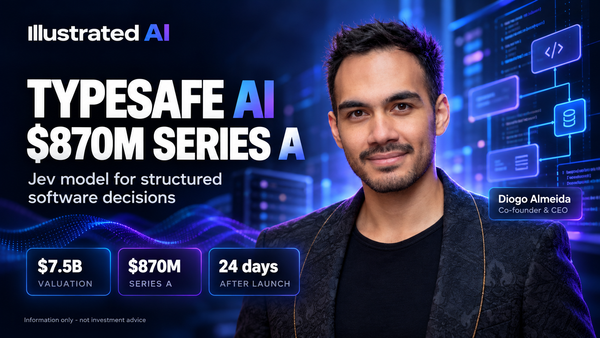
TypeSafe AI announced an $870 million Series A at a $7.5 billion valuation on 9 October 2026, 24 days after Jev’s early-access launch. Andreessen Horowitz led the round, with Sequoia Capital and existing investor DCVC participating. The financing indicates substantial investor interest, but does not independently establish commercial scale or sustainable financial performance.
Invest in top private AI companies before IPO, via a Swiss platform:
 SmartProfit Finder AG
The scale of the leap was striking. Jev launched alongside a seed round of roughly $40 million. Less than a month later, the company announced financing 21.8 times larger. That escalation suggests investors saw not just a clever demo, but a possible platform—one that could become deeply embedded in customer workflows.
Jev is designed for structured decisions inside software rather than unrestricted text generation. For support-ticket routing, Jev can return a predefined category and probability that software can process directly. General-purpose language models can also produce structured outputs, so Jev’s advantage must be demonstrated through decision accuracy, calibration, latency and total operating cost.
The company calls these "System One Models"—optimized for fast, bounded judgments. Its training approach, "Reinforcement Learning for Calibrated Decisions," focuses on not only choosing an answer but expressing confidence in it. That confidence matters: enterprise systems use it to decide whether to act automatically or escalate to a human. Jev aims to be less like a digital essayist and more like a dependable decision engine.
RLCD is TypeSafe’s name for its training approach. Confidence scores require validation on the intended workload: predefined outputs do not guarantee correct decisions, and calibration can deteriorate as inputs change. Monitoring and human review remain important.
A large part of the economy runs on millions of tiny decisions made inside software every day. Which request gets approved? Which document gets flagged? Which order gets routed? TypeSafe AI is betting this unseen layer of digital judgment deserves its own infrastructure.
The most powerful technologies often become invisible. Cloud computing changed the world not because servers became exciting, but because reliable infrastructure allowed everything else to scale. If AI decision engines become similarly embedded, they may generate value precisely because nobody notices them after implementation. Every transaction, support ticket, and compliance check becomes a demand point—small decisions, repeated constantly, forming a substantial compute market.
TypeSafe AI reports that roughly one-third of Fortune 500 companies use Jev and that the product crossed one million users shortly after launch. These are attention-grabbing figures that suggest velocity and demand. They also raise an obvious question: what exactly does "use" mean?
A developer experimenting with an API differs from a business unit running a paid production workflow. Without independent verification, adoption figures should be treated as indicators of interest rather than proof of commercial traction. Durable demand reveals itself through repeat usage, contract expansion, low churn, and deep workflow integration—not launch-week enthusiasm. The transition from visibility to verification is where TypeSafe AI's story will truly be written.
Large model providers already offer structured-output features. Orchestration platforms are wrapping general models in workflow controls. Specialist startups are building smaller focused models. TypeSafe AI is not competing in an empty arena. It must prove superior economics and reliability once all real-world frictions are included—integration complexity, monitoring overhead, and calibration drift over time.
The $7.5 billion valuation reflects negotiated investor expectations. TypeSafe has not disclosed the revenue assumptions, financial projections or valuation methodology supporting that price. The milestones that will matter next: independent enterprise case studies, clear separation between trials and paid contracts, gross margin evidence, and signs that competitors cannot easily replicate the experience.
The bottom line: TypeSafe AI’s $870 million Series A provides substantial capital for its decision-model platform. Company-reported adoption suggests early interest, but does not establish paid deployment depth, retention or profitability. Investors should watch independent customer evidence, decision accuracy, calibration under changing conditions, repeat usage and margins after computing and support costs.