Tesla’s Big Bet on Growth: Deliveries Up, Margins Down, CapEx Surges
– 5 min read
Tesla is increasingly evolving from an automaker into a software and AI platform, using every vehicle as a long-term revenue-generating asset rather than a one-time sale. Deliveries rebounded across all major regions, with the Model Y setting records in several markets. More importantly, management emphasized that customers are no longer simply buying a vehicle—they are entering a software ecosystem where autonomy, connectivity, and future AI capabilities continue to add value long after delivery.
Invest in top private AI companies before IPO, via a Swiss platform:
 SmartProfit Finder AG
This fundamentally changes Tesla's business model. Traditional automakers generate most of their revenue when a vehicle leaves the showroom. Tesla aims to extend that relationship through recurring software subscriptions. A large share of North American deliveries included Full Self-Driving enabled at delivery, while the global paid subscriber base has grown into the millions. Recurring software revenue creates longer customer relationships, more predictable cash flows, and significantly greater lifetime value than traditional vehicle sales.
Tesla exited the quarter with its largest order backlog since 2023, suggesting demand continues to exceed current production capacity. Battery availability and electronics supply remain important constraints, but for investors the opportunity extends beyond vehicle deliveries. The larger story is Tesla's ability to increase the lifetime value of every vehicle through software, autonomy, insurance, charging, and future mobility services.
Automotive gross margin declined to 16.3%, largely because several favorable items from the previous quarter—including regulatory benefits and warranty adjustments—did not repeat. At the same time, higher commodity prices, financing costs, and competitive pricing continued to pressure profitability. Rising interest rates also increase financing expenses, making attractive customer payment programs more costly to support.
Energy storage deployments reached 13.5 gigawatt-hours, marking the segment's second-largest quarter on record. However, energy gross margin declined to 20.4% from 39.5%, reflecting warranty charges, the absence of previous tariff benefits, and competitive pricing pressure. This illustrates a common pattern in disruptive industries: rapid adoption does not always translate into stable profitability. The key question for investors is whether today's margin pressure represents a temporary investment phase or a permanent structural challenge.
One encouraging development came from the services business, where gross margin reached a record high, supported by growing activity across used vehicles, charging infrastructure, servicing, and insurance. As Tesla's installed base expands, these recurring businesses should contribute an increasingly meaningful share of overall profitability, helping balance the cyclicality of vehicle manufacturing.
Tesla's Robotaxi initiative represents an attempt to transform transportation from a product business into a recurring mobility platform. The fleet has accumulated hundreds of thousands of unsupervised miles across multiple cities without notable incidents, continuously improving the underlying AI through real-world experience.
The economics are potentially transformative. Unlike a privately owned vehicle that remains parked most of the day, a Robotaxi network dramatically increases asset utilization, allowing each vehicle to generate revenue continuously throughout its operating life. If Tesla succeeds in deploying a reliable autonomous network, lifetime revenue per vehicle could rise substantially while strengthening customer lock-in through vertically integrated software, hardware, and AI systems.
The same AI models supporting Robotaxi also improve Full Self-Driving, allowing advances in one area to strengthen the other. Management indicated that the primary challenge is no longer customer demand but scaling reliable autonomous capacity. This shifts Tesla's investment case beyond vehicle deliveries toward platform usage, recurring transportation revenue, and software-driven network effects.
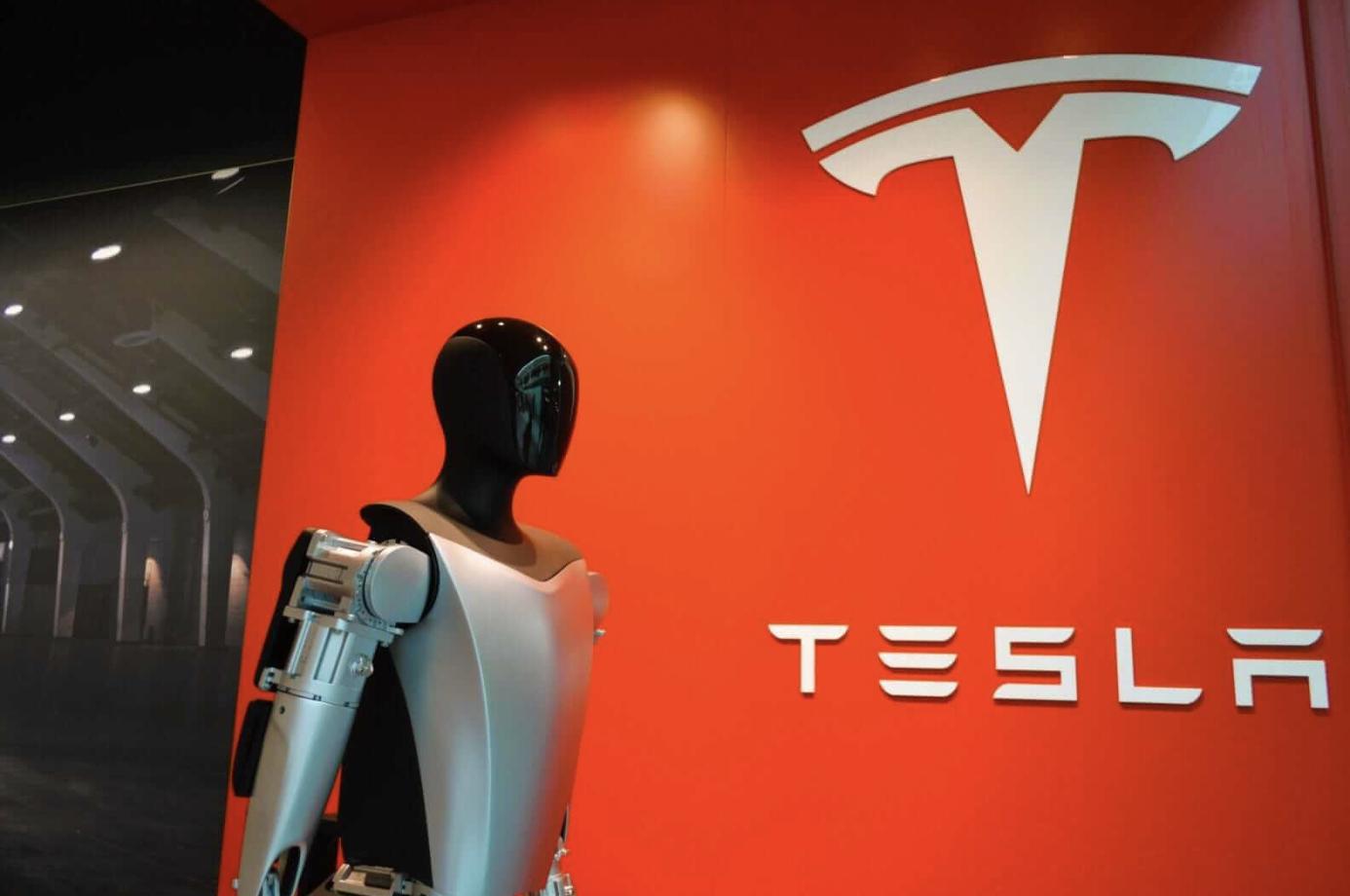
Tesla's investments in Optimus and custom AI hardware demonstrate an ambition extending far beyond automobiles. Optimus targets manufacturing and logistics environments where repetitive, physically demanding tasks remain difficult to automate. Rather than relying entirely on external suppliers, Tesla is building critical manufacturing capabilities internally while developing the production systems needed to scale humanoid robotics.
Optimus learns through demonstrations, factory worker data, internet video, and end-to-end AI training, allowing robots to adapt to complex real-world environments instead of relying on manually programmed movements. This learning-based approach could significantly expand the range of commercially viable robotic applications over time.
Tesla is also investing heavily in semiconductor development covering chip design, packaging, testing, and manufacturing capabilities. AI-powered vehicles, humanoid robots, and autonomous mobility all require enormous computing resources, making secure access to advanced chips a strategic priority. By strengthening its control over critical AI infrastructure, Tesla aims to reduce one of its most important long-term scaling risks while building technological independence.
Tesla expects capital expenditures to exceed $25 billion in 2026, with additional increases anticipated in subsequent years. These investments span Robotaxi infrastructure, Optimus manufacturing, AI computing capacity, semiconductor development, and factory expansion. Such spending reflects management's conviction that autonomy, robotics, AI infrastructure, and electrification will define the next generation of industrial leadership.
Large-scale investment programs also create substantial barriers to entry. Few competitors possess the financial resources to invest simultaneously across automotive manufacturing, robotics, AI hardware, autonomous transportation, and energy infrastructure. While this level of capital intensity pressures near-term profitability, it may also create durable competitive advantages if execution remains strong.
For investors, the central question is whether today's investment program will produce tomorrow's leadership in autonomy, robotics, and AI infrastructure. Tesla is deliberately sacrificing short-term financial efficiency in pursuit of long-term strategic positioning, betting that early investment and industrial scale will become durable competitive advantages as these markets mature.
 MarketBeat