Hadrian’s Lockheed Deal Signals a New Era in Defense Manufacturing Automation
– 5 min read
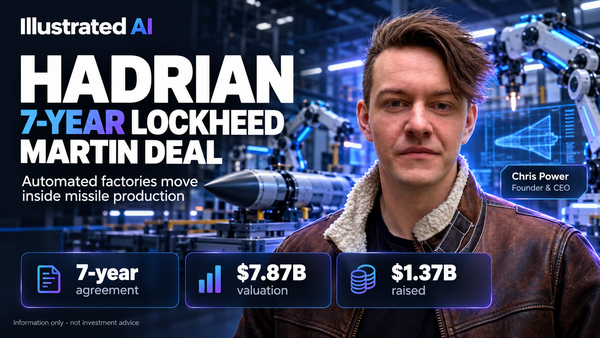
Hadrian announced a seven-year agreement with Lockheed Martin on 14 October 2026 to bring automated manufacturing capabilities into its Missiles and Fire Control facility in Grand Prairie, Texas. The agreement builds on a memorandum of understanding announced in December 2025 and combines Hadrian’s manufacturing capabilities, Opus software and factory network with Lockheed Martin’s production expertise.
Invest in top private AI companies before IPO, via a Swiss platform:
 SmartProfit Finder AG
Commissioning is planned to begin in early 2027, with manufacturing cells introduced over the agreement’s duration. The announcement establishes a deployment commitment rather than evidence that the new capacity is already producing parts.
Defense manufacturing is no longer judged only by who has the best designs. Industrial strength is now measured by who can actually build enough critical parts, fast enough, with dependable quality. The challenge is not merely designing a missile component. It is producing that part repeatedly, within tight tolerances, under pressure, and at a scale that supports real-world demand.
Hadrian focuses on highly automated precision manufacturing, aiming to transform production from a labor-heavy process into something more repeatable, data-driven, and scalable. The key shift is from supplier to embedded partner. Once automation tools and software are woven into a customer's workflow, the relationship deepens and credibility grows. Being trusted in a demanding environment says more than any presentation ever could.
There is a major difference between helping a customer from the outside and becoming part of their production engine. This agreement combines Hadrian's automated manufacturing capabilities, its Opus software platform, and its factory network with Lockheed Martin's production expertise. It is the joining of software, automation, process control, and industrial know-how into a more integrated system.
Manufacturing software can coordinate workflows, machine activity, inspection and performance monitoring. Automation could improve repeatability, but equipment wear, programming errors and process variation still require controls and maintenance. Lockheed Martin says its workforce will operate the planned 24-machine cell; that does not establish the partnership’s overall effect on employment or labour productivity.
Embedded automation could increase switching costs as training, software integrations and qualified production processes develop around a system. Whether this creates durable customer relationships will depend on performance, contract terms and alternatives. A manufacturing-data advantage would also depend on collection permissions, restrictions on reuse and measurable improvements across deployments.
The real prize is not theater. It is throughput: the unglamorous but critical ability to make more of what matters, with fewer delays, better consistency, and stronger economics. In strategic industries, throughput can decide who wins and who waits. Manufacturing capacity itself is becoming a strategic asset.
Machining sits at the foundation of countless complex systems. Precision parts must be cut, shaped, and finished to exact specifications. Slow production can delay entire programs, and a shortage of reliable machining capacity can ripple across supply chains in ways that are both expensive and strategically damaging. Software-guided automation could reduce variation and improve repeatability, provided processes are qualified, equipment is maintained and output meets required specifications.
What customers want is faster production that still meets exacting standards. That combination is difficult to deliver, which is why successful providers of advanced manufacturing solutions become so valuable. They are not merely offering acceleration. They are offering controlled acceleration. Throughput is measurable: either the factory produces more within the same constraints, or it does not. That discipline makes the business case concrete rather than speculative.
Hadrian raised $1.37 billion at a $7.87 billion valuation. The deeper question is why investors supported it so aggressively. Precision manufacturing for aerospace and defense sits inside vast industrial systems where the cost of delay is high and the need for reliability is constant. Investors are drawn to businesses that attack expensive, painful bottlenecks, and manufacturing bottlenecks qualify.
Industrial relationships, once established, tend to be deep and long-lasting. The seven-year term provides a period for deployment and evaluation, but does not by itself establish guaranteed revenue, funding runway or attractive returns. Automated manufacturing also increasingly looks like a necessity rather than a luxury. As demand grows in critical sectors and labor constraints persist, the pressure to modernize production becomes unavoidable.
High valuations are a vote of confidence but also a demand for proof. The true test will be whether Hadrian can convert capital into factories, software deployments, and customer outcomes that improve over time. Building industrial capacity is expensive, requiring physical infrastructure, equipment, and talent. Large funding rounds may therefore be a structural feature of the model rather than mere exuberance.
The most exciting part may not be what has already happened, but what could follow if the model works. One successful deployment is important. A repeatable deployment model is something much bigger. The first thing to watch is whether the initial machining-cell expands into a broader relationship, and whether additional major aerospace or defense customers adopt similar arrangements.
If Hadrian can become part of the operating layer of modern industrial production, its role could expand meaningfully. Software coordinates, automation executes, and networked capacity absorbs demand. Together, those elements can create a business that is more integrated and defensible than any single component alone. That is often how major industrial platforms are built: one successful workflow at a time, until the workflow becomes indispensable.
The wider economic backdrop supports the importance of this race. Supply chains are under scrutiny, domestic production capacity matters more, and strategic resilience is now discussed alongside efficiency. The future factory is unlikely to be simply larger. It will be smarter, more connected, and more capable of adapting to pressure. The stakes are practical: can critical parts be made faster, with more consistent quality, and at scale? If the answer is yes, automated manufacturing will not be a side story in modern industry. It will be one of the main stories.
The bottom line: Hadrian’s Lockheed Martin agreement provides a concrete customer commitment for embedded automated manufacturing, with commissioning planned for early 2027. Its financing supports expansion, but neither milestone establishes profitable production at scale. Investors should watch commissioning, qualification, accepted-part throughput, defect rates, uptime, contract economics and returns on deployed capital.