Modal’s AI Infrastructure Surge
– 3 min read
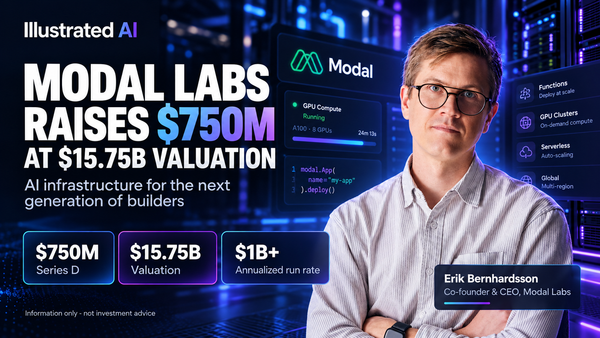
Modal announced a $750 million Series D on 14 October 2026 at a $15.75 billion post-money valuation. Accel led the round, with Kleiner Perkins and existing investors participating. The valuation is approximately 3.4 times the $4.65 billion established in May, reflecting negotiated investor expectations rather than independently demonstrated financial performance.
Invest in top private AI companies before IPO, via a Swiss platform:
 SmartProfit Finder AG
Every AI application needs computing power on demand. The new leaders in this space aren't merely renting chips—they're building the operating layer for AI execution, translating complexity into simplicity. As AI moves from experimentation to industrial usage, infrastructure becomes the backbone of the digital economy. In every gold rush, the people supplying the tools shape the era.
Fresh capital buys time, talent, and strategic freedom. It also raises the bar. A business priced for extraordinary success must eventually show extraordinary evidence. Big money doesn't settle the story—it makes the next chapter impossible to ignore.
The next wave of AI isn't just about systems that answer questions—it's about systems that perform tasks. Once AI starts acting, it needs a secure digital workspace. Execution platforms make computing programmable by letting developers run functions, scale applications, and spin up isolated sandbox environments without managing complex infrastructure manually.
Sandboxes provide isolated environments where agents can execute code. They can be provisioned rapidly and terminated after use, while logs, outputs and persistent storage depend on configuration and retention policies. Modal has published a company benchmark creating one million concurrent sandboxes in under a minute; that demonstrates reported test capacity rather than sustained production demand or guaranteed customer performance.
Modal reports that usage tripled in five months, its business grew more than 15-fold year-on-year and annualised revenue run rate exceeded $1 billion. It reports a $300 million run rate for Sandboxes and nearly three billion sandbox launches cumulatively. These are company-reported metrics. Annualised run rate extrapolates recent activity; it is not equivalent to recognised annual revenue or guaranteed future sales.
These figures indicate substantial reported activity and revenue momentum, but do not establish customer retention, concentration or profitability. Usage growth becomes more informative when accompanied by measurement definitions, paid production activity and margins after infrastructure costs.
Explosive growth doesn't guarantee durable economics. Infrastructure businesses live or die by unit economics—what remains after paying for cloud capacity, GPU resources, and support. Dependence on third-party compute creates vulnerability if providers change pricing or tighten capacity. Meanwhile, hyperscale cloud giants, specialist GPU operators, and agile software challengers are all competing for the same workloads.
The critical checkpoints are measurable: recognized revenue, gross margins, customer concentration, and retention. Do customers keep spending more once experimentation matures into production? Can Modal grow its existing training and post-training offerings while maintaining reliable service and sustainable margins? Great stories attract capital.
The bottom line: Modal’s financing and company-reported growth indicate strong investor interest and commercial momentum. They do not establish sustainable profitability. Investors should watch recognised revenue, gross margins, customer concentration, retention, compute-supply terms and performance under sustained production workloads.