ICON’s $200M Bet on 3D-Printed Homebuilding Scale
– 5 min read
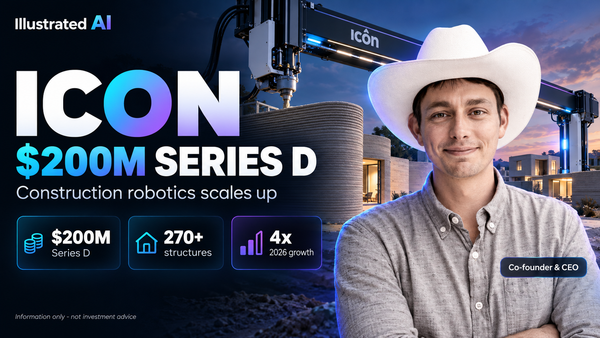
CON announced a $200 million Series D on 13 October 2026, co-led by Baillie Gifford and funds managed by BlackRock. The company says the financing will support manufacturing and deployment of its robotic construction systems, research facilities and expansion into additional US markets.
Invest in top private AI companies before IPO, via a Swiss platform:
 SmartProfit Finder AG
ICON is expanding its technology offering through Titan, an integrated construction system that outside builders can acquire. This adds equipment and supporting services to its business model; ICON continues to operate its own Build division. The opportunity is to make its technology repeatable across customer projects, although successful third-party operation remains an important commercial test.
ICON launched the Titan programme in March 2026, opening reservations and anticipating first system deliveries in early 2027. Reservations and a commercial launch should not be treated as completed customer deliveries or proven operation at scale.
A platform business has the chance to be broader and more scalable. Revenue no longer depends only on one-off projects. It can expand through equipment sales, recurring material purchases, software services, maintenance, and training.
Building something impressive in-house proves technical capability. Enabling customers to operate it successfully proves commercial potential. Those are very different tests. Outside builders will not adopt a system merely because it looks innovative. They will adopt it if it helps them finish projects faster, manage labor constraints, and make money.
Capital is a signal. A $200 million funding round in construction robotics suggests this is no longer a small experiment. The capital targets expanding manufacturing, increasing research capacity, and moving into new markets. These are stated expansion objectives. The financing does not independently establish manufacturing readiness, profitability or funding runway.
Hardware businesses are especially capital-hungry. Unlike pure software ventures, they must build machines, manage inventory, support field operations, and maintain supply chains. Deep funding can be a strategic weapon. Early capital pays for invention. Later capital pays for repetition. Repetition proves something can be done reliably, economically, and at scale.
Bigger rounds raise expectations. Markets ask harder questions: How quickly can manufacturing scale? What portion of revenue comes from machine sales versus materials and services? Construction adds difficulty. Building is local, regulated, and full of variables no spreadsheet can completely tame.
Housing is one of the largest and most stubborn markets in the economy. If a company can lower timelines and reduce parts of the cost structure credibly, the prize is enormous. The money is real. The opportunity is big. The hard part starts now.
The real value is not in the machine alone. The deeper story is the system around it. The construction system combines robotics, proprietary printable material, software, design tools, and operational support. A robot that can print a wall is interesting. A full stack that helps turn digital designs into physical structures with a consistent workflow is far more important.
A vertically integrated robotic system reduces fragmentation. Design begins in digital form. Software translates it into machine instructions. The robotic system executes a defined part of the build. Proprietary materials are formulated to work with the machine. Tighter integration could improve consistency, provided materials, software and equipment perform reliably under varying site conditions.
ICON’s March Titan announcement targeted wall-system costs around $20 per square foot, potentially 40% below industry-reported conventional wall-system averages. Its October financing announcement also described a six-week construction-time reduction and lower costs. These are company engineering targets and internal projections, rather than independently verified outcomes across customer projects. Wall-system savings should not be presented as equivalent to whole-home savings.
Construction has historically lagged other industries in productivity gains. That creates an opening for technology that can standardize tasks once dependent on manual variability. The machine is the muscle, but software acts as the nervous system. Integrated hardware, materials, software and deployment experience could create barriers to entry, but a durable advantage will depend on customer results, service costs and available alternatives.
Can ordinary customers use the technology repeatedly, safely, and profitably without the inventors standing beside them? That is the real commercial exam. Construction is messy, local, and full of moving parts. Soil conditions, weather, labor availability, building codes, and permit pathways all vary. A robotic system must do more than impress. It must fit.
A builder considering adoption asks practical questions first: How long does installation take? What happens if the machine fails on site? How quickly can service teams respond? These are the real gates to adoption. A category only scales when the supporting system becomes dependable enough for mainstream users.
If third-party builders succeed, the technology begins to look like a true platform. If they struggle, the business risks being seen as a specialist capability that only works under close internal control. That distinction shapes everything from growth rates to margin potential.
The market will look less at polished renderings and more at actual operating data. How many systems have been delivered? Are customers placing repeat orders? How do total project timelines compare with traditional methods? Operational discipline turns vision into value.
Investors get paid when bold technology turns into durable economics. The first important signal is delivery. Actual systems shipped and used on paying projects. Repeat orders are even more revealing. A second order suggests the economics were strong enough to justify doing it again.
Independent cost and time measurement matters. How much time is truly saved from start to finish? How does the full cost compare once permitting, finishing work, and site conditions are included? Broad claims can hide narrow improvements.
Revenue mix is a vital clue. If machine sales lead to recurring demand for materials and services, the platform thesis strengthens. Investors are not only asking whether the company can sell the printer. They are asking whether the printer becomes the start of a lasting commercial relationship.
The most sophisticated investors will watch concrete signals: systems delivered, systems operating, customers returning, real-world cost outcomes, and revenue composition. Those data points separate a captivating story from a compounding business.
The bottom line: ICON’s $200 million Series D supports its expansion into supplying robotic construction systems to builders. Titan’s integrated offering could generate equipment, material and service revenue, but the reviewed disclosures do not establish third-party deployment performance or profitable recurring economics. Investors should watch deliveries, repeat purchases, independently measured project costs and timelines, revenue mix and margins after manufacturing and field-support costs.