AI Drug Discovery Partnership: insitro and AstraZeneca’s $1.5B Bet
– 6 min read
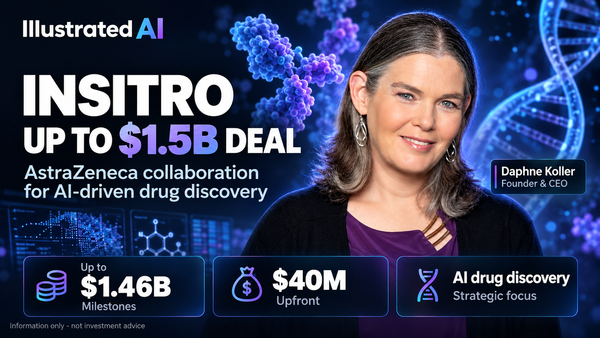
Insitro announced a discovery collaboration with AstraZeneca on 15 October 2026 covering metabolic dysfunction-associated steatohepatitis (MASH) and cardiomyopathies. The agreement provides for $40 million upfront and up to approximately $1.46 billion in contingent milestones, plus royalties.
Invest in top private AI companies before IPO, via a Swiss platform:
 SmartProfit Finder AG
The approximately $1.5 billion headline is a maximum potential payment total before royalties, rather than funding already received or guaranteed revenue. The announcement does not confirm receipt of the upfront payment.
For investors, this is where the story becomes genuinely important. Large pharmaceutical companies are willing to test advanced AI platforms with real commercial commitments—more meaningful than buzzwords or conference presentations. The diseases targeted raise the stakes further: MASH, a serious liver disease linked to fat buildup and scarring, and cardiomyopathies, conditions that damage the heart muscle. Both represent enormous unmet medical need and substantial commercial opportunity.
Insitro will apply Virtual Human to investigate disease biology and advance AstraZeneca-nominated targets through development-candidate selection. AstraZeneca will lead clinical development, regulatory work and commercialisation.
Drug development often fails not because scientists cannot make a molecule, but because they begin with the wrong target. If AI can reduce that mistake rate even modestly, the economic consequences could be transformative—better decisions at the start could save years and billions at the end. The upfront payment marks the moment a large buyer judged the platform useful enough to commit actual capital. The milestone-heavy structure keeps everyone honest: show the science works, and the economics will grow.
The bold promise behind this platform is simple to state and incredibly hard to achieve: tell the difference between what merely accompanies disease and what actually drives it. A symptom may travel with an illness without causing it. Building a drug on a weak biological link is like fixing the wrong part of a machine.
The company's Virtual Human platform addresses this by combining three ingredients: genetically anchored human data, cellular experiments, and machine learning. Human genetic data can help prioritise biological pathways and support causal hypotheses, but findings require experimental validation and do not establish that modifying a target will safely benefit patients. Cellular experiments test those clues in controlled settings. Machine learning sifts through complexity, finding patterns too tangled for traditional methods. The platform also includes TherML, designed to help engineer therapeutic molecules against identified targets—connecting the right biological door to the right key.
The economic logic is compelling. Pharmaceutical research is full of expensive dead ends. Scientists may spend years pursuing targets that looked promising but never meaningfully influenced human disease. If an AI platform reduces those false starts, it changes the cost structure of innovation entirely—fewer wasted programs mean more resources for better ones.
Yet the promise carries an important caveat. Better models do not automatically produce successful medicines. Biology is staggeringly complex, and disease mechanisms behave differently across tissues, patient groups, and illness stages. A platform may improve target selection odds while still falling short in real-world development. Until patients in trials show better outcomes, the technology remains promising rather than proven.
Still, the proposition deserves serious attention. Faster screening is useful. Better causal reasoning could be transformative. If causal biology can be mapped more accurately at the beginning, the entire drug pipeline may become smarter—shifting discovery from informed guesswork toward something genuinely more precise.
How a deal is structured reveals more than how it is advertised. The approximately $1.5 billion maximum is 37.5 times the agreed $40 million upfront payment, which represents about 2.7% of that total. Almost all the value sits in contingent milestones that arrive only if specified research, development, regulatory, and commercial events occur. This is not a treasure chest waiting to be opened; it is a map of optionality showing how much value could be created if many difficult things go right over many years.
The structure protects the pharmaceutical partner from overpaying early while preserving upside for the AI company if its science proves powerful. Risk is being shared rather than ignored. The deal also includes potential single-digit royalties on sales, giving the originating company long-duration exposure to post-approval commercial success—though royalties too depend on clearing many hurdles first.
For investors, this offers a valuable lesson in reading biotech announcements. The first question should not be "How large is the total?" but "How much is real now, and what must happen next?" A milestone-heavy agreement can still be very positive—it often signals that a large partner sees genuine promise while staying disciplined about uncertainty. That is commercial optimism with scientific brakes attached.
The economics are exciting precisely because they are conditional. This is not a lottery ticket disguised as certainty. It is a staged test of whether advanced biology plus advanced computation can create drugs worth developing. The headline billions show the size of the prize. The agreed upfront payment establishes a commercial commitment; it does not quantify scientific validation, clinical efficacy or the probability of future milestone payments. Everything between is the long, difficult journey from promising platform to tangible results.
Founded in 2018, the company set out not merely to sell software but to build an integrated engine for discovery and therapeutic design—aiming to become a central player in creating new medicines, not just supporting research around the edges.
By 2026 the picture had become much richer: the TherML platform launched, ALS-related target nominations were reported through a Bristol Myers Squibb collaboration, predictive models became available through Lilly TuneLab, and now the AstraZeneca cardiometabolic partnership has arrived. The BMS target nominations and availability of jointly developed models through Lilly TuneLab demonstrate additional partnership milestones. They do not independently establish broad clinical utility or improved drug-development success rates.
Insitro reports more than $750 million in capital and a pipeline of nine programmes. Combining partnerships with an internal pipeline could provide multiple sources of future value, but internal development also requires substantial spending. These figures do not establish available cash, funding runway or profitability.
There is also a meaningful storytelling shift underway. Early-stage technology companies begin with a vision; over time they must demonstrate the vision can become a business. This company is moving from being perceived as an AI concept to being judged as a pipeline-enabling organization. The market will increasingly ask whether targets are nominated, candidates emerge, trials begin, and outcomes improve. The AstraZeneca deal does not complete that transition, but it substantially strengthens the bridge.
Every important deal sends signals beyond the two companies involved. This one addresses a larger question: what kind of AI creates durable value in healthcare? The partnership suggests large drugmakers may pay not just for faster molecule screening, but for better biological understanding. Direction matters more than speed. If an AI platform points researchers toward targets more likely to matter in human disease, it improves the quality of research spending—not merely its pace.
The financial leverage is significant. Pharmaceuticals are shaped by attrition—huge sums invested in programs that never become products. Small improvements in target selection can have enormous impact throughout the entire development chain. Better early choices may mean fewer wasted experiments, fewer doomed candidates, and ultimately better returns on research budgets.
At the same time, investors should not read this as a declaration of victory. Drug discovery remains long-cycle and failure-prone. Clinical trials are unforgiving. Human biology still surprises even the best teams. Competition is fierce across data advantage, target validation, chemistry, clinical execution, and economics ownership. Winners will likely be those connecting computational strength to experimentally testable biological truth—and carrying that truth far enough into development to matter commercially.
The most important future signals are concrete: target nominations producing development candidates; disclosed milestone receipts rather than headline maximums; internal programs entering human trials; repeated agreements with differentiated pharmaceutical partners; and measurable evidence that the platform improves prediction or success rates. These markers distinguish platforms that change the economics of drug discovery from those that merely decorate existing processes.
The bottom line: insitro’s AstraZeneca collaboration provides an agreed upfront payment and substantial conditional upside. It demonstrates pharmaceutical interest in the platform, rather than proven clinical or financial outcomes. Investors should watch development-candidate selection, milestone receipts, clinical progress, independently evaluated predictions and cash consumption. The central test is whether the platform produces safe, effective medicines with attractive development economics.