Stripe’s OpenRouter Bid Signals an AI Infrastructure Gold Rush
– 5 min read
Every major technology boom creates opportunities not only for the products attracting the most attention, but also for the businesses that make the broader ecosystem easier to use. In AI, one of the most valuable emerging positions may lie not in building a single model, but in creating the layer that helps businesses move efficiently between many competing models.
Invest in top private AI companies before IPO, via a Swiss platform:
 SmartProfit Finder AG
The modern AI market looks exciting from the outside but fragmented from within. Many powerful models exist, each with different strengths, prices, and reliability levels. Managing several providers simultaneously creates a real operational burden, and that fragmentation creates an opening for companies that simplify access and coordination.
An AI routing and marketplace layer can direct requests toward the most appropriate model based on cost, performance, or availability. If one provider experiences an outage, workloads can move elsewhere. If pricing changes, businesses can adjust usage without rebuilding their applications. Developers avoid creating new integrations every time the competitive landscape shifts.
As AI models multiply, the need for orchestration increases. Payment networks simplified financial transactions, while cloud platforms reduced the technical burden of accessing computing resources. In AI, routing layers may perform a similar function by helping businesses manage model selection, cost, and reliability while gaining insight into demand patterns across the ecosystem.
The more deeply developers integrate these services into production workflows, the more durable those relationships can become. Over time, routing platforms may evolve into important operating layers that support model access, billing, optimization, and reliability across increasingly complex AI environments.
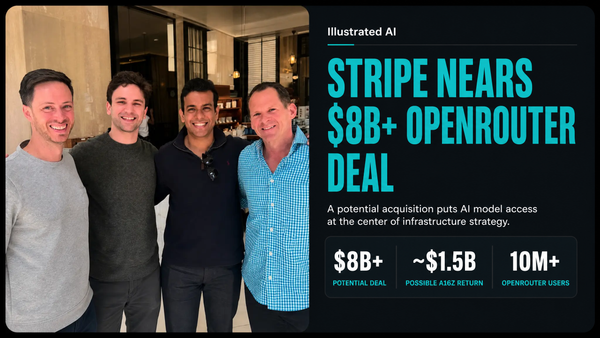
In AI, a business can move from early-stage startup to multibillion-dollar strategic target remarkably quickly. Large companies may value such businesses not only for current revenue, but for the strategic position they could occupy as the market matures.
Platform businesses are often evaluated differently from conventional software companies. The central question is not simply how much revenue exists today, but how embedded the platform could become if customer adoption continues expanding. If developers begin building applications around a common routing layer, technical habits, standards, and operational dependencies can develop around it.
Timing also matters. If AI becomes as central to enterprise software as cloud computing, owning an important orchestration layer could carry significant strategic value. Acquiring that position early may be more attractive than allowing a competitor to establish control or attempting to recreate years of integrations and customer relationships internally.
A startup positioned between rapidly growing demand and a fragmented supply of models can therefore gain value faster than traditional valuation methods might suggest. Investors are not simply pricing growth; they are pricing strategic positioning within an expanding ecosystem.
Payments and AI routing may appear unrelated, but both depend on trust, reliability, coordination, and developer-friendly infrastructure. Stripe built its business by simplifying fragmented payment systems through APIs, billing tools, subscriptions, and usage-based pricing. AI is creating similar challenges as businesses manage multiple providers, different pricing models, variable performance, and large volumes of metered usage.
The economic overlap is especially clear in billing and cost control. As companies embed AI into products and workflows, monitoring spending becomes increasingly important. A platform that helps optimize model usage while managing billing and operational reliability provides measurable value that can support recurring customer relationships.
Owning an orchestration layer could also give Stripe broader visibility into how customers use AI, which models gain adoption, and where demand is shifting. That information could support new products, partnerships, and financial tools without requiring Stripe to bet on a single model provider.
The opportunity is significant, but competition remains an important risk. Hyperscalers and vertically integrated AI companies have strong incentives to keep customers inside their own ecosystems, potentially limiting the role of independent routing services. Long-term success will therefore depend on whether neutral platforms can continue delivering enough flexibility and economic value to justify their position between customers and model providers.
Large venture outcomes matter because a small number of investments typically generate a disproportionate share of returns. When a potential exit implies gains measured in hundreds of millions or billions, it can also reshape investor attention by showing where strategic value is beginning to concentrate.
In AI, strong valuations for orchestration businesses may encourage more capital to flow toward model management, monitoring, optimization, security, and middleware. Investors tend to search for recurring patterns: which bottlenecks are becoming essential, where integration costs are rising, and which companies are simplifying problems that every enterprise must eventually solve.
For founders and engineers, these outcomes can also influence where talent moves. A successful infrastructure company demonstrates that durable value may emerge not only from building frontier models, but also from organizing how those models are accessed, evaluated, and deployed.
As a category matures, strategic acquisition interest becomes a useful signal of where buyers believe long-term control points are forming. The broader implication is that the orchestration layer of AI is gaining economic significance alongside the models themselves.
A more useful investment question than asking which AI product will dominate may be asking which layers become increasingly necessary as the entire market expands. That question increasingly points toward services that help businesses connect to, manage, monitor, and optimize multiple AI models.
As enterprise adoption broadens, reliability, cost control, flexibility, governance, and security become more important. Companies solving these problems at scale can establish themselves as important enabling layers rather than simply participating in a short-term technology trend.
Fragmentation creates opportunity because greater model choice increases the need for coordination. A control-layer business can benefit from overall AI usage regardless of which individual model is currently leading the market, although competitive pressure from large integrated providers remains a meaningful risk.
Previous technology cycles show that durable value often accumulates around companies that simplify access to essential technologies. In AI, long-term value may increasingly concentrate in the platforms coordinating model access, optimization, billing, and operational control. If that pattern continues, the companies organizing intelligence may become just as strategically important as those building the models themselves.