Stripe’s OpenRouter Acquisition Signals AI Infrastructure as Financial Infrastructure
– 3 min read
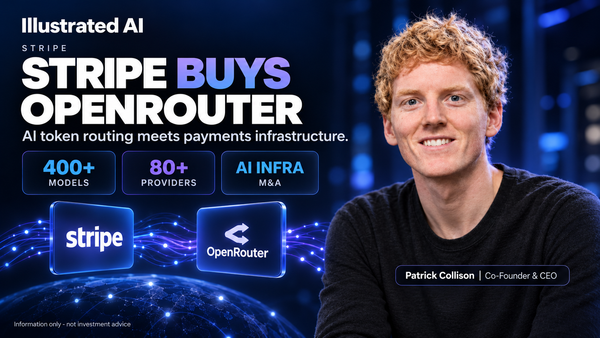
Stripe has agreed to acquire OpenRouter, an AI model gateway that helps businesses route and optimize token usage across more than 400 models from over 80 providers. The transaction extends Stripe beyond payments and usage-based billing into the infrastructure that determines how companies access AI models, balance cost against performance and manage variable computing expenses.
Invest in top private AI companies before IPO, via a Swiss platform:
 SmartProfit Finder AG
AI tokens are not currency in the conventional financial sense. They are units used to measure model input and output, and they increasingly function as a basis for calculating AI usage costs. As businesses embed AI into software and automated workflows, those costs become a measurable operating expense that must be tracked, optimized and billed. Stripe’s move suggests that the economic infrastructure surrounding AI usage may become an important platform category.
A router acts like an intelligent traffic controller for AI requests, directing each task to a suitable available model based on factors such as cost, speed, quality and reliability. As the AI market fragments, this orchestration becomes increasingly valuable. No single model is perfect for every job, and businesses want flexibility — not vendor lock-in.
Every routing decision can affect operating costs and product performance. Using an expensive model for simple tasks burns money; using a weak model for critical work damages customer experience. A smart router balances those trade-offs dynamically, becoming a margin-management system. For investors, companies operating at this critical junction may gain valuable usage insights and strategic importance. However, their pricing power will depend on competition, customer concentration and the availability of alternative routing platforms. Over time, routing providers may also expand into billing, analytics and governance.
Payments and AI routing share the same core logic: both are infrastructure that becomes more valuable by reducing friction. Modern commerce exploded when payments became programmable. The next leap comes from making intelligence programmable the same way — metering usage, managing cost, and monetizing outcomes.
AI is shifting software from fixed-cost to variable-cost logic. Each query carries a live compute expense, making economics more dynamic and exposed to usage fluctuations. A platform already trusted to manage money is well positioned to manage the economics of intelligence. Integration across revenue collection, token optimization and operational decision-making may increase switching costs, support customer retention and create additional revenue opportunities.
Stripe did not disclose the financial terms of its agreement to acquire OpenRouter. Any reported purchase price should therefore be attributed to the publication reporting it rather than presented as a confirmed company figure.
Even without disclosed terms, the transaction demonstrates the strategic interest surrounding AI-routing infrastructure. Companies positioned between applications and model providers can help customers manage cost, reliability and model selection across a fragmented market. Their long-term value will depend on usage growth, customer retention, routing performance and the ability to monetize services without compromising platform neutrality.
For investors, the important question is not simply which company offers the most visible product. It is which platform occupies a strategically important position, demonstrates durable customer demand and can convert growing AI usage into sustainable economics.
Whoever controls the model routing gateway influences how demand flows, shapes preferences, steers traffic, and collects valuable market data. But that power raises a critical question: neutrality. Businesses want routing decisions based on their interests, not the owner's agenda. A neutral router provides optionality — the ability to adapt as models, prices, and performance shift rapidly.
The gateway could evolve beyond model selection into an operating console for enterprise AI, adding budgeting tools, governance controls, security features, and automated optimization. This is how technology markets mature — innovation first creates the core capability, then commercial attention shifts toward orchestration and economics. Competition is no longer focused only on who builds intelligence. It is about who routes it, meters it, monetizes it, and governs it. The gateway may look invisible. In practice, it may become one of the most strategically important layers of the enterprise AI stack.