EUCLYD’s €200M Bet on AI Inference Infrastructure
– 5 min read
AI infrastructure investment is expanding from model training toward the recurring cost of inference. Training advanced models remains highly capital-intensive, but inference determines how economically those models can serve customers at scale.
Invest in top private AI companies before IPO, via a Swiss platform:
 SmartProfit Finder AG
Inference is the process through which a trained model generates answers, content or actions. As AI usage expands across enterprise software, consumer products and industrial systems, businesses must serve requests continuously, reliably and at manageable cost.
Training typically requires large, concentrated investment and may continue through fine-tuning and model updates. Inference creates recurring operating costs that rise with usage. Every generated token requires computing resources, making cost per token, energy consumption, latency and system capacity important commercial metrics.
The central question is no longer only whether a model can perform a task, but whether that capability can be delivered economically at scale. Companies addressing compute, memory and energy constraints are targeting an increasingly important part of the AI value chain.
EUCLYD is pursuing a broader infrastructure approach than companies focused only on models or individual chips. It is redesigning the entire infrastructure stack — from silicon through memory to rack-scale systems — treating AI performance as a systems problem, not a single-chip problem.
The analogy is simple: a world-class kitchen fails if ingredients arrive late, ovens are undersized, and serving staff cannot keep pace. Every piece must move in sync. EUCLYD is trying to redesign the entire kitchen for AI.
At the centre of EUCLYD’s roadmap are craftwerk, which the company describes as agentic-AI silicon, and CWS 32, a planned exascale AI system. EUCLYD says its platform combines programmable ASIC compute, processor-memory co-design and system-level optimization to address memory, energy and scalability constraints. These remain company-stated objectives that will require validation through working silicon, independent benchmarks and customer deployments.
Headquartered in Eindhoven, EUCLYD is drawing on the Netherlands’ established semiconductor and systems-engineering ecosystem while targeting global enterprise and hyperscale AI markets.
Hardware is unforgiving. Real proof requires tape-out, fabrication, yield, software integration, and customer deployment. Semiconductor history is full of revolutionary concepts that stumbled under manufacturing realities. EUCLYD is targeting material improvements in AI infrastructure economics rather than an incremental performance gain. If successful, its architecture could become relevant to the infrastructure requirements of large-scale inference.
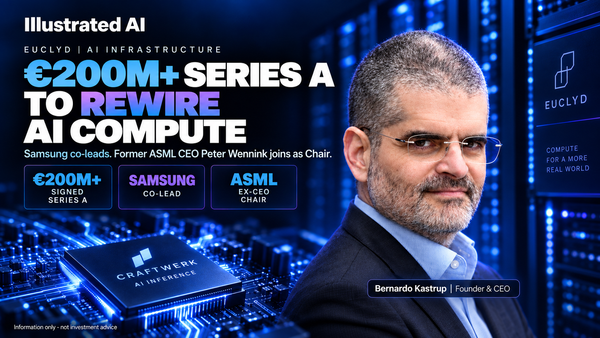
EUCLYD says it has signed a Series A financing round of more than €200 million. The round is co-led by Samsung, Somerset Capital Partners, the Scaleup Europe Fund managed by EQT, and Innovation Industries. Additional participants include EIFO, imec.xpand, Brabant Development Agency and Quadri. Peter Wennink, the former president and CEO of ASML, has joined EUCLYD as chairman.
Hardware development demands large capital long before revenues appear. When serious money arrives this early, it signals that the problem being solved is urgent and valuable enough to justify the risk. Investors appear to be asking a practical question: if AI usage keeps growing, what happens when hardware becomes the bottleneck? The answer is that the bottleneck itself becomes the investment opportunity.
The investor composition adds significance. Samsung’s participation as a co-lead investor adds semiconductor-industry relevance, although EUCLYD has not announced a manufacturing, supply or commercial partnership with Samsung as part of the financing disclosure.
This round also reflects a broader market shift. Investor capital is moving deeper into the AI infrastructure stack, including semiconductor, memory and datacentre-system development. In technology revolutions, infrastructure providers often quietly build long-term power while flashy early winners capture imagination. Railroads, the internet, cloud computing — the most durable value frequently came from the systems enabling applications, not just the applications themselves.
The message behind the money is simple: AI's future depends on lowering the cost of using intelligence at scale, not merely inventing it.
AI looks effortless on the surface. Behind it is physical infrastructure: processors performing calculations, memory supplying data, electricity being consumed and heat being generated. These are among the industry’s most important engineering and economic constraints.
AI inference is not limited by raw compute alone. A processor can be incredibly powerful, but if it waits for data, its potential is wasted. Modern AI models are hungry for enormous parameter volumes — like owning a race car forced to drive through a narrow alley. Faster, more efficient memory systems improve throughput, reduce latency, and cut energy waste. At scale, those gains decide whether an AI service is profitable or practical.
Energy efficiency is another important constraint. Every AI response consumes energy. Multiplied by millions of users, the power bill becomes strategic. Lower power per token means lower operating expenses, better sustainability, and improved competitiveness — especially as electricity availability itself becomes a limiting factor.
Physical footprint matters too. More useful inference within the same datacenter space increases economic productivity and influences margins, deployment speed, and total service capacity.
The broader market is already diversifying beyond general-purpose GPUs. Hyperscalers are building custom accelerators. Startups are targeting inference-specific chips. The shift is clear: AI is too important and demanding to rely on one-size-fits-all infrastructure. The next phase rewards companies that orchestrate compute, memory, and datacenter design more intelligently — potentially creating competitive advantages through system-level optimization rather than relying solely on additional computing capacity.
Big ideas create excitement. Real milestones create confidence. In deep-tech infrastructure, the distance between concept and commercial success can be vast. The next chapter depends on whether technical ambition survives contact with manufacturing and market reality.
Silicon progress is the first checkpoint. Tape-out and first working chips mark the transition from design claims to physical reality — revealing whether performance targets hold under real conditions of yield, thermals, and power efficiency.
Independent benchmarking matters more than company-stated targets. Inference economics is a measurable contest. Material reductions in cost per token or power per token must be shown, not promised.
Customer adoption—including named design wins, pilot programmes and production deployments—would provide evidence that buyers are prepared to test or adopt the technology for real workloads. Enterprise customers are demanding; early commercial traction is therefore highly meaningful.
Software ecosystem readiness is perhaps the most underestimated variable. A great chip fails commercially if developers find it painful to use. Compatibility with mainstream frameworks and deployment pipelines is non-negotiable, especially as AI evolves toward complex agentic workloads.
Capital efficiency also matters. More than €200 million provides substantial development capital, but semiconductor and systems companies can consume cash rapidly.
Investors should think in layers of proof: technical feasibility, then manufacturability, then software usability, then customer validation, then commercial scaling. Weakness in any layer can undermine the thesis.
The right posture is alert curiosity backed by clear evidence criteria — neither blind enthusiasm nor reflexive doubt. Watch the silicon. Watch the benchmarks. Watch the customers. Watch the software. Watch the cash burn.
The bottom line: EUCLYD’s financing reflects substantial investor interest in reducing the cost and energy intensity of AI inference. The decisive evidence will come from working silicon, independent benchmarks, software compatibility, manufacturing progress and customer deployments. Until those milestones are demonstrated, EUCLYD should be assessed as a well-financed but early-stage infrastructure company pursuing an ambitious technical roadmap.