Apptronik’s Humanoid Robots Move Toward Industrial Scale
– 4 min read
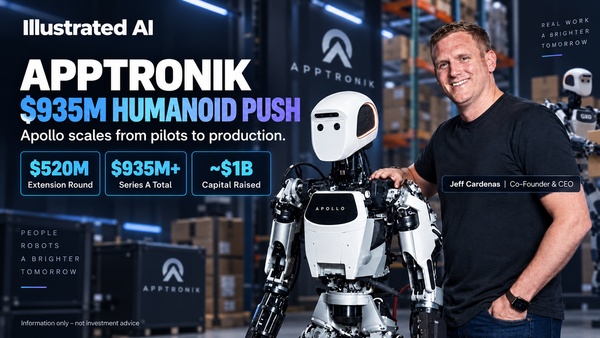
Apptronik’s Series A financing has grown to more than $935 million, bringing its total capital raised to nearly $1 billion. The funding comprises an oversubscribed $415 million initial Series A announced in 2025 and a $520 million Series A-X extension announced in February 2026.
Invest in top private AI companies before IPO, via a Swiss platform:
 SmartProfit Finder AG
The structure of the financing reinforces this signal. Apptronik said the extension was completed at three times the valuation multiple of the initial Series A. Because the company did not disclose a dollar valuation, the financing demonstrates stronger investor pricing but does not establish Apptronik’s precise market value. The higher pricing indicates stronger investor confidence, although the commercial evidence supporting that confidence will ultimately need to appear in deployments, customer orders and revenue.
The real test has always been whether a humanoid robot can leave the laboratory, show up at a factory or warehouse, and perform useful work day after day. Apptronik is beginning to test that proposition through partnerships, pilot programmes and deployment initiatives. Investors are backing the possibility that these programmes can develop into repeatable commercial adoption. They are increasingly paying for the possibility of a company building a scalable robotics platform for industrial tasks designed around human environments.
Apollo's mission is simple to describe and incredibly difficult to achieve: build a machine that works in human environments, handles repetitive physical tasks, and operates alongside people in warehouses and factories.
The strategic insight behind this design is significant. Rather than asking businesses to rebuild facilities around robots, Apollo’s humanoid form is designed to operate in spaces and with tools already built for people. Warehouses have aisles sized for human movement. Factories use equipment designed with human bodies in mind. A humanoid robot slots into those environments far more naturally than a purpose-built machine with a completely different shape.
Traditional automation excels in controlled settings where identical objects arrive at identical angles. Real industrial environments are messier. Objects vary, conditions shift, people move, tasks change. A humanoid robot promises adaptable flexibility, often more valuable than perfect efficiency on a single narrow task. A robot that augments a workforce can be transformative without eliminating every human role. It only needs to reduce friction in enough high-cost processes to create enormous value.
If Apollo succeeds, the breakthrough will not feel futuristic. It will feel useful. And in industry, useful is what changes everything.
Partnerships with Mercedes-Benz, GXO Logistics and Jabil give Apptronik access to real industrial environments in which Apollo can be tested against operational requirements. These relationships are meaningful validation opportunities, but they should not yet be treated as evidence of scaled fleet orders or recurring revenue unless Apptronik discloses those results. A humanoid robot functioning in those settings says far more than any stage demonstration.
The critical commercial loop investors are watching: a robot gets deployed, does useful work, improves over time, earns broader customer trust, and leads to larger fleet orders. Without that sequence, a robotics company may attract headlines but struggle to justify its valuation. With it, the company builds a repeatable model that can scale across sites, customers, and industries.
Real deployments also generate irreplaceable learning. Varied floor surfaces, lighting conditions, packaging shapes, and workflow interruptions reveal weaknesses and improvement paths no test environment can simulate. Commercial deployment is not just about revenue. It is learning at the point of use.
In robotics, technical capability becomes commercially meaningful when customers can measure improvements in productivity, reliability, safety and operating cost.
The most powerful part of Apptronik's story may not be Apollo's hardware or its funding. It may be the data engine behind it. Data collected from Apollo’s operation in controlled facilities and partner environments can be used to refine software, improve decision-making and strengthen the robot’s understanding of physical tasks.
This creates a flywheel. More deployments could generate additional operational data where customer permissions and technical arrangements allow. Better data may improve performance, which could support stronger customer adoption and further deployments. If that loop spins fast enough, it becomes a powerful competitive moat that newcomers cannot easily replicate.
Apptronik has presented Apollo 2 as a data-collection platform whose operational experience is intended to inform Apollo 3, its planned next-generation commercial platform. Although scaled commercial purchases have not been disclosed, participating customers and partners are helping Apptronik test and refine its broader embodied-intelligence system.
In embodied AI, data is not a side benefit. It is the machine behind the machine.
Apptronik's investor syndicate tells a layered story. Continued support from B Capital, Google, and Mercedes-Benz signals sustained conviction, while new participants including AT&T Ventures, John Deere, and Qatar Investment Authority add industrial reach and fresh credibility. Strategic investors contribute more than capital. They offer deployment environments, supply-chain knowledge, and pathways to accelerated commercialization.
The partnership with Google DeepMind reinforces the core thesis: humanoid robotics breakthroughs will emerge from combining physical engineering with advanced learning systems. A robot that moves beautifully but lacks adaptive intelligence fails in real environments. Brilliant AI without a body cannot navigate a warehouse.
The sector is attracting substantial capital because its potential market is large. Funding provides development capacity, but commercial success will depend on manufacturing, reliability, safety, deployment economics and the ability to convert prototypes into reliable fleets that deliver measurable value for customers.
For investors, five signals matter most: deployment growth, customer breadth, learning speed, product evolution from Apollo 2 to Apollo 3, and revenue quality moving toward recurring economics. These translate excitement into business reality.
Industrial humanoid robotics combines potential near-term applications with a much larger long-term market opportunity. The sector remains capital-intensive and technically uncertain, making deployment growth, reliability, manufacturing cost and repeat customer orders the most important indicators to watch.