Maven Robotics’ $100M Stealth Breakout and Warehouse AI Scale-Up
– 5 min read
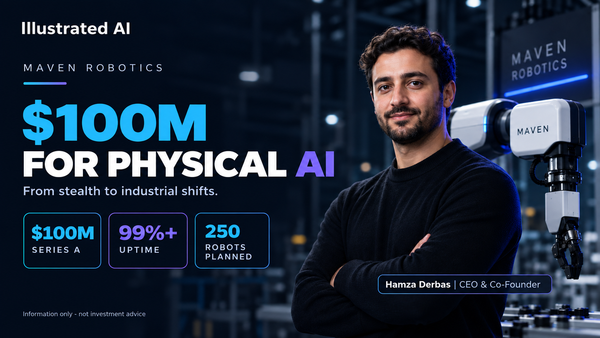
Big industrial shifts rarely arrive with flashing lights. That is where Maven Robotics stepped into view with force. Founded in 2024, this young company emerged from stealth with a striking signal: a $100 million Series A, live robots already working in customer facilities, and a plan to build hundreds more. In a market crowded with dramatic demonstrations, that combination changed the tone immediately. This was not just a lab story. It was a scaling story.
Invest in top private AI companies before IPO, via a Swiss platform:
 SmartProfit Finder AG
The financing suggests investors believe Maven has crossed a critical threshold from concept to execution. Industrial buyers do not pay for excitement. They pay for reliability, productivity, and cost savings. A machine has to keep performing when the environment is hot, dusty, and unpredictable. In that reality, a robot either creates value every shift or it does not.
Maven's plan to build 250 third-generation robots while beginning work on a fourth-generation platform reveals a business industrializing a product cycle, not just proving a single invention. That is the difference between building one clever machine and building a repeatable company around fleets, upgrades, and service operations. Disruptive technologies change the rules when they stop being speculative and start becoming operational. That is the line Maven is attempting to cross.
Some of the most demanding tests of industrial robotics take place in distribution centres where goods arrive late, pallets need rebuilding, and every delay has a cost. Mixed-case palletizing and tote handling are a perfect stress test for intelligent machines, combining constant variation, physical movement, and timing pressure. If a robot can thrive there, it can create real economic value.
Traditional automation performs best when tasks are repetitive and predictable. Warehouses, shaped by e-commerce and dynamic inventory flows, offer variation everywhere. That variation is exactly where old automation struggles. Warehouses punish fragile systems quickly. If a robot breaks down, throughput suffers. If it cannot adapt, workflows stall. If it requires too much oversight, labor savings disappear.
The appeal of solving these problems is enormous because the pain point is enormous. Logistics is one of the economy's largest invisible engines. A company that can automate difficult warehouse tasks is selling productivity to one of the busiest parts of modern commerce. The emerging rule is that AI-enhanced machines may handle more fluid, semi-structured tasks, opening a far larger market. Mastering one painful process can lead to others: sorting, loading, assembly support, and beyond. The warehouse is a gateway market, and disruption there stops being a theory. It becomes a line item.
Commercial revolutions rarely depend on looking familiar. They depend on solving problems efficiently. Maven's design reflects this: wheeled bases, two arms, and vacuum grippers built to move quickly, lift meaningful loads, and operate reliably in industrial settings. These machines are designed less like science-fiction characters and more like high-performance warehouse tools with intelligence.
Wheels are simpler, faster, and more energy efficient than legs on warehouse floors. Vacuum grippers are highly effective for lifting boxes. Every design element asks the same question: what creates the highest return on investment in a real facility? Maven reports that its robot can travel at up to 10 miles per hour and lift loads of up to 30 kilograms. Investors will need operational evidence showing whether those specifications translate into sustained throughput, uptime and attractive deployment economics. Speed matters because warehouses are ruled by throughput. Payload matters because handling useful loads determines whether automation can reduce manual handling and improve throughput in a financially meaningful way.
Co-founder and CEO Hamza Derbas has more than two decades of experience developing autonomous systems and bringing complex physical technologies to market. Co-founder and CFO Khalid Derbas is an investor and operator with experience scaling businesses across global markets. Underneath the robot's visible form sits perception software, motion planning, task coordination, and integration logic. By refusing to overcomplicate the form factor, Maven may reach commercial adoption sooner. Customers trust tools built clearly for the job. In industrial technology, elegance is measured in output, not applause.
Every disruptive company carries a before-and-after moment. Maven's leap from early pitch to live deployments and major funding captures the essence of startup transformation. Maven says its robot fleets are already operating autonomously across multiple shifts for a Fortune 250 customer. This represents meaningful early deployment evidence, but broader commercial proof will require additional customers, repeat orders and disclosed operating results. In robotics, commercial proof is rare. When proof and appeal align, valuations and expectations change quickly.
The initial focus on mixed-case palletizing is already a large market, but management sees a path into more complex material handling and assembly. This is how platform businesses start: solve one painful workflow, gather data, refine operations, then move into adjacent problems. Each paid deployment could contribute revenue and, where customer permissions and technical arrangements allow, operational data that supports product development. Software, models, and operating knowledge become more powerful when supporting several applications. The robot becomes a node in a broader physical-AI system expanding into larger portions of industrial work.
Real-world operational data is hard to fake and expensive to collect. Competitors may copy ideas but cannot instantly replicate thousands of hours of edge-case learning from live deployments. That knowledge becomes a moat. A young company becomes interesting not because commercial success is assured, but because early deployment evidence can make its market ambition more credible. One workflow solved can become many. One quiet sketch can turn into a market story large enough to reshape an industry.
Excitement is cheap in emerging technology. Metrics are expensive. Maven has laid out milestones that can be watched with unusual clarity: fleet expansion, autonomous operating hours, uptime, and customer adoption. Operating hours are especially revealing. Every additional shift worked is a test passed, proving the machine survived imperfect inputs, congested paths, and physical wear. High uptime is the language of trust. If a machine becomes embedded in a customer’s workflow and consistently delivers value, it may support stronger retention and repeat orders. Maven has not yet disclosed sufficient commercial data to establish this pattern.
The plan to build 250 third-generation robots is a stress test of the business model. Can the organization manufacture at higher volume without quality slipping? Can it support those machines efficiently while preparing a fourth-generation platform? Scaling introduces painful realities: supply chains become critical, service teams must respond quickly, and integration challenges multiply because no two customer sites are identical.
Leadership in physical AI may depend less on theatrical unveiling events than on accumulated operational evidence. The strongest evidence will be measurable: more paid deployments, longer autonomous operating hours, sustained uptime and broader customer rollouts. Boring, in industry, means dependable. Dependable means valuable. If physical AI becomes a trusted production asset, the impact could spread far beyond one warehouse niche, absorbing repetitive and strenuous tasks while allowing human workers to focus on higher-value responsibilities. The relevant performance indicators are already becoming clear.
Quiet demos impress. Real shifts change industries.