Anthropic’s Claude Enters Wealth Management Workflows
– 3 min read
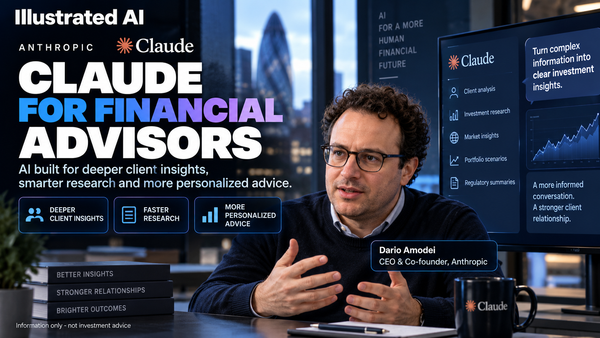
Anthropic has introduced Claude for Financial Advisors, extending its enterprise-AI strategy into wealth management. The offering is designed to support tasks including client-meeting preparation, portfolio review, documentation and follow-up communications while connecting Claude with software already used by financial advisers.
Invest in top private AI companies before IPO, via a Swiss platform:
 SmartProfit Finder AG
Charles Schwab is a prominent partner, and the offering is intended to connect with customer-relationship management, portfolio-reporting and financial-planning systems. The strategic importance is not simply that Claude can generate text. It is that Anthropic is attempting to embed its models within recurring, regulated professional workflows.
Inside a business, the central problem is rarely whether a model can generate a capable response. It is whether it can find the right information, from the right systems, at the right moment. In wealth management, portfolio data, planning details, client history, and research all sit in separate platforms. Advisers can spend considerable time gathering information from separate systems before beginning their analysis.
Integration may create commercial defensibility by embedding the product within recurring workflows and increasing switching costs. Whether this produces durable retention will depend on adoption, measurable productivity improvements and the availability of competing products.
The relevant evidence will be operational: whether preparation takes less time, documentation becomes more complete and advisers continue using the product after initial deployment.
Wealth management is a demanding test case for enterprise AI because advisers work with sensitive client information and operate under extensive supervisory and recordkeeping requirements. Anthropic’s broader financial-services architecture emphasizes governed data access, audit logs and human review, but financial institutions remain responsible for validating outputs and ensuring that deployments meet their regulatory obligations.
The commercially viable model is therefore likely to involve staged assistance: AI gathers approved information and drafts materials, while authorized professionals review the output and remain responsible for final decisions. Governance, permissions and auditability are not peripheral features in this market; they are part of the product’s potential commercial value.
Anthropic has not established that using Claude automatically makes a financial adviser or institution compliant. Any compliance-screening capabilities should be evaluated within each firm’s approved systems, policies and supervisory processes.
Anthropic has not publicly disclosed detailed revenue generated specifically by Claude for Financial Advisors. The product should therefore be viewed as evidence of its enterprise expansion strategy rather than proof of material wealth-management revenue.
Vertical products can create recurring usage by supporting operational routines such as meeting preparation, portfolio review, documentation and compliance-related workflows. If customers adopt these capabilities broadly, Anthropic may increase usage and strengthen retention. The investment case will ultimately depend on paid adoption, usage growth, renewal rates and whether enterprise revenue can support the company’s substantial model-development and compute costs.
Wealth management combines information overload, fragmented software, demanding clients, strict regulation, and constant documentation needs. If AI proves itself here, it offers a blueprint for other professional sectors. Law firms, healthcare providers, and insurance companies face the same central challenge: too much information, too many disconnected systems, and too much expensive human time stitching pieces together.
The pattern that emerges is AI complementing rather than replacing professionals. The machine handles assembly, synthesis, and drafting. The adviser handles interpretation, empathy, and final judgment—making the human more valuable by stripping away low-value burden. The strategic question for the industry is whether leading companies will remain horizontal suppliers of intelligence or move up the stack to own workflow experiences in specific sectors. Complexity can be a moat: the harder something is to build and govern, the fewer rivals will execute it well.
The bottom line: Claude for Financial Advisors illustrates Anthropic’s effort to move beyond general-purpose model access and into governed, recurring enterprise workflows. The evidence investors should watch is measurable adoption: named deployments, active usage, workflow volume, renewal rates and disclosed enterprise revenue. Integration may strengthen Anthropic’s commercial position, but the product’s long-term economic contribution remains to be demonstrated.