Stripe Eyes $10 Billion OpenRouter AI Deal
– 4 min read
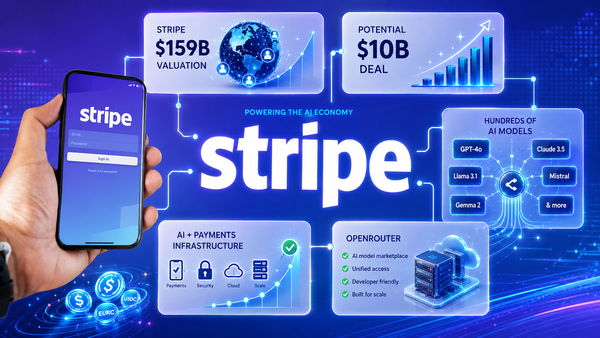
Every technology boom creates new infrastructure businesses that quietly become essential to the entire ecosystem. In AI, one of those emerging layers is model routing—helping companies access, compare, and switch between competing AI models without rebuilding their applications each time the market changes. That is the role OpenRouter has stepped into, explaining why acquisition interest approaching $10 billion has captured attention across both technology and finance.
Invest in top private AI companies before IPO, via a Swiss platform:
 SmartProfit Finder AG
OpenRouter gives developers access to many AI models through a single platform, eliminating separate integrations and reducing the cost of switching as new models improve. Instead of committing to one provider, businesses can choose the model that best matches their needs for performance, cost, or reliability while keeping the same technical interface.
This capability becomes more valuable as the AI market grows increasingly fragmented. New models appear constantly, each offering different strengths, pricing, and capabilities. Businesses deploying AI at scale need flexibility, cost control, and protection from vendor lock-in. The faster the market evolves, the greater the value of an independent platform that simplifies those choices.
Infrastructure businesses also benefit from strong network effects. More developers attract more model providers, while broader model availability attracts even more customers. Over time, a routing platform can expand beyond simple access into billing, analytics, optimization, governance, and security—making itself progressively harder to replace.
As AI matures, businesses increasingly optimize for business outcomes rather than benchmark scores. Instead of asking which model is the smartest, they ask which delivers the best balance of quality, speed, and cost for a specific task.
Different workloads require different models. Customer support, software development, document analysis, and research each have unique requirements, making a multi-model strategy increasingly attractive. Without a unified routing layer, companies face multiple integrations, higher maintenance costs, and expensive switching whenever better alternatives emerge.
This flexibility also strengthens competition among model providers. When businesses can compare performance and pricing more easily, vendors compete on measurable value rather than customer lock-in. As AI adoption expands across industries, platforms that simplify selection and optimization become increasingly valuable because they reduce complexity rather than adding to it.
Stripe has built its business by simplifying complex financial infrastructure for developers through APIs, subscriptions, billing, and usage-based pricing. AI is creating remarkably similar challenges. Companies now manage millions of AI requests, multiple providers, token-based billing, and constantly changing usage patterns—problems that closely resemble the payment infrastructure Stripe has spent years solving.
Acquiring a model-routing platform would allow Stripe to extend its existing developer ecosystem into AI infrastructure rather than entering an entirely new business. Developers could discover models, route workloads intelligently, manage usage, automate billing, and monitor spending through a single integrated platform. This fits naturally alongside Stripe's existing products for subscriptions, invoicing, recurring billing, and consumption-based pricing.
The strategic value extends beyond transactions. By sitting between developers and AI providers, Stripe would gain visibility into how enterprises consume AI services, creating opportunities to build additional financial, operational, and optimization tools around that ecosystem. Rather than becoming another AI company, Stripe would strengthen its position as the infrastructure layer powering how developers build and monetize modern software.
A company recently valued near $1.3 billion being discussed at approximately $10 billion may appear extraordinary, but strategic acquisitions often reflect long-term positioning rather than current financial results alone.
Infrastructure platforms frequently command substantial strategic premiums because they occupy critical points within an ecosystem. OpenRouter combines broad developer adoption, neutrality across competing AI providers, and growing integration into production applications. Reproducing those relationships internally could require years of development while competitors continue strengthening their market position.
The premium also reflects ecosystem value. A platform that already connects developers, model providers, enterprise customers, and usage data becomes increasingly valuable as AI adoption accelerates. Buyers are not simply acquiring software—they are acquiring distribution, customer relationships, and a strategic position inside one of the fastest-growing technology markets. In rapidly evolving industries, purchasing an established platform can be considerably less expensive than losing valuable time building one from scratch.
AI investing is gradually shifting beyond model developers toward the infrastructure that makes enterprise adoption practical. As organizations deploy AI more broadly, they increasingly require routing platforms, governance tools, optimization software, billing infrastructure, and evaluation systems that help manage growing complexity.
Platforms such as OpenRouter address this need by reducing friction while giving customers greater flexibility. Once businesses build production workflows around an orchestration layer that manages multiple AI providers, switching becomes increasingly costly—not because customers are locked into one model, but because the orchestration platform itself becomes deeply embedded in daily operations.
This reflects a broader shift across the AI industry. As foundation models become more capable and competitive, long-term differentiation may increasingly come from the platforms that determine which model is used, when it is selected, how performance is optimized, and how costs are controlled. Those orchestration layers can capture durable value regardless of which individual model leads the next benchmark.
The next phase of AI investing will likely reward businesses that organize complexity rather than simply create it. Chips remain essential. Models remain essential. Cloud infrastructure remains essential. But the platforms coordinating those technologies may become equally important because they enable enterprises to use AI more efficiently, economically, and at scale. In the long run, value may increasingly accumulate around the companies that make the entire AI ecosystem easier to navigate rather than around any single model alone.
https://www.wsj.com/tech/ai/stripe-in-talks-to-buy-buzzy-ai-model-marketplace-openrouter-decc6a74