Starcloud’s $250M Raise Fuels Orbital AI Data Center Ambitions
– 3 min read
Space is no longer just a place that delivers data to Earth. Satellites are being redesigned as brains, capable of processing data directly in orbit. This shift makes orbital AI compute genuinely disruptive: instead of transmitting entire datasets to ground-based systems, spacecraft act as floating compute nodes, sending only the most useful outputs back down.
Invest in top private AI companies before IPO, via a Swiss platform:
 SmartProfit Finder AG
AI has become one of the most power-hungry technologies ever built, and terrestrial data centers face real bottlenecks in land, power, and permitting. Orbital compute attempts to bypass those constraints by creating an entirely new infrastructure layer. For investors, that is not an incremental improvement. It is a new architecture, and new architectures attract serious capital.
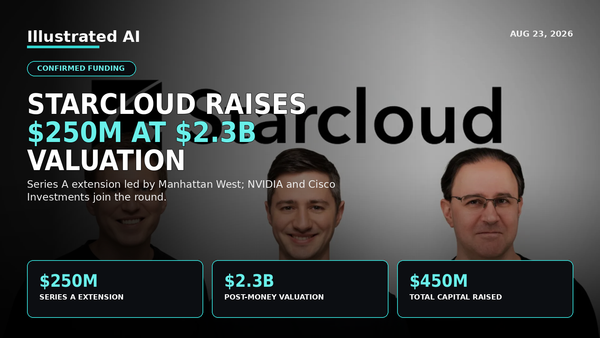
A $250 million Series A extension at a $2.3 billion post-money valuation is more than a cash event. Total capital raised has reached $450 million since the company's 2024 founding, with valuation more than doubling in roughly five months. That pace signals institutional urgency, not casual interest.
Investors include Manhattan West, NVIDIA, and Cisco Investments, a blend of financial capital and strategic validation. In orbital compute, money does more than fuel operations. It compresses time, enables parallel workstreams, and changes a company's gravitational pull for talent, partners, and customers. Markets often crown infrastructure leaders early, and this raise positions the company to be that name.
NVIDIA's participation as both investor and engineering collaborator elevates the entire thesis. The two companies are developing the Space-1 Vera Rubin Module, adapting world-class AI hardware for the radiation and thermal realities of orbit. That is an engineering commitment, not a branding exercise.
The company has already demonstrated AI tasks in orbit using an NVIDIA H100 GPU, including model training, inference, and fine-tuning. For investors, this matters because durable competitive advantages emerge where domain expertise overlaps. Aerospace alone is hard. AI hardware alone is hard. Making them function together in space creates a meaningful barrier to entry and positions the company as a genuine node in the broader AI infrastructure ecosystem.
Vision gets headlines, but manufacturing determines destiny. The expansion into a 100,000-square-foot facility in Woodinville, Washington signals a transition from proving an idea to industrializing it. Orbital AI compute becomes meaningful only through repeatable, reliable spacecraft production, not a single successful demonstration.
The company is now developing its Starcloud-3 spacecraft, suggesting a platform roadmap rather than a one-off mission. Each hardware generation can incorporate operational lessons, converting fragile novelty into robust infrastructure. For investors, a production facility is tangible proof of intent. Buildings, equipment, and production lines announce seriousness with a clarity that slide decks cannot match.
The long-range vision, an 88,000-satellite constellation delivering 20 gigawatts of orbital compute capacity, is architectural in scale. If even partially realized, it could redefine where AI workloads run. But the risks are equally substantial. Launch availability, thermal management, radiation resilience, and competition from rapidly expanding terrestrial data centers are all material challenges, not footnotes.
The most important question is whether orbital compute can offer unique capability or economics that justify its complexity against ground-based alternatives that are also improving fast. Financing, partnerships, manufacturing, and orbital demonstrations all narrow the gap between concept and commercial viability, but they do not close it. That gap is precisely why the opportunity remains so compelling. Big risks and transformative returns usually travel together, and here they are practically holding hands.
Space is becoming compute, AI is becoming infrastructure, and infrastructure is becoming the next great battleground. The vision is enormous, the risks are real, and the investors circling it know exactly why that matters.