CMR Surgical’s $400M Stryker Alliance
– 6 min read
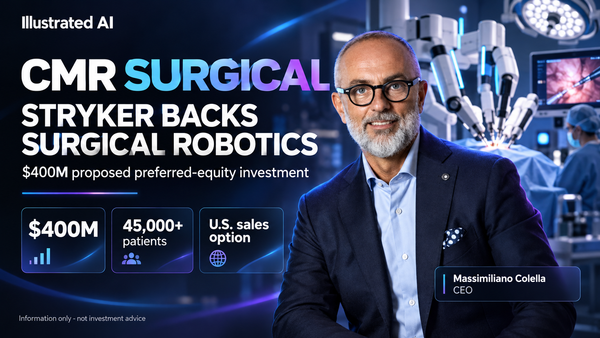
Stryker and CMR Surgical announced a strategic alliance on 12 October 2026, including an approximately $400 million preferred-equity investment, an exclusive US sales agency agreement for the Versius portfolio and an exclusive option for Stryker to acquire CMR’s remaining equity. The transaction is subject to regulatory approvals and customary closing conditions. The alliance could strengthen CMR’s commercial reach, but does not establish future installations, utilisation or profitability.
Invest in top private AI companies before IPO, via a Swiss platform:
 SmartProfit Finder AG
CMR Surgical built its reputation around Versius, a modular and portable robot-assisted surgical system designed to fit into existing workflows rather than forcing hospitals to redesign operating rooms. Hospitals do not just buy machines. They buy convenience, reliability, and the confidence that a new tool will not cause chaos on surgery day.
Stryker changes the scale of the opportunity entirely. By becoming the exclusive U.S. sales agent for Versius, Stryker becomes the bridge between an innovative surgical platform and the hospitals that may adopt it. Even excellent technology can struggle without a route to market strong enough to turn interest into installations and installations into routine surgical use.
The structure adds intrigue. This is not a full takeover. It combines strategic capital with exclusive U.S. sales rights and an option for future acquisition. Stryker gains access to a growing field without building a rival platform from scratch. CMR would gain capital and access to Stryker’s US commercial network while remaining a separate company. The announcement does not disclose the full governance rights attached to the investment. It is careful corporate choreography: enough commitment to matter, enough flexibility to leave room for future decisions.
This moment feels larger than a capital raise. It signals that surgical robotics is entering a more industrial phase, where strategic partnerships may matter as much as technical breakthroughs. The real battle begins long before surgery starts — in boardrooms, purchasing departments, and service networks. This deal pushes CMR onto that larger stage with a powerful new ally beside it.
Robotic surgery is not about removing human expertise from the operating room. Systems like Versius aim to extend it — helping surgeons perform delicate movements with enhanced control and improved ergonomics in minimally invasive procedures. The robot is a tool that helps a skilled surgeon work with greater precision in tight spaces inside the body.
A successful surgical robot must do far more than move accurately. It has to fit the rhythm of an operating room: easy to set up, intuitive to learn, dependable enough to trust, and useful enough to justify the cost. This is where CMR's approach becomes interesting. Versius was designed around modular bedside units and an open console, intended to adapt to the hospital rather than demanding hospitals bend around the robot. Modularity and portability could help hospitals integrate the system, but comparative advantages require evidence on installation, training, operating-room efficiency and total costs.
The clinical history gives the technology substance. CMR reported more than 45,000 patients treated worldwide by March 2026. This is not a prototype seeking attention — it is a platform with real-world use across multiple countries. Versius Plus’s US clearance covers robot-assisted cholecystectomy in patients aged 22 and older who are eligible for soft-tissue minimal-access surgery; it does not establish clearance across all procedures performed internationally. Progress in surgical robotics comes step by step, with each indication expanding the platform's practical reach.
Competition sharpens the story. Soft-tissue robotic surgery already has a powerful incumbent in Intuitive Surgical's da Vinci system. Any challenger must prove a distinct advantage. CMR's case rests on modularity, portability, and workflow fit. Hospitals comparing systems ask hard questions about space, training time, reliability, and clinical evidence. Winning those answers is what turns design into market share.
Rather than a simple venture round or straightforward acquisition, this arrangement combines minority strategic capital, exclusive commercial rights, and an option for future control — one of the most powerful playbooks in frontier hardware.
The Times reported that approximately $400 million would purchase a stake of about 10%, implying an equity valuation around $4 billion. CMR’s chief executive declined to confirm the stake or valuation. This calculation does not establish enterprise value, and the preferred shares’ economic rights could affect comparisons with common equity. The full investment terms have not been disclosed.
The deeper significance lies in aligned incentives. Strategic capital means Stryker is not just chasing financial return — it is buying a commercial relationship and an inside track on future opportunity. For a robotics company, that can be transformative. For the larger device company, it offers participation in a high-growth area without assuming all the developmental risk upfront.
This model is increasingly relevant where commercialization is as difficult as invention. Strategic minority deals allow emerging companies to retain independence while plugging into distribution networks that would otherwise take years to replicate. The startup brings agility and invention. The established company brings scale, systems, and customer reach. Together they can move faster than either side acting alone.
The connection to AI here is not that autonomous robots are performing surgery. The significance lies in how software, simulation, and data may eventually make robotic systems more adaptable and more useful to clinicians.
CMR demonstrated a research simulation involving NVIDIA’s Isaac for Healthcare and Cosmos-H-Dreams, exploring how an action-conditioned model could predict changes in a simulated surgical scene. CMR explicitly states that the simulation is not part of the currently cleared Versius Plus system and is not intended for clinical decision-making or patient care. It does not establish autonomous surgery or demonstrated patient benefit.
One promising use case is training. AI-enhanced simulation could create richer environments where surgeons rehearse complex scenarios and receive granular feedback on technique, shortening learning curves before entering the operating room. Another is workflow support — a data-informed system might one day help flag patterns or improve awareness of procedural progress, acting more like a smarter co-pilot than an autonomous decision-maker.
Hardware is expensive and slow to improve once installed. Software can evolve faster. If a robotic platform gains new capabilities through updates and data integration, its value proposition expands over time. But medicine does not reward wishful thinking. Research success in simulation is only an early step. The hard questions — does it improve outcomes, is it reliable, can surgeons trust it — stand between an impressive demonstration and a meaningful product.
The real test comes when strategy collides with hospital budgets, regulatory reality, and competitive pressure. This alliance has created a stronger launch platform, but it has not removed the need for proof.
The first point of attention is simple: closing conditions. The investment was announced as conditional, subject to regulatory approvals. Before drawing large conclusions, the market will want to see the alliance move from announced intention to completed reality.
After that comes commercial traction. Exclusive sales rights only matter if they lead to actual adoption. Utilization is the pulse of the business — it reveals whether the technology is becoming part of routine surgical practice or remaining a carefully marketed promise. Training capacity will be equally critical, since surgical robotics spreads through surgeon confidence as much as procurement decisions.
Regulatory breadth could reshape the opportunity. Future approvals for additional indications would expand the practical universe in which the robot can be used. Meanwhile, the competitive backdrop cannot be ignored. Intuitive Surgical remains the major incumbent, and CMR must show that its modular design advantages translate into tangible commercial and clinical benefits.
Then there is the long shadow of the acquisition option. Whether Stryker exercises it will likely depend on performance and strategic fit at the time — making it one of the strongest future verdicts on the platform's progress.
The bottom line: Stryker’s proposed investment and exclusive US sales alliance could support CMR’s expansion, but closing and commercial execution remain important milestones. Company-reported clinical use demonstrates experience, while FDA clearance defines the permitted US indication. Investors should watch installations, utilisation, training and service costs, comparative clinical evidence and margins. The NVIDIA simulation remains research rather than cleared clinical functionality.