Precision Neuroscience’s $250M Raise Signals BCI Commercial Shift
– 4 min read
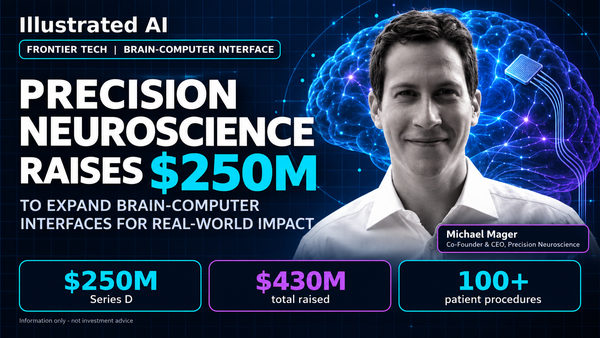
Precision Neuroscience has closed a $250 million Series D financing, bringing its total capital raised to $430 million. Pershing Square, the Ackman Oxman Institute and an undisclosed life-sciences investment fund co-led the round. Precision did not disclose the valuation attached to the financing.
Invest in top private AI companies before IPO, via a Swiss platform:
 SmartProfit Finder AG
The company says it will use the capital to expand clinical programmes, advance its Layer 7 Cortical Interface through further FDA review and build infrastructure for possible commercialisation. The financing provides additional capital for development, but Precision has not disclosed its cash consumption or how long the funding is expected to support operations. The round does not establish clinical effectiveness, regulatory authorisation for a permanent brain-computer interface or commercial demand.
Precision is developing a surface-based brain-computer interface intended ultimately to help people with paralysis control digital devices. Its investment case depends on whether the company can translate early procedures and temporary-use clearance into a safe, effective, fully implantable system that hospitals can deploy economically.
Precision’s Layer 7 Cortical Interface is a thin, flexible electrode array designed to rest on the surface of the brain rather than penetrate brain tissue. Each array contains 1,024 electrodes. In a reported 2024 procedure, four Layer 7 arrays were used simultaneously, providing a total of 4,096 electrodes.
The surface-based design may reduce tissue penetration compared with intracortical electrodes, but it still requires neurosurgery. Precision must demonstrate whether this approach provides sufficient signal quality, stability and decoding performance for clinically useful applications.
The company’s longer-term objective is to enable people with paralysis to control digital devices through neural signals. That application remains investigational and is not covered by the existing FDA clearance for the cortical electrode array.
Precision says its technology has been used in more than 100 patient procedures across 18 medical institutions. This provides operational and research experience across several clinical sites, but the company has not disclosed enough aggregated data to establish decoding accuracy, adverse-event rates, long-term signal stability or effectiveness across patients.
The FDA granted 510(k) clearance to the Layer 7 Cortical Interface for recording, monitoring and stimulating electrical activity on the brain’s surface for implantation periods of up to 30 days. The clearance applies to the cortical electrode array and does not constitute approval of Precision’s planned permanent wireless BCI or establish that patients can reliably control digital devices.
A 510(k) clearance is based on substantial equivalence to an existing legally marketed device. Precision’s permanent system will require additional clinical evidence and regulatory review before broader commercial use.
Precision acquired a microelectromechanical systems (MEMS) manufacturing facility near Dallas, Texas, to support development and production of its electrode arrays. Internal manufacturing could improve design iteration and quality control, but Precision has not disclosed production capacity, manufacturing yield, unit costs or readiness for commercial-scale output.
Precision and Medtronic have announced a co-development partnership to integrate Layer 7 with Medtronic’s StealthStation neurosurgical-navigation platform. The relationship could assist surgical workflow development, but the companies have not announced a commercial launch, distribution agreement, revenue contribution or completed deployment programme.
The commercial importance of both initiatives will depend on successful integration, regulatory progress, manufacturing consistency and adoption by hospitals.
Brain-computer-interface developers are pursuing intracortical, surface-based, vascular and non-invasive approaches. Each architecture involves trade-offs among signal quality, surgical complexity, durability and potential clinical applications.
Precision’s strategy is to achieve clinically useful signal capture without penetrating brain tissue. Whether this creates an advantage will depend on comparative evidence covering decoding performance, procedural risk, long-term stability and patient outcomes. The company has not published sufficient head-to-head data to establish superiority over competing approaches.
Important milestones include progress towards a fully implantable system, reproducible results across participants, manufacturing consistency and further development of the Medtronic integration. Investors should also assess whether the $250 million financing advances Precision far enough towards additional regulatory submissions and potential commercial deployment without requiring substantial further capital.
Clinical performance: Precision must disclose whether neural signals can be decoded accurately, consistently and with sufficiently low latency across multiple patients.
Safety and durability: Relevant evidence includes adverse events, infection rates, device movement, signal degradation and performance over longer implantation periods.
Permanent-system regulation: The cleared temporary array should not be confused with authorisation for the planned fully implantable wireless BCI.
Hospital economics: Adoption will depend on surgical time, clinician training, technical support, reimbursement and whether patient benefits justify the cost and procedural burden.
Manufacturing: Investors need evidence covering production yield, unit economics, quality controls and the ability to manufacture consistently at higher volumes.
Commercial disclosure: Precision has not publicly disclosed revenue, paid commercial customers, gross margins, cash consumption or the valuation attached to the Series D.
The bottom line: Precision Neuroscience’s $250 million Series D provides substantial capital to expand its clinical programme, pursue further regulatory review and prepare for potential commercialisation. Its surface-based Layer 7 design, temporary-use FDA clearance and experience across more than 100 company-reported procedures provide meaningful development milestones. However, the permanent BCI remains investigational, and Precision has not disclosed sufficient aggregated evidence on decoding performance, safety, durability or commercial economics. Investors should watch clinical endpoints, adverse events, regulatory progress, manufacturing yield, hospital adoption and evidence that the system delivers sustained benefits for people with paralysis.