Snorkel AI’s $350M Raise Signals the Rising Value of AI Data Infrastructure
– 4 min read
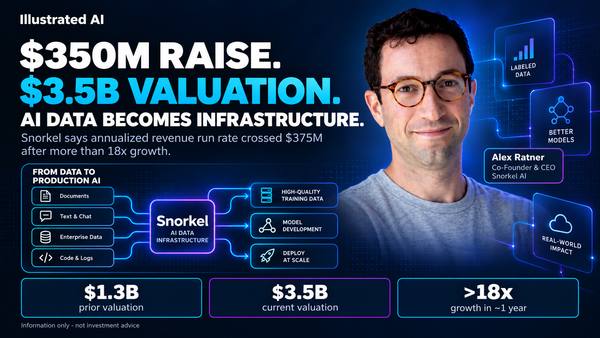
Snorkel AI has raised $350 million in a Series E financing at a $3.5 billion valuation as demand grows for specialised datasets, evaluation systems and reinforcement-learning environments used to improve advanced AI models. Insight Partners and S32 co-led the financing, with significant participation from existing investor Addition.
Invest in top private AI companies before IPO, via a Swiss platform:
 SmartProfit Finder AG
The company says its data-as-a-service offering has grown more than 18-fold since launching nearly a year ago and that Snorkel recently crossed a $375 million annualised revenue run rate. These are company-reported figures. Snorkel has not publicly disclosed audited revenue, gross margins, profitability, customer concentration or the proportion of its run rate generated by individual products.
The financing highlights the growing commercial importance of the data layer behind frontier AI. As models are trained to perform more complicated reasoning, coding and agentic tasks, developers may require specialised training examples, evaluations and simulated environments that test more than basic pattern recognition.
Snorkel originated from a Stanford research project focused on programmatic data labelling. Its original approach allowed organisations to create training data using rules and weak supervision rather than relying entirely on manual annotation.
The company has since expanded towards a data-as-a-service model that delivers finished training and evaluation datasets, reinforcement-learning environments and associated development infrastructure. Snorkel says it works with frontier laboratories, hyperscalers, specialised AI companies, enterprises and US government agencies, although it has not disclosed detailed revenue or contract values by customer category.
This transition could expand Snorkel’s commercial opportunity, but it also changes the economics of the business. Delivering expert-created data and customised environments may generate more revenue than licensing software alone, while also introducing contributor costs, project-management requirements and potentially lower margins.
Snorkel’s expansion from data-development software into delivered data products could deepen its role in customers’ model-development workflows. Rather than providing only tools for customers to build datasets, the company increasingly supplies completed datasets, evaluations and environments designed for specific training objectives.
This may support larger contracts and stronger customer integration, but it does not automatically establish recurring revenue or high software-like margins. Investors need to understand how much work remains bespoke, what proportion is automated and how contributor and delivery costs change as revenue grows.
Snorkel’s combination of expert contributors, proprietary workflows and automation could provide differentiation. The durability of that advantage will depend on dataset quality, delivery speed, measurable model improvements and whether customers continue buying rather than developing comparable capabilities internally.
Snorkel’s financing reflects investor interest in businesses that help make advanced models more capable, specialised and commercially useful. Training data, evaluations and reinforcement-learning environments can become important as developers extend models into reasoning, coding and agentic tasks.
The demand trajectory is not guaranteed. More capable models may require increasingly sophisticated expert feedback, but advances in synthetic data, automated evaluation and self-improving systems could reduce some dependence on human-created material. Frontier laboratories may also bring more of this work in-house.
Snorkel’s potential differentiation lies in its data-development technology, expert networks, delivery workflows and experience working across different model-development requirements. Pricing power and strategic importance will depend on whether these capabilities produce results that customers cannot replicate internally or obtain from competing suppliers.
The reported $375 million annualised run rate establishes substantial commercial scale, but it is not equivalent to recognised annual revenue. Investors should examine how much of the figure is contracted or recurring, the duration of customer commitments and whether rapid growth is concentrated among a small number of frontier-model developers.
Gross margins will be particularly important. Snorkel’s combination of software, automation and expert labour may produce different economics from a conventional software company. The central question is whether proprietary systems increasingly automate data creation and evaluation or whether revenue growth requires a broadly proportional increase in human delivery costs.
Rapid growth can hide fragility. A company might benefit from temporary spending bursts by frontier labs, win large projects difficult to repeat, or rely on bespoke work that scales revenue faster than margin. Durable businesses need resilience, not just speed.
Repeatability is critical. Productised evaluation systems, domain datasets and reinforcement-learning environments may produce more scalable economics than bespoke projects, although this will depend on customer reuse, automation and delivery costs.
Customer diversity could reduce dependence on any single spending cycle. A business spanning model developers, cloud platforms, enterprises and public-sector users may be more resilient than one concentrated among a few frontier laboratories. Meanwhile, major labs may build internal data teams, making the defence not simply being early but providing better results or greater efficiency than an in-house alternative.
The $3.5 billion valuation establishes substantial expectations for recurring demand, improving delivery economics and durable differentiation. Snorkel will need to demonstrate that its reported growth can translate into retained customers, sustainable margins and a defensible position in the AI-data supply chain.
The bottom line: Snorkel AI’s $350 million financing, $3.5 billion valuation and reported $375 million annualised revenue run rate demonstrate strong investor and customer interest in specialised AI data. However, the company has not disclosed audited revenue, profitability, gross margins, customer concentration or the proportion of demand generated by repeat contracts. Investors should watch recognised revenue, retention, contract duration, delivery margins, automation levels and whether its data-as-a-service growth remains durable as frontier laboratories develop more capabilities internally.