Neuralink Speech BCI Demo and Surging Brain-Computer Interface Funding
– 3 min read
A person can lose the physical ability to speak while retaining the capacity to formulate language. Speech brain-computer interfaces aim to decode neural activity associated with attempted or intended speech and convert it into text or audible words. For people affected by severe paralysis or progressive motor conditions, this technology could provide another way to communicate.
Invest in top private AI companies before IPO, via a Swiss platform:
 SmartProfit Finder AG
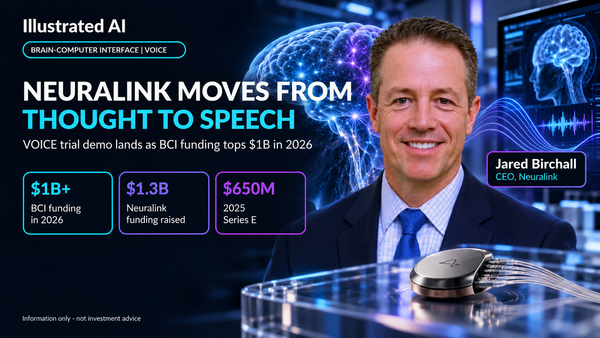
Neuralink has released demonstrations from its investigational VOICE programme, which is studying whether its wireless N1 implant can translate neural signals associated with intended speech into text or audible words. In a detailed demonstration released in March 2026, a participant identified as Kenneth, who has amyotrophic lateral sclerosis, used the system to generate synthetic speech.
Neuralink presented the demonstration as evidence that its implant could help restore communication to people who have lost the ability to speak. However, the company has not published sufficient peer-reviewed data from the VOICE programme to establish accuracy, latency, durability or effectiveness across multiple participants. The system remains investigational and is not approved for general clinical use.
Neuralink says its N1 implant records neural activity through 1,024 electrodes distributed across 64 threads, each thinner than a human hair. Its R1 surgical robot is designed to insert those threads into the targeted brain region. This architecture may provide detailed neural signals, but electrode count alone does not establish speech-decoding accuracy, long-term signal stability or clinical effectiveness.
Software then transforms raw signals into meaningful output. Speech decoders generally require participant-specific training to associate recorded neural activity with attempted or intended speech. Neuralink has shown aspects of this calibration process publicly, but it has not disclosed enough technical and clinical data to assess the decoder’s performance independently. The speech demonstration extends a platform that Neuralink is also studying for computer and device control. If the same hardware-software architecture can support multiple clinically useful applications, it could broaden the platform’s potential value. That possibility still requires validation across studies and participants.
Brain-computer-interface companies raised more than $1 billion during 2026, according to PitchBook data reported by the Financial Times. This is a sector-wide figure covering companies with different technologies, clinical objectives and levels of invasiveness; it should not be presented as funding received by Neuralink alone.
The funding surge indicates growing investor interest in several competing BCI architectures. This capital can support hardware development, clinical studies, surgical systems and regulatory work, but the sector-wide total does not reveal which approaches will produce safe or commercially viable products. Even so, funding headlines should never be mistaken for guaranteed success. Capital can accelerate progress but cannot manufacture clinical evidence.
A demonstration can show technical possibility, but clinical and commercial assessment requires repeatable results. The relevant questions are accuracy, latency, durability and safety across multiple participants and everyday settings.
Decoding errors could reduce usability, while latency may interrupt conversational flow. Signal drift and hardware degradation could also affect long-term performance. Because the system requires surgery, broader clinical adoption will depend on evidence covering safety, reliability, adverse events and sustained benefit over time.
The field divides into invasive, minimally invasive, and non-invasive approaches, each trading signal quality against procedural complexity. Higher performance often demands greater burden. Simpler deployment may sacrifice capability. No path is automatically right; each reflects a different view of what users, clinicians, and regulators will value most.
Competition revolves not only on technical achievement but on product-market fit: who can justify the procedure, build clinician trust, satisfy regulators, and create workflows hospitals can adopt. Today's funding leader may not be tomorrow's category leader. Long-term leadership will depend on which companies can convert technical progress into safe, reliable and clinically useful systems.
The bottom line: Neuralink’s speech demonstration provides an early indication that its N1 implant may support communication for people who have lost the ability to speak, but a single company-released demonstration does not establish clinical effectiveness. Investors should watch participant numbers, decoding accuracy, latency, implant durability, adverse events, peer-reviewed results, regulatory progress and evidence that the system performs reliably in everyday use.