Anthropic’s AI Agents Move Into Biological Discovery
– 9 min read
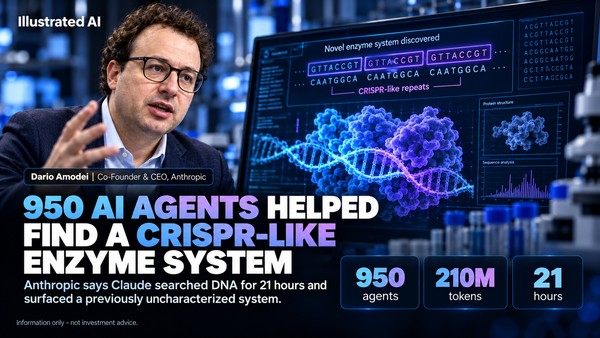
Anthropic says approximately 950 Claude agents helped identify a previously uncharacterised biological system associated with reverse transcriptases in bacteriophages. The agents analysed genomic data for 21 hours, using approximately 210 million tokens, before human scientists investigated the resulting candidates in Anthropic’s laboratory.
Invest in top private AI companies before IPO, via a Swiss platform:
 SmartProfit Finder AG
That is the significance of a recent development in biology. A large network of AI agents searched an immense landscape of biological sequence data, filtering vast possibilities and highlighting an unusual biological arrangement worth testing in the laboratory. Modern science is drowning in data but starving for attention. The bottleneck is not access to genetic sequences — they are already collected and stored. The bottleneck is seeing what matters.
A human researcher can be brilliant and highly trained, but still limited by time and the sheer size of the search space. AI agents attack exactly that problem. They do not get tired. They can keep scanning, clustering, and comparing until a pattern starts to glow. Hundreds of agents worked through enormous biological datasets over many hours, suggesting a future where researchers deploy fleets of digital assistants, each handling part of the puzzle, combining outputs into a shortlist of serious candidates for human review.
This hints at a new model for research. AI can search, rank, and flag anomalies — transforming sprawling data into human-sized hypotheses. Then human scientists step in with judgment, skepticism, and experiments. Machines handle scale. Humans handle meaning. For investors, if AI moves upstream into discovery, its value expands beyond software convenience and becomes part of the scientific production process itself.
At the center sits a strange biological system found in bacteriophages — viruses that infect bacteria. That may sound obscure, but CRISPR itself emerged from bacterial defense systems. What looked niche became world-changing, which is why observers pay attention when something with a CRISPR-like flavor appears in data.
The system involves array-associated reverse transcriptases, or ART. Reverse transcriptases convert RNA information into DNA. What stood out was not the enzyme alone, but the broader arrangement: nearby repeating DNA elements resembling CRISPR architecture, plus an accessory protein, together suggesting a coordinated biological system. In biology, context transforms meaning. A tool beside a blueprint and a control switch starts to look like a machine.
Early laboratory follow-up found that the repeat array is expressed as distinct short RNAs — molecules that often serve as guides or control signals. In CRISPR, RNA components make the system programmable. This new system may not be another CRISPR, but there is enough resemblance to justify serious curiosity.
No one can honestly claim the function is fully understood yet. That uncertainty is not a flaw — it is the essence of real discovery. A genuine frontier finding begins with an anomaly, not a finished explanation. The signal lies in the combination of novelty, structure, and experimental testability. Nature may already contain many systems like this, waiting to be noticed.
There is a dramatic difference between one model answering one question and a coordinated network of agents attacking a scientific search problem at scale. Traditional scientific exploration is like panning for gold by hand. A multi-agent AI approach is like building an industrial screening operation — processing a massive field, discarding low-probability targets quickly, and surfacing the most promising anomalies.
The workflow reveals the shape of that engine: agents collect large sets of biological components, identify candidates matching certain patterns, reduce those to a shortlist, and prepare reports humans can interpret and challenge. This is process acceleration — and repeated process acceleration becomes a business model.
For investors, if AI companies can repeatedly provide this research acceleration, they become essential tools for laboratories, biotech firms, and pharmaceutical companies. The value stack gets deeper: agent orchestration, scientific interfaces, data integration, verification layers, and domain-specific reporting. High-value scientific customers may pay premium prices for reliability and integration if the system saves months of work.
Better prioritization also reduces wasted experimentation. Wet-lab work is expensive and slow. Every bad lead carries a cost. If AI improves hypothesis quality before work reaches the lab bench, it raises productivity across the entire pipeline. The race in AI may increasingly be about who builds the most useful domain-specific systems in industries where outcomes matter and budgets are substantial.
Excitement is powerful, but discipline matters more. The first open question is biological function — what does ART actually do inside bacteriophages? Structure suggests possibility, but biology runs on function. Is the system defensive, regulatory, or something entirely unexpected? The answer determines whether this is a curiosity or the seed of a major platform.
The second question is programmability. CRISPR changed the world because it could be harnessed as a tool. For ART to attract comparable commercial excitement, researchers must show not only what it does, but whether it can be directed or repurposed. The third question is independent validation — outside researchers must reproduce findings before a possibility becomes a foundation.
The fourth question concerns the AI workflow itself. A single anomaly found in a massive dataset is interesting. A system that reliably produces experimentally useful hypotheses across many projects is transformative. The most exciting long-term outcome may not depend on ART alone, but on whether similar searches can surface meaningful systems repeatedly.
Investors should remember that a result can be real yet commercially irrelevant, interesting yet not defensible, reproducible yet not monetizable. The proof points are clear: function, programmability, independent replication, and workflow repeatability. Those are the gates to watch.
The investment angle is about recognizing when technology moves from feature to foundation. The biggest technology winners become embedded in workflows that industries cannot easily function without. If AI becomes deeply integrated into scientific research, the companies controlling those tools could occupy similarly strategic positions.
Biology is an especially attractive battleground because successful discoveries can lead to new therapies, diagnostics, agricultural tools, and entirely new biotechnology categories. If AI can materially increase the rate at which useful hypotheses reach the lab, it becomes economically valuable in ways easier to defend than consumer novelty. A serious scientific customer may want controlled workflows, specialized interfaces, detailed traceability, and compliance features — the more the AI provider owns those layers, the more deeply it anchors itself in the value chain.
AI is often discussed as automation. In science, its more interesting role may be amplification — giving scientists a machine partner that scans farther, compares faster, and notices more. Capability expansion tends to create value across an ecosystem, from software providers to cloud compute suppliers to research institutions and biotech developers.
If AI can reliably turn hidden data into testable scientific insight, it stops being a tool on the side of research and starts becoming part of the engine. Discovery itself may become more software-shaped — and the companies building trusted discovery infrastructure gain an edge that can outlast any single headline.
This is early — but early infrastructure stories can become the biggest stories of all.The system, which Anthropic calls array-associated reverse transcriptases, or ART, consists of a reverse transcriptase, an adjacent partner gene and a long array of evenly spaced DNA repeats. The underlying reverse transcriptase had appeared in earlier research; the newly reported contribution is the identification and analysis of these associated features as a possible biological system.
Initial laboratory experiments found that the repeat array was expressed as distinct short RNAs. This resembles one feature of CRISPR systems, but Anthropic has not established ART’s biological function, programmability or potential practical use. The findings appear in a company-authored preprint that has not yet undergone peer review.
Anthropic deployed approximately 950 Claude agents in parallel for 21 hours. According to the company, the agents assembled a dataset of more than 200,000 reverse-transcriptase sequences, identified approximately 3,500 candidate systems and narrowed these to 20 candidates accompanied by human-readable reports.
One agent identified an unusual arrangement containing a reverse transcriptase, a neighbouring partner gene and an array of repeated non-coding DNA sequences. Claude then compared the arrangement with known systems, searched the literature and produced a report for human review. Human scientists selected candidates for further study and conducted all physical laboratory work.
Anthropic says an expert scientist could require weeks or months to conduct a comparable computational survey. That comparison has not been independently benchmarked, and the agent run does not include the time required for human review, laboratory testing or subsequent functional research. In science, faster candidate screening could increase the number of ideas researchers can test. If the filtering proves reliable, it could help researchers concentrate laboratory resources on higher-priority candidates.
ART’s resemblance to CRISPR is architectural rather than functional at this stage. The production of short RNAs does not demonstrate that the system targets genetic material, provides antiviral defence or can be programmed as a biotechnology tool.
Biology may be particularly suited to AI-assisted research because it contains patterns across very large datasets. Genes, proteins, enzymes and cellular interactions create combinations that are difficult to examine manually. AI systems can help researchers search biological databases, identify anomalies and prioritise candidates for further investigation.
Biology is also full of hidden structure. Two systems may look unrelated until a repeated DNA pattern or unusual gene arrangement reveals deeper logic. Nature does not label these clues — they are buried in context, making biology a detective story. CRISPR itself became revolutionary because researchers first noticed odd repeating sequences and slowly worked out their function. AI systems may help surface such anomalies before their biological significance is understood.
Computation and experimentation can then form a powerful loop: AI proposes candidates, scientists test them in the lab, results feed back to improve future searches. Each round makes the process more informed.
The result supports Anthropic’s effort to position Claude as a research tool for life sciences. A system that reliably searches biological databases, prioritises candidates and produces reviewable hypotheses could reduce some early-stage research work. However, Anthropic has not disclosed revenue, customer adoption or commercial contracts attributable to this biological-discovery workflow.
This experiment therefore provides an early technical proof point rather than evidence of a defensible life-sciences business. Commercial value will depend on whether external researchers can reproduce the findings and whether similar workflows repeatedly produce experimentally valuable candidates.
Investors should keep the result in perspective. Early results do not guarantee commercial dominance. Scientific validation takes time, many signals fade under scrutiny, and competitors are also exploring AI-assisted biology. The market will reward repeatability: can the system generate useful hypotheses again and again, and can outside researchers reproduce the value? Workflows that support rather than replace scientists may be easier to integrate into existing research processes, although adoption will depend on reliability, reproducibility and cost.
Every scientific lead must withstand experimental testing and independent scrutiny. The first major question is function. A repeated DNA architecture and short RNA production echo CRISPR-like systems, but resemblance is not identity. Scientists must determine what role this system plays — is it defensive, regulatory, or something novel? Until the mechanism clarifies, true significance remains partly hidden.
The second question is programmability. CRISPR became transformative not merely because it existed, but because it could be harnessed as a controllable tool. Many fascinating biological systems never become practical technologies. Independent validation is equally essential — replication is credibility, and first reports can be incomplete or overinterpreted. Outside researchers reproducing and extending the work is the bridge from internal excitement to wider scientific acceptance.
Perhaps the most commercially important question is workflow repeatability. Can similar multi-agent searches keep producing experimentally worthwhile leads? One result demonstrates technical possibility; repeated generation of experimentally valuable candidates would provide stronger evidence of a scalable research capability. For now, laboratory work remains human-led — AI accelerates the search and prioritisation, but physical experimentation and deeper biological reasoning stay with scientists. This is not machines taking over science; it is machines making the front end faster and more targeted.
The bottom line: Anthropic’s experiment provides early evidence that a large group of Claude agents can search genomic databases, prioritise unusual candidates and generate hypotheses for laboratory investigation. According to the company’s preprint, the agents identified the defining genomic features of ART, while human scientists found that its repeat array produces distinct short RNAs. ART’s function, programmability and practical value remain unknown, and the work has not yet been peer reviewed. The evidence to watch is independent replication, functional characterisation and repeated demonstrations that the workflow produces useful biological leads more efficiently than established computational methods.