CADDi’s $1.2B Bet on Manufacturing AI
– 5 min read
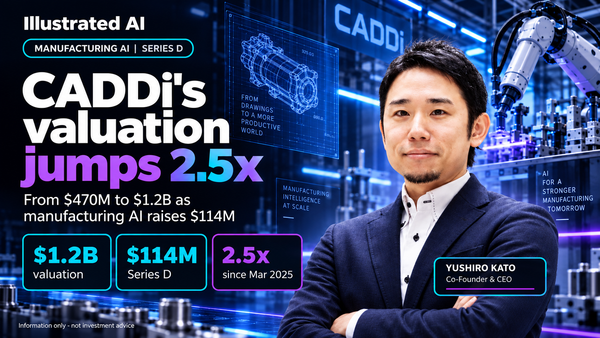
Something important is happening in industrial technology. For years, AI was easiest to imagine in digital worlds: writing software, answering questions, generating images. But the next major battleground is in factories, design offices, procurement departments, and production lines. CADDi has now attracted attention after raising a $114 million Series D at a $1.2 billion valuation.
Invest in top private AI companies before IPO, via a Swiss platform:
 SmartProfit Finder AG
The valuation reflects investor expectations that CADDi could become an important data and intelligence layer for manufacturers. However, a private financing valuation represents the negotiated terms of a funding round rather than an independent measure of commercial performance. The financing brings CADDi’s total funding to $234 million. The company says the new capital will support technology development, expansion of its Manufacturing AI Data Platform and global operations centred on North America.
Manufacturing has often been overlooked in mainstream AI excitement because it is harder to transform. Industrial work runs through design files, technical drawings, supply chains, and inspection records. One mistake can cause delays, defects, or wasted materials. If a company can make this information easier to use, the payoff can change cost, quality, speed, and resilience across an entire operation. Investors are responding to the possibility that CADDi can unlock that hidden value at scale.
Most factories are full of information that behaves like buried treasure without a map. Knowledge accumulates across CAD drawings, procurement records, quality reports, and engineering notes — rich in insight yet poor in usability. This is the problem CADDi is attacking: connecting scattered industrial information so it can be understood in context.
The key concept is a semantic data layer — a system that does more than store information. It interprets meaning and connections, helping software understand that one design relates to a specific supplier history, or that a quality issue connects to a process variation. Instead of users hunting through digital filing cabinets, industrial knowledge becomes something machines and people can reason over together.
CADDi says its platform can help engineers find relevant designs, historical costs and quality information associated with previously manufactured parts. These capabilities could shorten development cycles and reduce duplicated work, although CADDi has not disclosed independently verified, company-wide customer outcomes. A procurement team can assess an alternative supplier using historical fit and quality risk data. By turning fragmented records into shared operating context, CADDi could make manufacturing knowledge more reusable. If customers can apply accumulated information across projects and departments, the platform may become more valuable as its use expands.
CADDi is expanding beyond information discovery into agent-based manufacturing workflows. The company says CADDi Agent can analyse manufacturing data, support decisions and take actions within a customer’s operating context. That is a major shift: the difference between software that helps someone search and software that participates in work.
In industrial settings, useful action is much harder than answering a question. Decisions must reflect specifications, processes, costs, compliance requirements, and physical constraints. A connected intelligence layer grows more valuable with each additional workflow it touches, becoming the connective tissue that helps engineering, procurement, production, and quality coordinate. Engineers move faster using historical precedents. Buyers respond better with richer technical context. Quality teams identify patterns earlier.
This vision mirrors how manufacturing organisations actually function — as webs of trade-offs where a design decision influences procurement cost, a supplier issue affects quality, and a production delay alters customer commitments. A true intelligence layer helps organisations navigate these interconnected realities. Built AI-native from the start, this approach reshapes workflows around decision-making rather than record-keeping, moving from useful application to essential infrastructure.
Hard problems create stronger competitive positions when solved well. Manufacturing is data-rich yet insight-poor — a paradox investors can see clearly. AI that bridges even part of that gap could generate substantial gains in efficiency and decision quality across one of the largest and most economically important sectors on earth.
Supply chain shocks and renewed focus on industrial resilience have pushed manufacturing higher on strategic agendas. In that environment, tools improving visibility and decision-making inside factories become part of a larger competitiveness strategy, not merely efficiency upgrades. Participation from software-focused and industrial investors—including Salesforce Ventures and Toyota-backed Woven Capital—suggests interest in CADDi’s position between enterprise software and manufacturing operations. Investor participation, however, does not establish customer adoption or commercial success.
CADDi says it serves manufacturers in more than 20 countries, but it has not publicly disclosed revenue, annual recurring revenue, customer retention, gross margins or profitability. Investors should therefore distinguish reported customer adoption and funding momentum from evidence of sustainable financial performance.
Great narratives demand evidence. Manufacturing companies already use entrenched ERP systems, product lifecycle tools, CAD platforms, and quality-management systems — crowded, mission-critical environments where large incumbents are also adding AI features. Any emerging player must show its approach is materially better, not just innovative. Domain specialisation could provide an advantage: if CADDi's models and semantic architecture generate superior outcomes with technical drawings, part histories, and sourcing complexities, it gains a real advantage generic tools cannot match.
The next critical tests are customer expansion and revenue quality. A billion-dollar valuation establishes high expectations for adoption across teams and workflows. CADDi must now demonstrate that customers are embedding the platform in daily operations. New agent-driven capabilities must generate incremental value customers willingly pay for — proving product expansion is commercially real, not merely experimental.
North American execution and implementation scalability are equally important. Enterprise sales cycles are long, and high-touch deployments must eventually become repeatable enough to scale economically. The strongest proof point will be measurable operational gains: faster design reuse, lower procurement friction, fewer quality surprises, and better supplier decisions. Industrial customers care about outcomes, and so do investors.
Defensibility — becoming hard to replace — may be the ultimate milestone. When customers rely on a platform connecting engineering, procurement, production, and quality, switching away becomes disruptive. That is when software becomes infrastructure. If CADDi can turn fragmented industrial knowledge into everyday operational advantage at scale, it will have done more than ride an AI wave. It will have helped teach factories how to think faster.
The bottom line: CADDi’s $114 million Series D and $1.2 billion valuation reflect substantial investor interest in manufacturing AI. The evidence to watch is North American customer growth, production adoption, retention, deployment costs, revenue expansion and independently documented improvements in engineering, procurement and quality workflows.