Physical Superintelligence: AI for Physics and Data Center Infrastructure
– 5 min read
Something important happens when artificial intelligence stops sorting images or generating code and starts working on the stubborn problems of the physical world. Instead of predicting words on a page, this frontier asks machines to help solve heat, energy, materials, and motion. It is the difference between drawing a bridge and making one stand.
Cambridge-based Physical Superintelligence is built around that leap: use AI to speed up discovery and design of real physical systems, tackling constraints that govern how things actually work. Electricity has limits. Materials wear down. Spacecraft need trajectories that obey gravity. A clever answer is not enough. The answer must survive reality.
Much of the recent AI boom focused on digital products. But every digital revolution eventually hits physical bottlenecks. Data centers need land, power, cooling, and cables. As AI grows more demanding, those bottlenecks become more expensive. The winners may not only be companies creating smarter software, but also those making physical infrastructure work better.
Invest in top private AI companies before IPO, via a Swiss platform:
 SmartProfit Finder AG
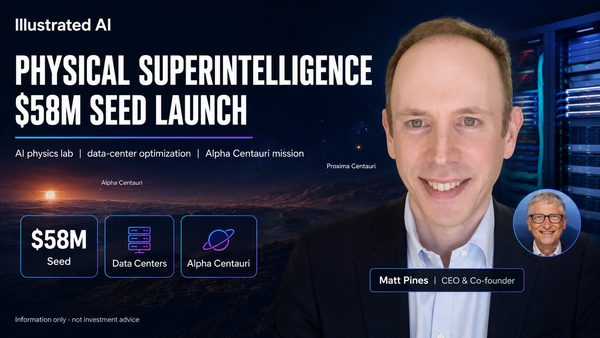
Physical Superintelligence enters this moment with more than $58 million in funding and a pointed mission: target places where engineering complexity blocks progress. If AI can meaningfully improve energy systems or data centers, the economic impact could be enormous. Better engineering reduces costs, increases performance, and unlocks projects that once looked impractical.
At the heart of the company sits a platform called Emmy, inspired by physicist Emmy Noether. Human experts define the goal and constraints. The AI breaks problems into hypotheses, explores possibilities through simulation, and verifies findings. It acts like a fast, tireless research engine testing far more options than a traditional team could manually explore.
Verification is the crucial word. In physical engineering, plausible is dangerous if wrong. A simulation can suggest a breakthrough, but that breakthrough must survive real-world deployment. The software is not meant to generate attractive guesses. It searches, tests, and supports results that can withstand scrutiny.
This could change the tempo of industrial discovery. Traditional engineering moves through expensive cycles: propose, prototype, test, adjust, repeat. An AI-native research loop can examine a much larger design space before real money is spent. Human experts remain essential, defining problems, judging constraints, and deciding which paths deserve commitment. The AI expands the search. Humans supply the judgment.
Scientific progress is often limited not by a lack of ideas, but by the size of the search space. Temperature interacts with materials, materials with geometry, geometry with fluid flow. That complexity can trap teams in local improvements while better solutions remain hidden. A well-designed AI engine can move through permutations rapidly, asking better questions at scale across energy systems, aerospace, advanced manufacturing, and beyond.
The first commercial proving ground is the data center. Every rack, cable, cooling channel, and airflow pattern matters. As AI systems grow larger, these facilities face growing pressure: significant electricity consumption, large heat generation, and highly coordinated designs where networking, cooling, and compute must operate together without waste.
Physical Superintelligence's pitch is straightforward: use AI-driven physics and simulation to optimize data center systems before construction or through retrofits. A single design change improving cooling flow, reducing wasted energy, or supporting higher compute density can be worth a great deal. If better simulation reduces design iterations needed to reach a high-performing configuration, savings come from lower energy bills, faster deployment, and fewer costly missteps.
Consider how many variables collide inside a modern facility. Servers need stable electrical supply. Heat must be removed rapidly, but cooling equipment consumes energy too. Networking layouts affect performance. Space utilization affects expansion. Each decision affects several others. That is exactly the kind of multi-variable problem AI is suited to explore, simulating interactions and exposing trade-offs not obvious through conventional workflows.
AI infrastructure competition increasingly depends on how efficiently companies can deploy and operate compute. A company making data centers cheaper or more reliable influences competitiveness at the system level. Customers want lower power usage, stronger thermal performance, and reduced capital intensity. Those are hard metrics. A company proving benefits along those lines earns serious commercial credibility.
Every young company needs a proof point that captures imagination. Physical Superintelligence has chosen participation in a privately funded mission aimed at sending a spacecraft toward Alpha Centauri. The objectives are extraordinary yet oddly disciplined: reach at least 99% of the way to Alpha Centauri within 80,000 years, carry a one-kilogram payload, launch before end of 2029, and keep total costs below $15 million.
PSI helped devise and validate the mission's proposed flight profile, which uses a series of perihelion-pump maneuvers near the Sun to build velocity while remaining within the mission's mass and budget constraints. Space missions live or die by precision. If a system helps uncover a viable route through those constraints, that is a stronger statement than any benchmark score on a standard AI test.
The brilliance of this mission as a signal lies in contrast. On one side sits near-term data-center optimization, grounded in immediate economics. On the other, a mission stretching human planning over tens of thousands of years. Together they communicate breadth. The platform is presented as useful for both practical infrastructure and extreme aerospace reasoning.
Technology markets fill with incremental claims. By connecting its platform to a long-horizon exploration concept, the company positions itself within a larger narrative of discovery, hinting that AI might expand what engineers are willing to attempt. That kind of narrative attracts talent drawn not only to compensation, but to missions that feel consequential.
The investment story is larger than one company. The first wave of AI excitement was dominated by software: models, interfaces, and cloud scale. The next phase broadens toward the physical layer, meaning the infrastructure, materials, energy systems, and engineering processes required to make AI growth sustainable.
Bottlenecks create opportunity. More compute requires more electricity, which creates more heat, demanding better cooling. The system becomes a chain of physical compromises. Solving those compromises is extremely valuable. Investors are paying attention to companies attacking infrastructure constraints because customers have urgent needs and large budgets, with value propositions tied to capital expenditure and operating efficiency.
Physical Superintelligence's disclosed funding of more than $58 million, led by a major climate and technology investor, signals that sophisticated capital is interested in this category. The team draws from physics, AI, and engineering backgrounds across top institutions. That mix reflects reality: solving physical-world problems requires interdisciplinary strength that pure software talent cannot provide alone.
The real questions remain practical. Can the platform generate measurable outcomes? Can it lower power usage, improve thermal efficiency, raise compute density, or cut capital costs? Can early wins extend into adjacent markets without losing rigor? Is it a scalable software system with repeatable advantages, or a consultancy dressed in AI language? Investors care deeply about that distinction.
The broader implication may be the most interesting. As AI matures, value creation could extend beyond model developers toward businesses that make large-scale intelligence more efficient and physically deployable. Cooling, power architecture, materials science and engineering optimization are increasingly important parts of that infrastructure stack. For PSI, the key test will be whether its ambitious physics platform can translate into repeatable, measurable improvements in real-world systems.