OpenAI’s Reported 2027 IPO Timeline
– 2 min read
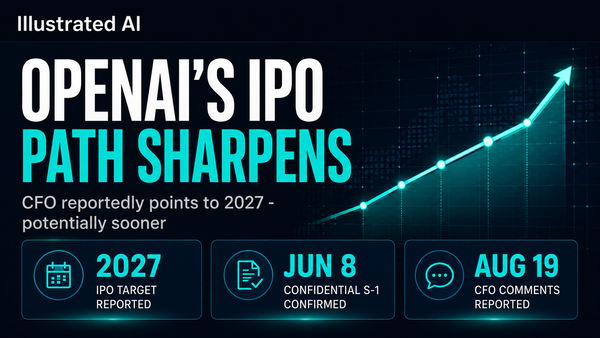
OpenAI has submitted a confidential draft S-1 registration statement to the SEC, transforming years of speculation into formal IPO preparation. This legal and financial foundation allows the company to work with regulators behind the scenes while preserving flexibility on timing. The filing signals that public shareholders could soon become part of the story, marking the moment where imagination meets formal scrutiny.
The door to an IPO is no longer hypothetical. It is open.
Invest in top private AI companies before IPO, via a Swiss platform:
 SmartProfit Finder AG
According to internal employee meeting reports, OpenAI's finance leadership expects a public listing by 2027, with potential to move earlier if momentum holds. While no official date exists, a target year reshapes behavior across the board. Employees reassess equity, investors sketch valuations, and competitors recalibrate strategy. The reported timeline also signals work still ahead: expanding enterprise revenue, clarifying governance, and strengthening financial maturity before full public exposure.
No date has been declared, but the clock has started to matter.
Frontier AI is structurally expensive. Training advanced models, serving millions of users, and continuously improving capabilities demands colossal computing infrastructure. Growth intensifies rather than reduces capital needs. Public markets offer access to broader funding pools that private backing alone may no longer satisfy. A successful listing would also create a traded currency useful for hiring, acquisitions, and partnerships, though it demands a convincing explanation of long-term economics.
The magic of AI feels effortless, but the machine behind it needs mountains of money.
Going public replaces mystery with microscope. Investors would scrutinize revenue composition, cost structure, enterprise adoption, and governance. OpenAI's unusual corporate structure would attract particular attention. Quarterly reporting creates ongoing accountability, forcing management to justify spending, explain slowdowns, and demonstrate measurable progress. Critically, OpenAI's disclosures could reset expectations across the entire private AI sector, separating genuine fundamentals from broad narrative.
Going public would not just raise money. It would expose the business to the full force of truth.
The first major AI company to reach public markets sets the benchmark. It shapes valuation frameworks, governance standards, and how investors model growth across the entire sector. Early movers gain talent, credibility, and capital advantages, but also bear the heaviest scrutiny. A successful listing could reopen exit channels for late-stage investors while imposing tougher standards on private peers. Ultimately, the race is no longer only about building better models.
Who lists first may not win the whole race, but they could set the rules for everyone else.