OpenAI’s $1.2 Trillion Funding Talks and the New AI Valuation Ceiling
– 4 min read
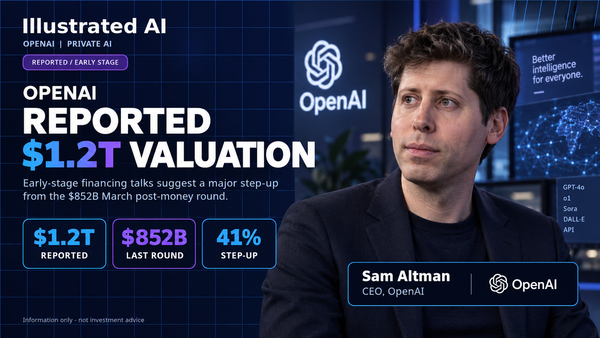
OpenAI is reportedly in early discussions with investors about a possible financing that could value the company at approximately $1.2 trillion. No transaction has been agreed, and the timing may depend on whether OpenAI proceeds toward a public listing.
Invest in top private AI companies before IPO, via a Swiss platform:
 SmartProfit Finder AG
The reported valuation would represent a substantial increase from OpenAI’s March 2026 financing, which valued the company at $852 billion post-money. It should not yet be treated as an established valuation: until investors commit capital and the financing terms are disclosed, $1.2 trillion remains a figure under discussion.
Even so, the talks illustrate how private investors are assessing companies that combine frontier models, large-scale computing infrastructure, global distribution and growing enterprise adoption. The potential valuation increase may reflect expectations of continued revenue growth and strategic importance, but it also raises the standard of commercial and financial performance required to justify the price.
Behind every AI interaction is a capital-intensive infrastructure system. Frontier AI runs on vast computing clusters, advanced chips and data centres with substantial energy requirements and continuous reinvestment. Maintaining a leading position may require continued investment in model development, inference capacity, data, engineering talent and product distribution. These objectives require substantial capital. Competition depends not only on current model capability but also on the ability to finance continued development.
This spending is aimed at building general-purpose technology touching nearly every industry. The technical and financial barriers may limit the number of companies capable of operating at frontier scale. High capital requirements may limit the number of companies capable of competing at scale, increasing the strategic value investors assign to well-funded platforms.
Large private financing rounds are allowing leading technology companies to remain private for longer. Staying private longer allows management to focus on building infrastructure and scaling products without constant quarterly scrutiny. Private financing can provide additional time to invest in infrastructure and commercialization, although investors may receive preferences and contractual protections that materially affect the economics for other shareholders.
Strategic investors bring more than cash. They offer compute access, cloud partnerships, and enterprise credibility. Those extras can be as valuable as the capital itself. Structure matters too: liquidation preferences, voting rights, and conversion features shape real economics far more than headline numbers suggest. If OpenAI proceeds with a public listing, a significant portion of its private-market repricing may already have occurred.
In frontier AI, financing supports model development, computing capacity, product pricing and expansion into new markets. A well-funded company may be able to invest before new products become profitable, subsidize adoption and expand infrastructure more rapidly than less-capitalized competitors.
Large financing rounds may also signal institutional support, but capital alone does not establish durable advantage. The commercial outcome will depend on model performance, customer adoption, revenue growth, infrastructure efficiency and the company’s ability to manage substantial operating costs.
Reports indicate that OpenAI’s annualized revenue recently exceeded $40 billion, while the company spent approximately $34 billion in the previous year. These figures illustrate both sides of the valuation argument: rapid commercial growth and exceptionally high infrastructure expenditure. Because OpenAI remains private, investors should distinguish reported run-rate figures from audited annual revenue and examine profitability, gross margins and cash consumption when fuller financial disclosures become available.
Investors should look beyond the headline valuation. Watch whether discussions become formal agreements with committed capital and confirmed structure. Examine the amount of committed capital, the investors participating and whether commitments are conditional or funded immediately. Scrutinize terms for downside protections and strategic rights that alter who bears risk and who captures upside.
Revenue growth can indicate commercial demand, but investors must assess it alongside gross margins, customer concentration and the cost of serving that demand. Cash consumption reveals whether spending is buying durable advantage or masking weakness. Compute economics may be the most underappreciated factor: if unit costs decline while usage expands and pricing remains resilient, margins may improve over time. Secondary-market pricing offers a reality check against headline fundraising figures.
Investors should distinguish the reported valuation discussion from a completed financing. The central evidence will be the final transaction terms, committed capital, revenue growth, gross margins, cash consumption and compute efficiency.
The bottom line: A possible $1.2 trillion valuation would place OpenAI in an exceptional private-market category, but the figure remains preliminary. The investment case will depend on whether OpenAI can convert rapid adoption and revenue growth into sustainable economics while funding the substantial infrastructure required to develop and operate frontier AI.