NVIDIA Powers the AI Infrastructure Boom
– 3 min read
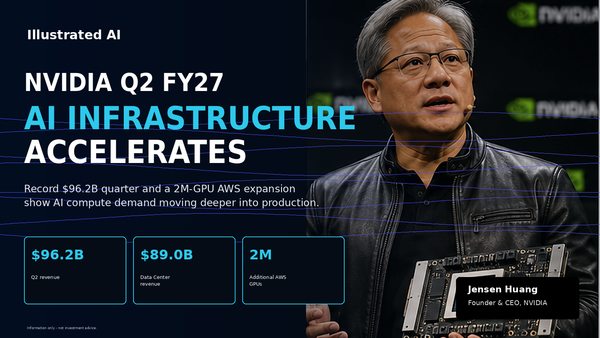
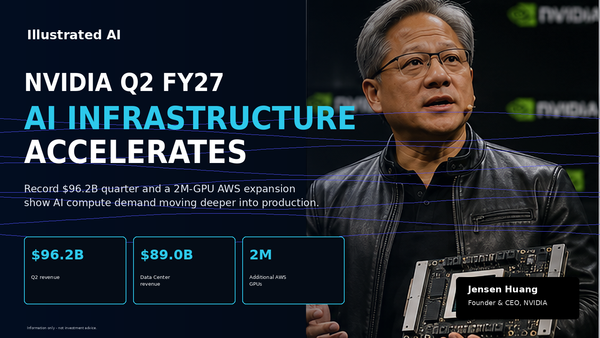
AI is no longer a science experiment. It is becoming industrial. NVIDIA sits at the center of this construction boom, posting $96.2 billion in quarterly revenue with 106% year-over-year growth. That acceleration signals a major shift: businesses, cloud platforms, and governments are treating AI as necessity, not curiosity.
Invest in top private AI companies before IPO, via a Swiss platform:
 SmartProfit Finder AG
Think of it as a modern gold rush where the most valuable resource is computing power. Companies worldwide are racing to train AI models, run them at scale, and embed them into daily operations. NVIDIA supplies the picks and shovels. Demand is broad, urgent, and structural — not a passing wave. Guidance for the following quarter stood at approximately $108 billion, signaling the build-out is broadening, not cooling.
Of $96.2 billion in quarterly revenue, $89.0 billion came from Data Center sales. AI workloads are extraordinarily hungry, requiring massive processor clusters running continuously. NVIDIA's hardware and software ecosystem helps customers build these systems efficiently and at scale.
Critically, NVIDIA is no longer just selling a chip. It is architecting entire computing environments — integrating processors, memory, networking, cooling, and software. Once customers design AI services around a platform, switching costs become high, making the relationship sticky and recurring. The Data Center segment is where AI moves from buzzword to business model.
AWS plans to deploy 2 million additional NVIDIA GPUs across global infrastructure in 2027 and 2028. This is not just a large order — it is a multi-year forecast wrapped in steel and silicon. AWS is preparing for an era, not a moment, expecting AI usage to rise across agentic AI, scientific discovery, enterprise automation, and robotics.
The partnership extends beyond GPUs into CPUs, networking, open models, and robotics — a deeply integrated relationship that becomes harder to unwind over time. Large hyperscaler commitments also influence everyone else: enterprises, developers, and smaller cloud providers tend to align around platforms gaining scale fastest, amplifying momentum further.
NVIDIA's most significant strategic shift is from component supplier to AI factory architect. An AI factory is a complete environment — compute, networking, memory, software, and robotics tools — built to create and run AI at industrial scale. The stack now spans GPUs, Vera CPUs, Spectrum networking, NVLink, Nemotron open models, CUDA libraries, and robotics platforms.
This matters because factories are more valuable than components. At global deployment scale, power, bandwidth, latency, and software compatibility all become critical. A full-stack provider simplifies an enormously complex engineering challenge. As AI extends into physical robotics and autonomous systems, tightly integrated platforms become even more essential — shifting the company from chip vendor to indispensable infrastructure architect.
The immediate milestone is $108 billion in quarterly revenue, but smart investors focus beyond the number. Supply-chain execution is central — chips, memory, networking, power, and software must all align for customers to deploy on schedule. Customer concentration among a handful of hyperscalers creates real risk if any major buyer slows spending or shifts toward custom silicon.
Gross margins reveal whether pricing power and differentiation are holding. Competition is intensifying as rivals develop alternative accelerators. And the broader question remains: will this investment cycle sustain as a multi-year foundation, or pause as customers digest capacity? The encouraging signal is that demand is diversifying across enterprise, scientific, automation, and physical AI applications — suggesting durability rather than a single-wave boom.
The ultimate prize is not selling more hardware. It is becoming indispensable in the architecture of the AI age — lasting control of the engines powering the future.