Isomorphic Labs’ $5B Bet on AI-Designed Drug Discovery
– 3 min read
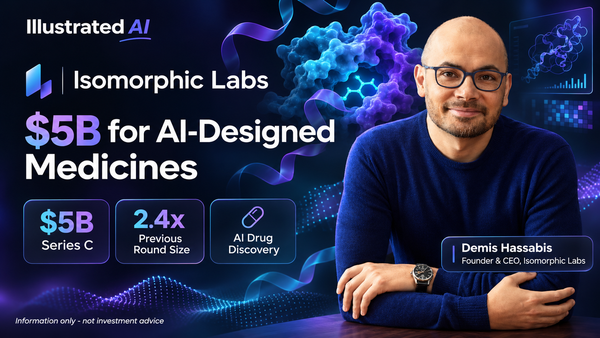
Isomorphic Labs announced a $5 billion Series C on 17 November 2026, co-led by Greenoaks and Sequoia Capital, with participation from Andreessen Horowitz, Alphabet and other investors. Proceeds will support its IsoDDE drug-design engine, therapeutic pipeline and translational and clinical-development infrastructure. The announcement does not disclose a valuation.
Invest in top private AI companies before IPO, via a Swiss platform:
 SmartProfit Finder AG

Something unusual is happening at the intersection of artificial intelligence and healthcare. Capital is pouring in at a scale normally reserved for giant infrastructure projects, while Isomorphic Labs attempts something medicine has struggled with for decades: designing better drugs faster, cheaper, and with a higher chance of success.
Traditional drug development is slow, expensive, and filled with failure. AI promises to change that by helping scientists predict, simulate, and refine molecules before they ever reach the lab bench. That promise explains why Isomorphic Labs, founded out of the Google DeepMind ecosystem, has captured such intense investor attention.
A $5 billion Series C round is not ordinary venture funding. It tells the market that backers see the company not as a niche experiment, but as a platform capable of reshaping a massive global industry. The round is approximately 2.4 times the $2.1 billion Series B announced in May 2026. This compares financing amounts, rather than company valuations, scientific productivity or investor returns.
Yet discipline matters here. A large fundraising round is confirmed capital, not confirmed success. It does not prove a drug is close to market. It simply means the company now has substantial resources to pursue its strategy at greater speed and scale. The money increases possibility. It does not erase risk.
Isomorphic Labs describes IsoDDE as a unified system of predictive and generative models that helps researchers design molecules, estimate their properties and refine candidates before synthesis and laboratory testing. Its reported computational performance does not by itself establish shorter development timelines, lower total costs or higher clinical success rates.
The most seductive mistake is assuming that because AI is powerful, drug development will suddenly become easy. A useful drug candidate must achieve potency, selectivity, stability, manageable toxicity, and manufacturability simultaneously. Living biology regularly surprises even the best computational models.
The real value of AI is not eliminating experimentation but making it smarter. Instead of testing vast numbers of weak candidates, scientists may test a smaller set of stronger ones, saving money and improving odds. Isomorphic reports positive preclinical results from internal oncology and immunology programmes and partnered work. The funding release does not provide detailed candidate-level results sufficient to assess safety, efficacy or reproducibility independently. Preclinical findings do not establish benefit in humans, and progressing towards trials is distinct from beginning patient dosing.
Isomorphic Labs has research collaborations with Eli Lilly, Novartis and Johnson & Johnson. These establish pharmaceutical engagement, rather than proof of clinical efficacy or repeatable platform economics. The business combines partnered research with internally owned programmes, whose financial outcomes depend on contract terms, development milestones and eventual clinical results.
Competitive position is another test. Firms such as Recursion and Insilico Medicine are also pursuing AI-assisted discovery. Winners will be decided by durable advantages in data quality, model strength, and experimental integration, not hype alone.
The unanswered question is the one that matters most: can this model produce repeatable drug-development economics? Can AI create medicines more efficiently in a way that justifies the capital deployed? If yes, it could change how venture capital approaches biotech, alter partnership models between technology firms and pharmaceutical giants, and make previously unattractive disease areas commercially viable.
The bottom line: Isomorphic Labs’ financing supports expansion of its AI drug-design platform and therapeutic pipeline. Pharmaceutical collaborations and company-reported preclinical progress do not establish improved clinical success rates or sustainable drug-development economics. Investors should watch named candidates, trial registrations, first-patient dosing, safety and efficacy results, collected partnership payments and development costs.