Model ML Raises $250M as AI Agents Enter Banking Workflows
– 4 min read
Beneath every merger pitch, valuation model, and diligence pack sits a mountain of repetitive labor. Analysts pull figures from multiple systems, associates update assumptions, and teams reformat slides late into the night. That is why the rise of AI agents in banking feels significant. This is not about a chatbot producing clever text. It is about software doing real work inside one of the most complex and controlled industries in the world.
Invest in top private AI companies before IPO, via a Swiss platform:
 SmartProfit Finder AG

Model ML has positioned itself at the center of that shift, building AI agents that operate within the tools financial professionals already use. The promise is an AI system that connects to internal data, reads live deal materials, understands preferred formats, and helps produce outputs teams actually need. This changes the story from "AI can answer questions" to "AI can complete tasks." A question-answering tool saves a few minutes. A task-completing agent can reshape an entire workflow.
Reducing manual work could improve turnaround times and staff capacity. Net productivity gains depend on output accuracy, source traceability, integration effort and the time professionals spend reviewing and correcting results. Faster drafting does not alone establish better analysis or lower total delivery costs.
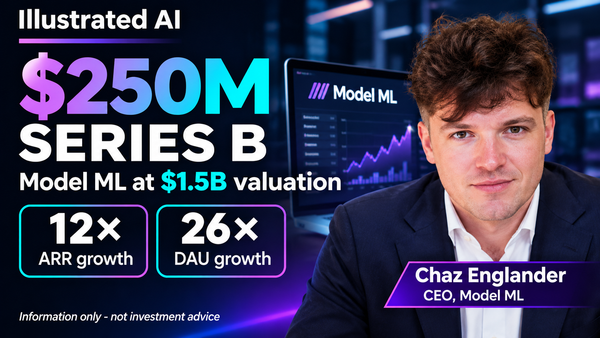
Model ML announced a $250 million Series B on 17 November 2026 at a $1.5 billion valuation, co-led by General Atlantic and QED Investors. The company says total funding now stands at $350 million. Proceeds will expand research and engineering teams and support wider customer deployments. Financing demonstrates investor backing, rather than independently established productivity, security or profitability.
The raise also signals a broader market shift toward application-layer AI focused on specialist workflows with clear economic value. The question is no longer simply what AI can do, but where it can be paid for doing something valuable. That said, a funding round is a vote of confidence, not a final verdict. It does not reveal revenue, margins, or retention. Capital opens doors. Only execution keeps them open.
Model ML reports twelvefold year-on-year ARR growth in Q3 2026 and a 26-fold increase in daily active users. The announcement does not disclose absolute ARR, user counts or calculation methods. These company-reported multiples indicate expansion, but do not establish recognised annual revenue, paid-user growth, retention or profitability.
Quality within the growth matters equally. Pilot projects can inflate early metrics without converting to durable enterprise contracts. Retention, renewal rates, and seat expansion reveal whether a company is building a lasting platform or surfing temporary curiosity. The growth figures are a strong signal that attention is warranted. They do not yet settle the deeper question of scale or durability.
Model ML says its fine-tuned open-source models run at approximately 2% of frontier-model cost and, in most cases, five times faster on the workloads they handle. It also uses other models through task routing. The announcement does not provide sufficient benchmark methodology for independent assessment. These comparisons do not establish equivalent savings across the complete platform or customer workflow.
Speed also matters in live financial work, where delays have real costs. A faster system fits into actual workflows rather than being reserved for occasional experimentation. Yet cost and speed only matter if quality holds after review. A cheap model that produces frequent errors may be more expensive in practice once human correction is factored in. Quality-adjusted cost per completed task is the metric that truly matters, and the winning system is the one that minimizes total effort for an acceptable standard of accuracy. If that balance is achieved, the technology does not simply automate a few tasks. It rewrites the economic equation of the workflow itself.
Financial institutions handle confidential information and client relationships built over years. Any software touching that environment must satisfy strict expectations around privacy, auditability, and accountability. A black box is not a feature in professional finance. It is a liability. Winning institutional confidence takes time, but once earned, it becomes a formidable advantage.
Integration is equally decisive. The more deeply a product fits into established workflows, understanding firm-specific context and producing outputs in formats teams already use, the more it becomes part of the daily routine rather than an optional experiment. Integration could support repeat spending and increase switching costs. Retention, expansion and pricing power still depend on reliability, implementation value, pricing, portability and available alternatives. Pilots are easy to celebrate. Enterprise-wide adoption is harder and far more valuable.
The bottom line: Model ML’s financing and company-reported growth support expansion of its financial-services AI platform. They do not establish broadly reproducible productivity gains, regulatory compliance or sustainable profitability. Investors should watch recognised revenue, ARR definitions, renewals, paid usage, customer concentration, reviewed-output accuracy and margins after inference, implementation and support costs.