Databento’s Billion-Dollar Bet on AI-Ready Market Data
– 4 min read
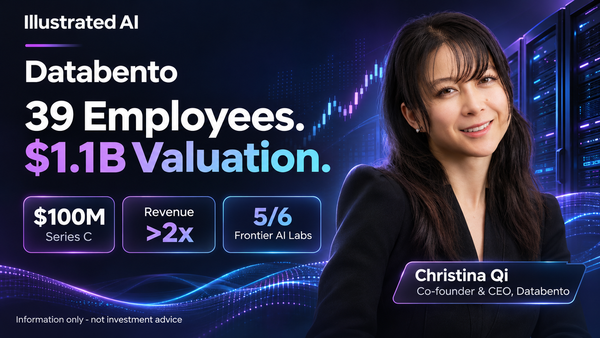
Databento announced a $100 million Series C on 12 November 2026 at a $1.1 billion valuation, led by Fifth Down Capital, with Fitch Ventures joining as a strategic investor. The company says it had 39 employees at closing. Its lean headcount is notable, but does not establish total operating costs, productivity relative to competitors or sustainable margins.
Invest in top private AI companies before IPO, via a Swiss platform:
 SmartProfit Finder AG

The company supplies market data: prices, trades, quotes, and exchange messages that power modern investing. Think of it as the electrical grid of financial decision-making. By building this hidden transport layer with a leaner model than investors expect, Databento is challenging the idea that only giant vendors can own the rails of market information.
Technology keeps shrinking the team size needed to tackle massive markets. Better software, cloud systems, and focused execution allow a small group to do work that once required sprawling organizations. When a young infrastructure company proves that promise at scale, it draws attention for good reason.
Databento says revenue more than doubled after its earlier Series B while it remained profitable. The announcement does not disclose absolute revenue, profit margins, the accounting basis for profitability or financial statements supporting independent assessment. Growth alongside profitability does not alone establish operating leverage or positive free cash flow.
The $100 million Series C announced in November and $97 million Series B announced in July total $197 million in financing during 2026. This is distinct from revenue, lifetime funding and cash currently available.
Sustained profitability could provide strategic flexibility, but expansion capacity also depends on cash collection, infrastructure expenditure, exchange fees, working capital and financing commitments. Reported profit alone does not establish that operations can fund the planned buildout.
The strongest reading is disciplined optimism. The combination of fast revenue growth and profitability suggests real commercial traction—but without detailed disclosure of ARR, margins, or customer concentration, important unknowns remain. Confidence begins not with the size of the round, but with the quality of the business emerging behind it.
Databento says it has signed enterprise contracts with five of what it describes as the six largest frontier AI labs. The announcement does not identify those counterparties, define the ranking or disclose contract values, permitted uses or resulting revenue. This indicates company-reported commercial relationships, rather than independently demonstrated AI performance.
Market data arrives in different exchange formats. Normalisation can make records easier to process consistently, but users still need to assess timestamps, instrument identifiers, coverage, corrections and missing observations.
Accurate source data can support AI workflows, but does not prevent hallucinations, establish predictive value or guarantee sound financial decisions. Training, retrieval, redistribution and other uses must also comply with the applicable data licences.
AI developers represent a potential additional customer segment. Its commercial importance depends on paid usage, renewals, contract economics and licensing costs. Entering that segment does not by itself establish pricing power or stronger retention.
Databento says it nearly completed infrastructure buildouts at nine data centres over four months. Near-completion does not establish that every location is commissioned, delivering its intended coverage or generating revenue.
Machines are less forgiving than humans. They need stable pipelines and consistent delivery, increasing the value of providers who abstract away complexity while preserving data fidelity. Newer infrastructure companies compete differently from legacy vendors by offering cleaner APIs, flexible delivery, and easier integration into modern software stacks—making powerful data effortless to consume.
Integration into customer workflows could support repeat spending and increase switching costs. Durable retention depends on coverage, accuracy, reliability, pricing, portability and available alternatives.
Databento is not entering an empty field. Established data vendors have spent decades building relationships, distribution networks, and deep enterprise integration. The fresh capital funds more data-center deployments and broader venue coverage—but turning capital into durable advantage is the real test.
The company's wedge is usability. Better developer experience shortens implementation time, accelerates experimentation, and reduces friction. Small improvements in usability produce big shifts in adoption when technical teams are choosing tools. But the path forward depends on four measurable signals.
First, sustained enterprise adoption among AI labs. Second, the pace of new venues and asset classes going live. Third—and most revealing—whether profitability survives expansion. Sustaining profitability and positive cash flow through expansion would provide stronger evidence of operating resilience, particularly if margins and service reliability also hold. Fourth, future disclosure on revenue retention and customer concentration, revealing whether growth is broad-based and recurring.
This story captures disruption in motion: a small company carving space inside one of finance's most demanding markets while connecting itself to the rise of frontier AI. Contracts must deepen, infrastructure must hold, and costs must stay controlled. If it succeeds, it will prove the future of AI is built not just on models—but on trusted inputs, disciplined infrastructure, and the companies that make complexity feel effortless.
The bottom line: Databento’s financing and company-reported growth support expansion of its market-data business. Lean headcount, reported profitability and AI-lab contracts do not establish durable margins or superior AI outcomes. Investors should watch recognised revenue, profitability definitions, cash flow, customer concentration, renewals, licensing costs and commissioned infrastructure.