Genesis AI’s $500M Bet on Smarter Robot Hands
– 5 min read
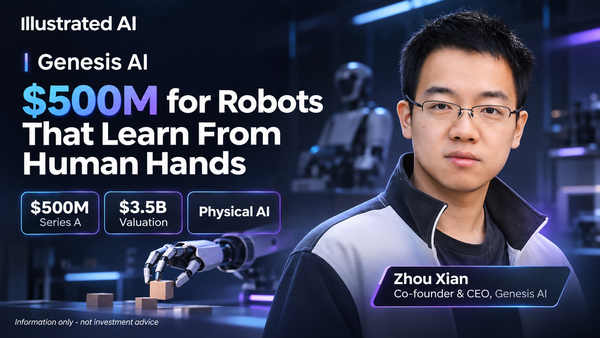
Genesis AI announced a $500 million Series A on 17 November 2026 at a $3.5 billion post-money valuation. Premji Invest, Khosla Ventures and Eclipse co-led the round. The funding will support data collection, model training, hiring and deployment of Eno, its flagship robot, initially targeting manufacturing, logistics and laboratories. Financing does not establish production readiness or profitable deployment economics.
Invest in top private AI companies before IPO, via a Swiss platform:
 SmartProfit Finder AG

AI is moving out of the screen and into the real world. For years, it dazzled us by writing text and answering questions. Now a harder challenge takes center stage: teaching machines to do useful physical work — gripping, sorting, packing, and adapting in messy environments where real objects rarely behave as software expects.
In a warehouse or factory, mistakes mean dropped items, broken parts, and higher costs. A robot impressive in a video is not necessarily one that survives daily industrial chaos. That gap between demonstration and dependable performance is where the real race is happening.
The new thinking: robots should learn by watching humans perform tasks, then improve through simulation and real-world experience. Intelligence in the physical world requires data about movement, pressure, timing, and the subtle adjustments human hands make without conscious thought. A $500 million Series A at a $3.5 billion valuation signals investors see more than a robotics experiment — they see a platform for bringing AI into labor-intensive industries.
If software automates thought, physical AI automates action. Many industries still depend on repetitive manual tasks that are expensive to staff and hard to scale. Even modest progress matters economically, because real-world labor tasks are everywhere. The first wave of AI transformed information. The next may transform work entirely.
Genesis AI says its data-collection glove uses tactile sensing alongside a robotic hand designed to resemble human-hand geometry. The approach aims to capture information about movement and contact that video alone does not directly measure. The company also uses human-viewpoint video and simulation in its training system.
Matching the glove and robotic hand could simplify parts of skill transfer. It does not eliminate differences in strength, compliance, sensing or control between humans and robots. Commercial value requires evidence that the resulting policies perform reliably across unfamiliar objects, layouts and operating conditions.
Demonstration data could support differentiation if the company has appropriate collection and training rights and can convert it into validated performance gains. Dataset growth alone does not establish a moat. Investors should look for improvements in task success, generalisation, intervention rates and total deployment costs.
Nothing in robotics is more seductive than a great demonstration. But in the commercial world, it is only an opening scene. Customers need to know whether a robot can repeat a task thousands of times under changing conditions without becoming a bottleneck. A machine that succeeds once is interesting. One that succeeds every shift is valuable.
Deployment demands tolerance for variation: objects arriving in different orientations, inconsistent packaging, shifting lighting, and human coworkers altering workflows without warning. These are not edge cases — they are normal conditions. Repeatability is everything. The robot must perform on Monday morning and Friday night, after months of wear, recovering from small disruptions rather than requiring constant rescue.
Economics then become the judge. Enterprises compare machines against human labor, simpler automation, and competing platforms. Throughput, failure rates, service intervals, and total cost of ownership all come into view. The robot must win not just technically, but financially.
The most exciting vision in robotics is mundane success at scale — a robot quietly doing useful work, every day, across many sites, with predictable economics. That is far more disruptive than any viral clip, and ultimately the only standard that matters.
Genesis AI is developing GENE, its robotics foundation model, alongside dexterous hands, data-collection gloves, Genesis World simulation and Eno. The company’s thesis is that developing these elements together will accelerate improvement. That is a development strategy, rather than independently established evidence of superior reliability or learning speed.
Integration could improve coordination across hardware, training and evaluation. A durable advantage would require measurable gains relative to alternatives, including faster deployment, lower support requirements and better customer economics. Simulation results must also transfer reliably to physical systems.
But full-stack control is unforgiving. Owning more means bearing more cost and execution risk. If manufacturing is inefficient, economics weaken. If simulation misses real-world conditions, training suffers. Integration magnifies strengths — and weaknesses. The prize goes not to the company with the most exciting prototype, but to the one with the strongest integrated system and deepest operational intelligence.
Reuters reports that Genesis is testing a small number of robots with customers and expects a wider rollout in 2027. These are early deployments and forward-looking plans, rather than evidence of broad production adoption.
TechCrunch reported that Genesis’ dexterous hands currently require replacement after only a few weeks of regular work.
Capital raised is not value created. A large financing signals expectation, not confirmation. The smartest way to read a high valuation is as a statement of possibility — the company still has to deliver.
Key milestones to track: Do pilots convert into disclosed production deployments? Is more data producing better task performance, or just accumulating? Can the system handle new objects and layouts with minimal retraining? Do robotic hands prove durable in the field, with manageable maintenance costs? Can production scale without burning disproportionate capital?
The deeper reason this space attracts attention is that it offers a window into the next stage of AI investing — giving intelligence a physical presence in the economy. Value creation will span sensors, mechanics, simulation, manufacturing, and operations. Investors who understand this shift may see opportunities others miss, because it should not be judged by pure software assumptions.
The watchlist is clear: real deployments, stronger data, better repeatability, durable hardware, scalable manufacturing, and improving economics. If those pieces fall into place, the story becomes far bigger than one funding round — evidence that physical AI is crossing from inspiration into infrastructure.
The bottom line: Genesis AI’s financing supports development and deployment of its integrated robotics platform. Its glove-based training approach and demonstrations do not establish dependable general-purpose autonomy or profitable operation at scale. Investors should watch paid deployments, task success, human interventions, hand replacement intervals, manufacturing yields and margins after maintenance and field support.