BrightAI’s $97M Bet on Always-On Infrastructure AI
– 4 min read
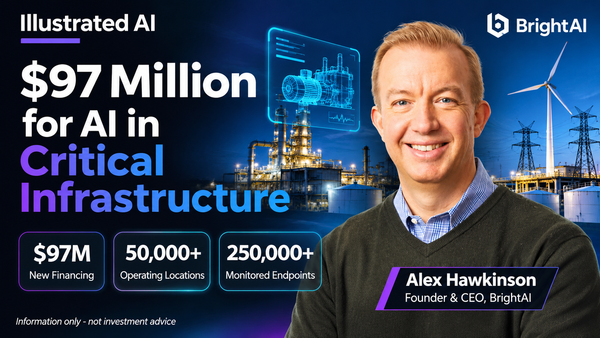
BrightAI announced a $97 million investment on 18 November 2026, led by Smith Point Capital. Participants included GE Vernova, already a customer, alongside Cobalt Capital, Marlinspike Partners, Zero Infinity Partners and existing investors. The company says total capital raised now stands at $184 million.
Invest in top private AI companies before IPO, via a Swiss platform:
 SmartProfit Finder AG

For decades, critical infrastructure was managed with a dangerous gap between inspections. Problems could quietly grow while nobody was looking. BrightAI is closing that gap with a powerful idea: infrastructure should never be silent. Pipes, grids, and machines should behave less like static objects and more like systems with a pulse—constantly generating data about their own condition.
This matters because the physical world is expensive. Unnecessary field visits cost money. Late fault detection causes damage and downtime. BrightAI's "always-on sensing" turns infrastructure into a continuous stream of changing conditions—temperature shifts, vibration changes, pressure variations—aiming to identify abnormal conditions early enough for operators to investigate and respond. Condition data could help operators prioritise field visits alongside scheduled inspections and other maintenance requirements. Its usefulness depends on detection accuracy, asset coverage and integration into operating procedures.
BrightAI says Stateful operates across more than 50,000 locations, integrating millions of sensors and connected systems and monitoring hundreds of thousands of assets. These company-reported measures describe deployment reach, rather than paid customer numbers, recurring revenue or independently measured operational benefits.
The $97 million investment is approximately 1.9 times BrightAI’s $51 million Series A announced in July 2025. This compares financing amounts, rather than valuations or operating performance. GE Vernova’s participation as both customer and investor establishes a commercial relationship, but does not independently validate savings, reliability or deployment economics.
Lifetime capital raised now stands at $184 million, funding a category at the crossroads of AI, sensing, and field services. Investors appear to be backing something bigger than niche software—a new information layer over the physical economy. The backdrop helps: aging infrastructure, cost pressures, and reliability demands create strong structural tailwinds for continuous monitoring technology.
BrightAI’s announcement does not disclose a valuation. Fortune separately reported a $750 million valuation, citing a person familiar with the matter.
BrightAI describes Stateful as combining asset monitoring, anomaly detection and guidance for field crews. Its tools include edge sensors, inspection robots and drones and wearable copilots. Monitoring can supplement existing inspection programmes; it does not establish that scheduled inspections can be eliminated across all assets.
Potential benefits include earlier fault detection and better prioritisation of maintenance. Demonstrating those benefits requires comparable operating conditions, measured false-alert and missed-fault rates and total costs after installation, connectivity, maintenance and field support. Sensors and alerts alone do not establish reduced downtime or improved safety.
Operating across 50,000 sites sounds impressive—but in industrial AI, reach is only the opening act. The main event is whether deployments produce durable economic value. Pilots often perform well under ideal conditions; scaling is harder. Installation costs rise, data quality varies, and support needs multiply. The critical question is whether unit economics remain sound across many sites and customers.
False alerts are a revealing test. A system that cries wolf too often gets ignored; one that misses faults collapses the entire promise. Independent verification—audited savings, third-party case studies, documented downtime reductions—builds the market confidence that company-reported metrics alone cannot. Expansion from anchor customers into enterprise-wide standardization is the signal investors watch most closely.
Hype can open the door. Only hard evidence keeps it open.
BrightAI may appear to be selling smarter inspections, but the deeper ambition is larger. Continuous observation of critical assets creates a growing operational-data layer—structured, accumulating knowledge about how physical systems behave under stress, use, and time. That layer could become the real prize.
Historical observations and intervention records could support better forecasting if data quality, permitted use, model validation and workflow integration are adequate. Improved prediction does not automatically extend asset life or improve capital allocation. Integration could increase switching costs, but retention depends on reliability, pricing, portability and measurable customer value.
Competition will be fierce from established automation providers and enterprise software vendors. But the opportunity is structurally significant: industrial operators cannot afford guesswork, and if continuous intelligence proves its economics, spending will shift toward it not because it's fashionable, but because it becomes essential.
The bottom line: BrightAI’s financing and company-reported deployment reach support expansion of its infrastructure-monitoring platform. They do not establish independently verified savings, reliable prediction across all assets or sustainable profitability. Investors should watch paid deployments, renewals, customer concentration, detection accuracy, downtime reductions and margins after hardware and field support.