Anthropic’s $119.5B AI Market Debut
– 4 min read
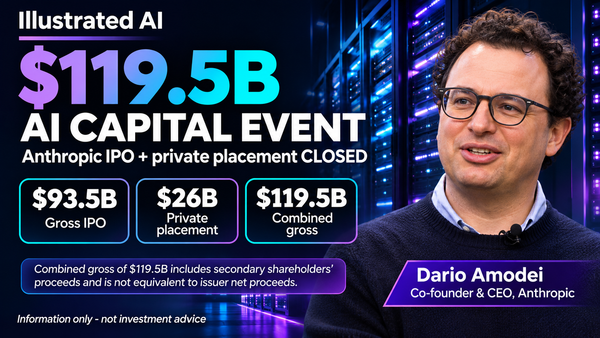
Anthropic announced on 20 November 2026 that it had closed its IPO and concurrent private placement at $83 per share. The IPO generated approximately $93.5 billion in gross proceeds, including selling-shareholder proceeds, while the placement totalled approximately $26 billion. Its Class A shares began Nasdaq trading under ANT on 19 November.
Invest in top private AI companies before IPO, via a Swiss platform:
 SmartProfit Finder AG
Anthropic received approximately $91.6 billion of the IPO’s gross proceeds and the $26 billion placement proceeds—approximately $117.6 billion combined before applicable deductions and expenses. It received none of the selling shareholders’ proceeds. The $119.5 billion headline therefore differs from both company gross proceeds and net capital available.
Capital is the fuel of modern AI. Powerful models require advanced chips, giant computing clusters, engineers, electricity, and constant iteration at a cost few industries can match. Unlike earlier software companies that scaled on light infrastructure, AI resembles a fusion of software, industrial capacity, energy planning, and deep scientific research. The winners may not simply be the cleverest coders but the companies that deploy enormous capital most effectively.
Public markets ask harder questions than private rounds. Once listed, a company moves from promise to proof, facing continuous disclosure, visible price movement, and unrelenting scrutiny. This event raised the stakes dramatically, giving Anthropic more room to compete, more resources to build, and far greater pressure to deliver.
AMD, Broadcom, Google, Micron, Microsoft, NVIDIA and TSMC Partners purchased Class N shares in the concurrent private placement at the same $83 price as the public offering. These were separate from the Class A shares sold through the IPO. Equal purchase prices do not establish identical voting rights or resale conditions.
This signals that AI is evolving into a tightly linked ecosystem where ownership, supply, and competition increasingly overlap. Strategic relationships could support technical coordination and infrastructure access. Any advantage depends on separate commercial agreements, pricing, delivery commitments and execution; equity participation alone does not guarantee supply, customer demand or preferential terms. However, a shareholder is not a guaranteed customer, and a prestigious investor list does not solve the hard problem of turning expensive research into profitable products.
Traditional categories are blurring. Supplier, partner, investor, and customer may all sit at the same table, making analysis harder. Investors cannot simply ask whether AI demand is rising. They must ask who controls the bottlenecks and who can convert strategic alignment into sustainable returns.
Private markets reward possibility. Public markets eventually reward delivery. Once listed, the narrative faces continuous testing. Every day the share price becomes a live scorecard of expectations, fear, and changing assumptions, a dramatic shift for any company operating where hope routinely runs ahead of economics.
Offering price, market capitalisation and financing proceeds measure different things. Full exercise of the underwriters’ option added 147 million company-issued shares, bringing the IPO to 1.127 billion shares. This increased proceeds and the share count; it did not independently demonstrate a corresponding improvement in operating value.
The prospectus gives Class A shares one vote each, while Class N shares generally have no voting rights. The Founder LLC’s Class F share carries 50.1% of voting power on matters submitted to shareholders generally, subject to specified arrangements. Separately, the Long-Term Benefit Trust generally has authority to elect and remove a majority of the board. Public disclosure obligations therefore coexist with substantial founder and trust governance rights.
Can expensive computing power be transformed into valuable, profitable services? That is the question where futuristic vision meets economic gravity. Capital extends runway and supports research, but large capital pools can mask weak economics longer than leaner businesses could. The central challenge is not whether the company can spend heavily but whether that spending produces products customers love and margins that justify the investment.
Inference cost is pivotal. Training teaches a model; inference is what happens every time it answers a question or completes a task. If each user interaction is too expensive, growth becomes a burden. Gross margins signal whether optimization, pricing, and hardware efficiency are improving or deteriorating. Enterprise contracts could support recurring revenue, but their value depends on renewals, usage, pricing, customer concentration and service costs. Consumer demand should likewise be assessed through retention and contribution economics.
Competition from lower-cost models pressures pricing power. Customers will compare quality, reliability, security, and cost. If good-enough alternatives multiply, premium pricing narrows, making differentiation essential. The chain that matters is straightforward: chips into services, services into workflows, workflows into contracts, contracts into durable cash generation. Capital opened the door. Disciplined execution must walk through it.
Big capital events ripple outward. This one created a new benchmark, forcing the entire ecosystem to reconsider what scale now means. For pre-IPO investors it provided a live public reference point. For infrastructure suppliers it was a loud signal that demand for chips, servers, networking gear, power, and cooling could remain enormous for years.
Investors must balance two conflicting instincts: fear of missing a transformational theme and the discipline to avoid overpaying when expectations become extreme. Financing size says nothing about profitability. Cash raised is only the beginning. Markets can mistake funds raised for value created, and the gap between technical brilliance and commercial success in AI can be surprisingly wide.
AI may reward winners at multiple layers simultaneously: model companies, chip providers, cloud platforms, memory suppliers, and power-related businesses could all capture significant value. Portfolio thinking must therefore ask where bottlenecks are tightening, where pricing power is strongest, and where demand is most persistent, because the economics differ sharply across the stack.
The bottom line: Anthropic’s completed IPO and strategic placement provide substantial capital, while public trading introduces continuing market scrutiny. Financing scale does not establish sustainable profitability or guaranteed infrastructure access. Investors should watch net proceeds, dilution, compute commitments, recognised revenue, retention, cash consumption and margins after training and inference costs.