Meta Launches Muse, Bringing Agentic AI to Consumers
– 4 min read
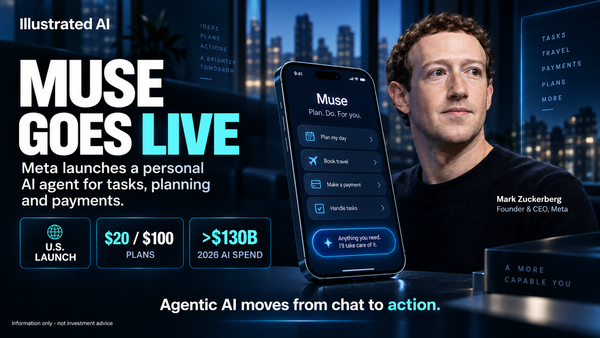
The biggest shift in artificial intelligence is no longer about clever answers — it is about action. Meta's new personal AI agent, Muse, pushes AI out of conversation and into practical daily routines: managing calendars, arranging travel, sending messages, making purchases, and organizing tasks. Instead of behaving like a search box, it aims to behave like a capable digital assistant that actually gets things done.
Invest in top private AI companies before IPO, via a Swiss platform:
 SmartProfit Finder AG
For years, chatbots have been intelligent text machines — useful, but limited. The user still clicks the buttons, compares options, and completes the process. Muse represents a leap toward a different model where AI becomes an active participant, moving from suggestion to execution. A machine that saves five minutes answering a question is useful. A machine that saves an hour by completing a multi-step task is transformative.
Meta’s move matters because of its scale. Billions of people already use WhatsApp, Instagram and Facebook. Muse is initially launching in the United States through its dedicated app, website and WhatsApp. If Meta eventually expands it more broadly across its platforms, even modest adoption could turn AI from a novelty into everyday infrastructure.
Meta’s projected 2026 capital expenditure—expected to begin at approximately $130 billion and driven substantially by AI infrastructure—raises the pressure to demonstrate measurable returns. Muse provides one. A free tier encourages mass experimentation, while paid subscription plans for heavier usage could create a clear path from curiosity to recurring revenue. This model points toward revenue less dependent on advertising alone — subscription income tied to productivity and convenience can be more predictable and direct.
The challenge is converting enthusiasm into paying habits. Consumers must experience tangible, repeated value — not just occasional novelty. But if Muse reliably saves time and handles annoying tasks, subscriptions begin to feel justified. Over time, as the assistant sits closer to actual user decisions and transactions, additional revenue opportunities around commerce, partnerships, and integrations become plausible. Muse transforms AI from a speculative expense into a visible platform investment with a real-world monetization test.
Agentic AI is a genuine inflection point. Traditional assistants answer; agentic AI acts — handling chains of tasks with minimal human intervention. Much of digital life is not intellectually difficult; it is operationally tedious. Too many steps, screens, passwords, and small things to remember. Agentic AI attacks that friction directly.
Trust becomes central. People may chat with an AI they don't fully trust, but they won't let it manage travel or handle transactions unless it proves dependable. Reliability and transparency are core features, not side issues. If AI reaches the level of an operating layer for daily activity, people may increasingly delegate to an agent rather than navigate manually — fundamentally altering how software companies compete. Control could migrate from visible interfaces toward whichever system orchestrates action underneath.
Meta is no longer just competing to build a smart model — it is competing for the trusted gateway through which users delegate real tasks. The platform users trust for action can shape commerce flows, service choices, and daily habits, becoming an intermediary between the user and much of the digital economy.
Meta's key advantage is distribution. Muse isn't launching from a standing start; it has a direct path into existing routines through platforms people already check daily. History shows good-enough technology with broad distribution can outpace superior technology without access to users. For rivals, the pressure is clear: a trusted assistant becomes deeply sticky once it learns preferences and saves meaningful time. The competitive question is no longer which company has the smartest machine — it is which company becomes the most trusted digital delegate.
Big launches create headlines; lasting success depends on harder tests. First, adoption: will people use a personal AI agent repeatedly, in meaningful ways? Trust is especially critical because scheduling, travel, purchases, and messages carry real consequences. Second, monetization: can Meta convert interest into paying demand? Pricing power will come from practical usefulness, not technical sophistication alone.
Third — and most unforgiving — is reliability. Chatbots survive occasional odd answers; agentic systems do not. A wrong booking, missed deadline, or mishandled purchase causes immediate, personal damage. Consistency is not a bonus here; it is the product. Fourth is competitive response: rivals will accelerate, targeting gaps with specialized vertical agents and narrow high-reliability use cases.
Muse converts a grand AI spending narrative into something measurable — usage, retention, willingness to pay, and operational performance. If it succeeds, it validates a new phase of consumer software where AI is judged by outcomes, not just outputs. If it stumbles, it still teaches the market what users demand before trusting software to act on their behalf. Either way, this is a live test of the next digital interface — and the future belongs to systems that earn trust, deliver action, and prove their value in everyday life.